
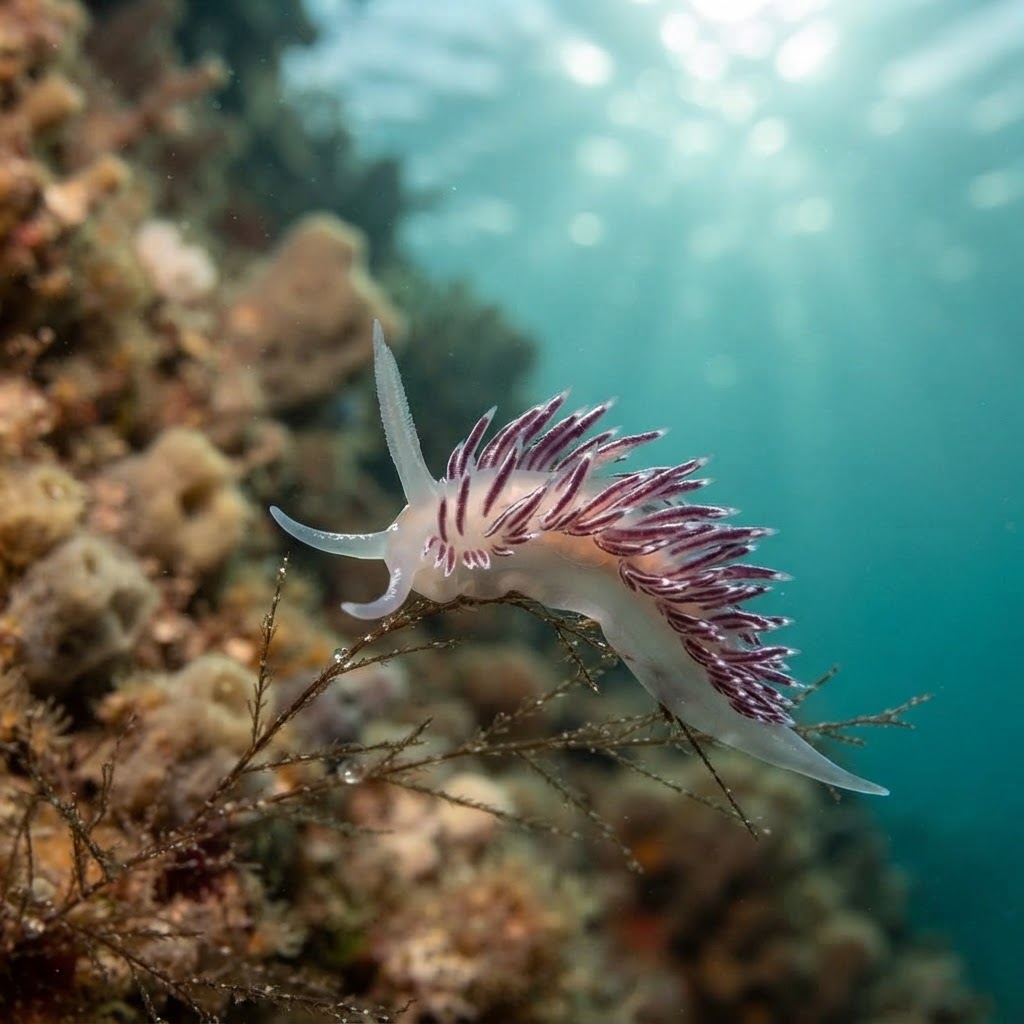
Coryphella capensis
A small cold-water nudibranch found off the Western Cape, most often logged as an uncommon find in 13.6 to 19.6 C water.
A small, slender sea slug with a translucent to pale body covered in finger-like projections (cerata) along its back, usually tipped in orange or red. The colour of the digestive gland showing through the cerata gives most of the visible pattern, rather than any bold skin markings. Look for it clinging to rock or algae rather than open sand, since it is easy to miss against cluttered cold-water reef.
Found tucked into rocky reef and among algae growth rather than out on open ground, moving slowly as it grazes on the hydroids it feeds on. It shows no reaction to divers beyond its usual unhurried pace, so a slow, close look with a torch or macro lens is the way to actually spot one against the reef texture.
Like other Coryphella-type nudibranchs, it likely feeds on hydroids and can incorporate stinging cells from its prey into its own cerata as a defence, a trick common across this nudibranch group.
Sightings show no clear seasonal pattern, so treat it as a year-round possibility on Western Cape dives. It's recorded across a fairly narrow cool-water band of 13.6 to 19.6 C, which matches the region's typical diving conditions for most of the year.
Logged almost exclusively in South Africa, with every recorded sighting so far concentrated in the Western Cape. Divers working the cool reefs around Cape Town and the surrounding coastline have the best shot at finding it, though it stays an uncommon to rare find even there.
Mapping where White-edged Nudibranch is logged…
Every logged sighting comes from South Africa, specifically the Western Cape. It's the region to target if you want a realistic chance of finding one.
There's no detected seasonal pattern, so it can turn up year-round on Western Cape dives within its usual 13.6 to 19.6 C water temperature range.
Look for a small, pale to translucent nudibranch with slender cerata tipped in orange or red running along its back. It clings to rocky reef and algae rather than open sand, so a slow, close search is key.
Exact size data isn't confirmed for this species, but like most Coryphella-type nudibranchs it stays small, typically only a few centimetres, so it's easy to swim past unnoticed.
No, it poses no danger to divers. It's a small, slow-moving sea slug best appreciated with a close look rather than any handling.
Site and sighting data is aggregated from diver logs, iNaturalist and GBIF. For taxonomy and conservation status:
Light-spotted Aegires
3,168 sites





