Limacia cockerelli
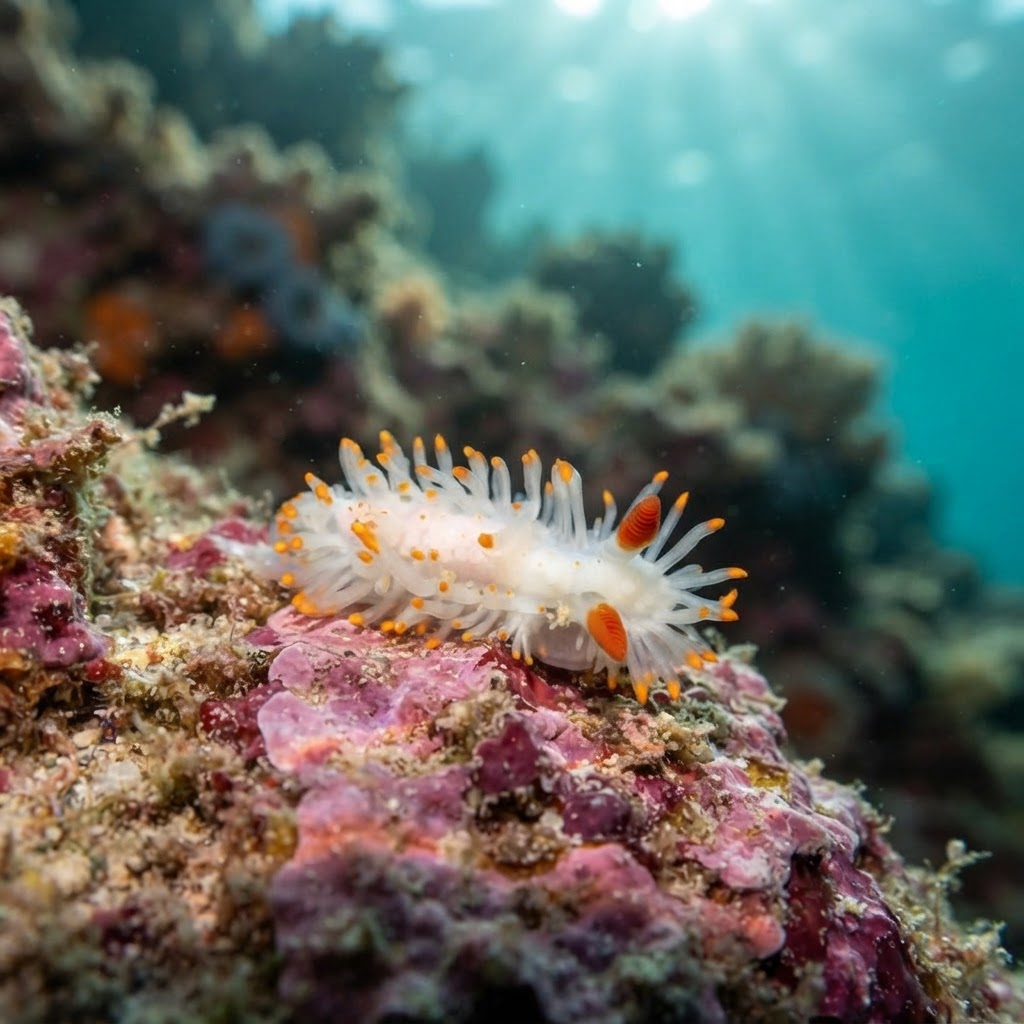
Tiny white nudibranch with orange-tipped gills, most reliably found on cold-water dives in British Columbia and California.
A tiny slug, rarely more than a centimetre long, with a translucent white to pale blue body covered in scattered bumps (tubercles) tipped bright orange or yellow. The gills and rhinophores (the paired sensory horns on the head) carry the same orange tips, which is the detail most divers key on against the plain white background of the body. At this size you are usually looking for a speck of colour on rock or algae rather than a recognisable slug shape from a distance.
Found crawling slowly over rock, algae, and hydroid growth where it grazes, usually spotted by divers doing a slow scan of the substrate rather than swimming mid-water. It shows no reaction to divers beyond continuing to feed, and its small size means most sightings come from divers already looking closely for macro life rather than casual passers-by. Logged most often as uncommon or rare at any given site, so it rewards a patient, close look at rocky or algae-covered surfaces rather than open water.
Like other nudibranchs, it feeds on hydroids and takes on some of their stinging cells for its own defence, which is likely why its orange-tipped tubercles stand out so sharply against the white body as a warning signal to predators.
Sightings don't show a clear seasonal pattern, so treat it as a year-round find on the cold-water reefs it favours. It's recorded in water from around 8.5 to 14.5C, which fits the temperate coastlines of the Pacific Northwest and California in any month rather than a narrow warm-season window.
Most consistently logged in British Columbia, Canada, which accounts for by far the largest share of sightings, followed by California in the United States and Baja California in Mexico. Divers in the Pacific Northwest of the US also turn it up regularly, making the whole cold-water coast from BC down through California and into Baja the reliable stretch to search.
Mapping where Cockerell's Nudibranch is logged…
British Columbia in Canada has the strongest record of sightings, with California and Baja California in Mexico also reliable. The Pacific Northwest of the United States turns it up regularly too.
There's no clear season in the sighting data, so it's considered a year-round find. It lives in cold water between roughly 8.5 and 14.5C, conditions that persist through the year along its core range.
Look for a translucent white slug about a centimetre long with scattered tubercles tipped bright orange or yellow, including on the gills and rhinophores. It's usually spotted crawling slowly on rock or algae rather than swimming.
They stay tiny, typically around 1cm in length, so most sightings come from divers doing a close, slow search of the substrate rather than a casual scan.
No. They pose no threat to divers and are entirely harmless to handle or observe, though as with all marine life it's best to look without touching.
Site and sighting data is aggregated from diver logs, iNaturalist and GBIF. For taxonomy and conservation status:
Light-spotted Aegires
3,168 sites