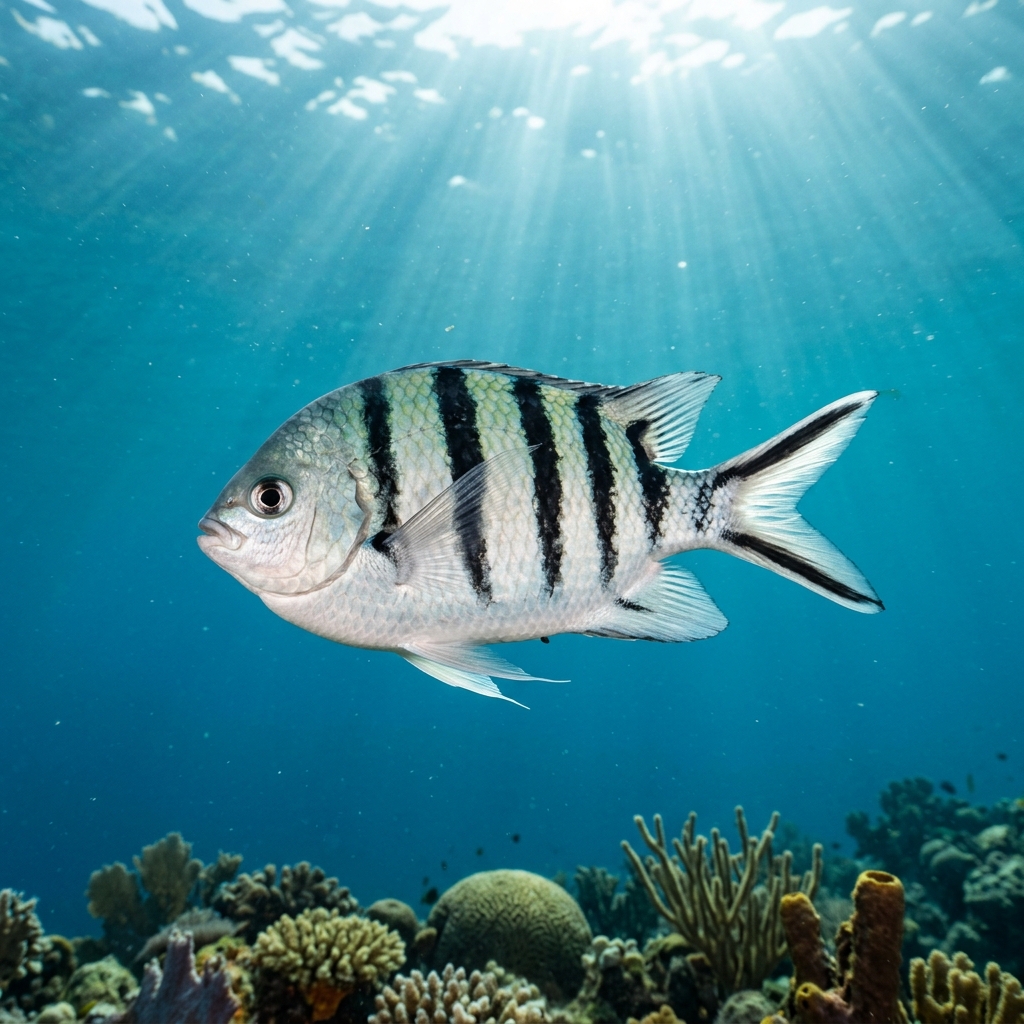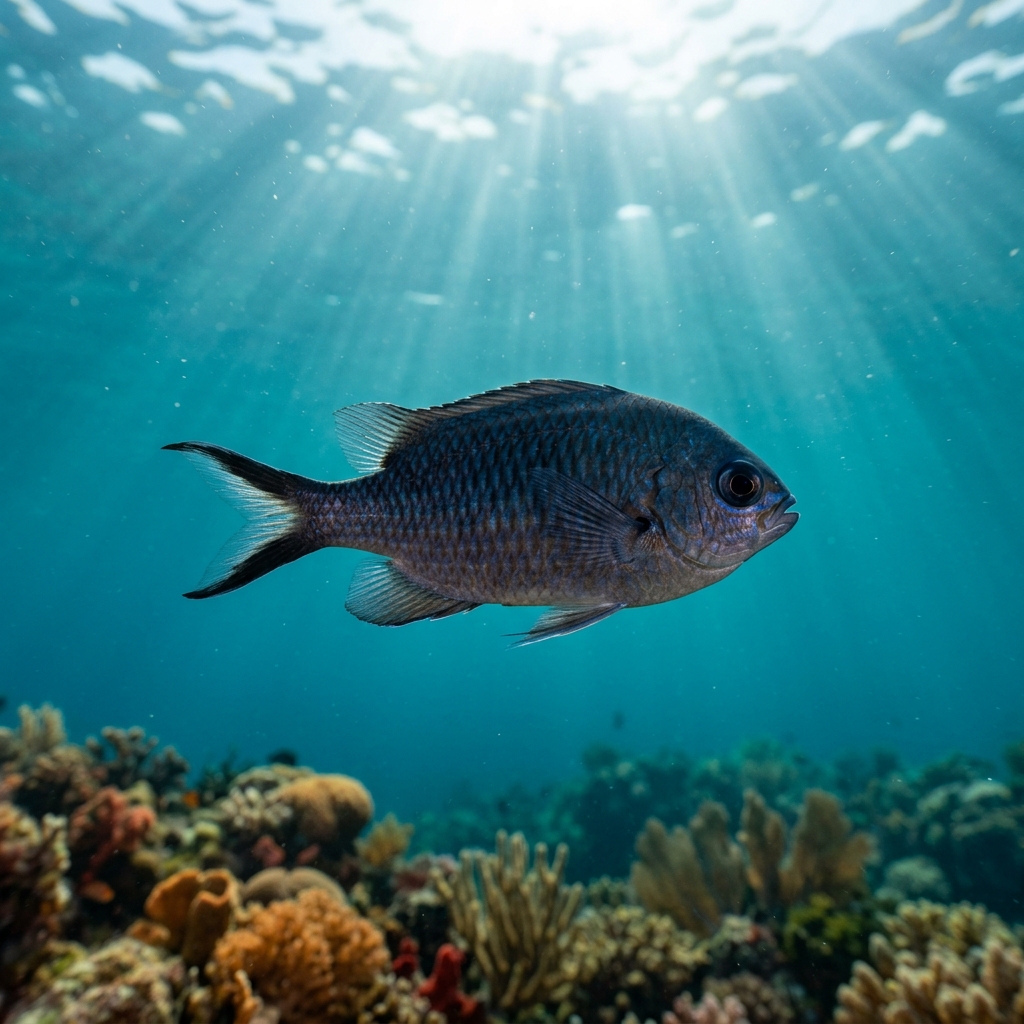
Chromis chromis
Spot castagnole across the French Riviera, Costa Brava and Croatian coast from April to November. Here's how to find and recognise this Mediterranean damselfish.
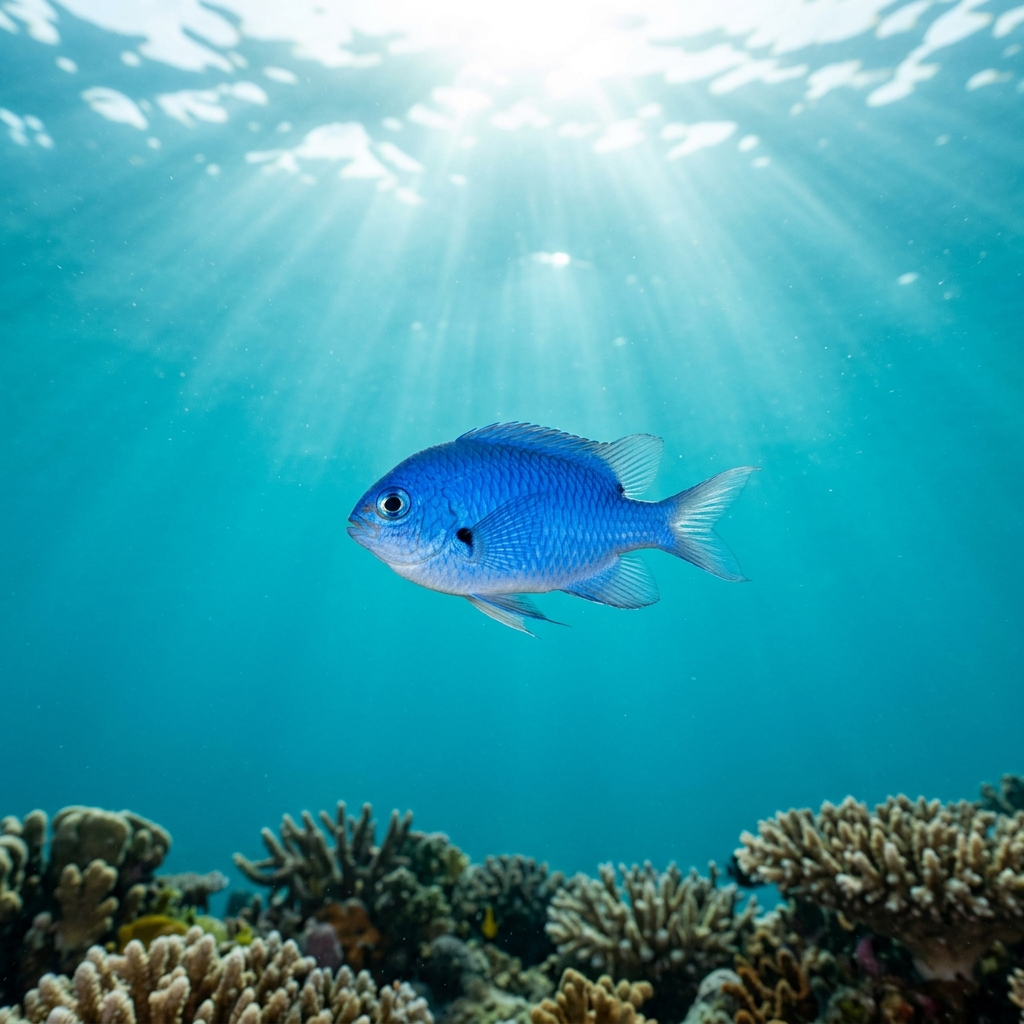
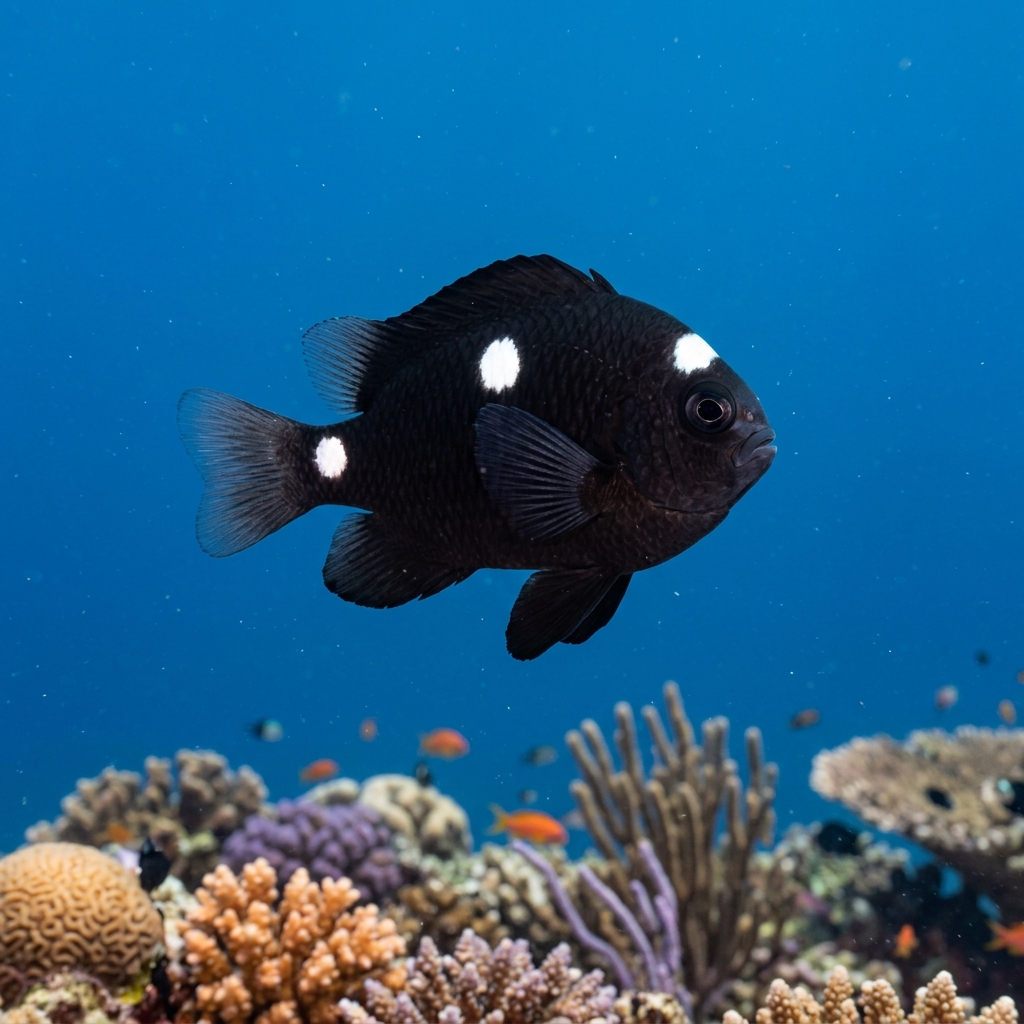
A compact, deep-bodied fish roughly the size of your fist, with uniformly dark brown to near-black colouring that can appear almost charcoal grey in deeper water. Look for a slightly forked tail and a small, neat mouth typical of damselfish. Juveniles are a striking electric blue with vivid orange-red on the upper body, making them almost unrecognisable as the same species. Adults sometimes show a faint whitish spot at the base of the pectoral fin, which can catch your eye at close range.
Castagnole typically form loose aggregations (shoals) around rocky reefs and Posidonia seagrass meadow edges, often hovering in mid-water above the substrate and feeding on zooplankton drifting in the current. They are not shy but tend to scatter back toward crevices if approached quickly; a slow, unhurried approach lets you get within arm's reach. You are most likely to encounter them in open water just above the reef rather than tucked into the rock itself.
The juveniles' brilliant blue-and-orange colouration is one of the most dramatic colour changes in any Mediterranean fish: they look like a tropical reef species before gradually darkening to the sombre adult brown over their first year or two.
Sightings concentrate between April and November in the Northern Hemisphere, tracking the warmer Mediterranean months. The species tolerates a wide temperature range (observed from about 16 to 28 °C), so early-season dives in April are productive, but peak activity aligns with the summer and early autumn warming.
Castagnole are overwhelmingly a Mediterranean species, with the strongest sighting records in Spain, Italy, France, Croatia, and Greece. The French Riviera and Provence coast, the Costa Brava, and Sardinia are among the most reliable areas, followed closely by the Croatian coast from the Kvarner Gulf down through Central Dalmatia. Turkey, Malta, and Cyprus also contribute solid records if you are diving the eastern Mediterranean.
Mapping where Castagnole is logged…
They are almost exclusively a Mediterranean species. The most reliable spots are along the French Riviera, the Costa Brava in Spain, the Sardinian coast, and the Croatian Dalmatian islands. Greece, Turkey, Malta, and Cyprus also have strong populations.
April through November is when sightings peak across the Mediterranean. Summer and early autumn offer the warmest water and the most active aggregations, though the species is tough enough to be present on cooler spring dives too.
Adults are uniform dark brown to near-black, deep-bodied, and roughly 15 to 17 cm long, about the size of a clenched fist. They hover in loose groups above rocky reef. Juveniles are completely different: vivid electric blue with orange-red on the upper body, a striking sight that surprises many first-time divers.
Typically around 17 cm in length, making them a medium-small reef fish. In the water they look compact and oval-bodied, noticeably chunkier than slender species of the same length.
Juveniles display electric blue colouration with vivid orange-red on the upper body, so different from the dark adult that divers often mistake them for an unrelated tropical species. This dramatic colouration fades gradually during the first year or two of life as the fish transitions to adult brown.
Site and sighting data is aggregated from diver logs, iNaturalist and GBIF. For taxonomy and conservation status:
Dascyllus
3,697 sites