Similiparma lurida
Spot the bright yellow Canary Damsel across Tenerife, Gran Canaria and the Azores in water from 18 to 24 °C. Here's where and when to find it.
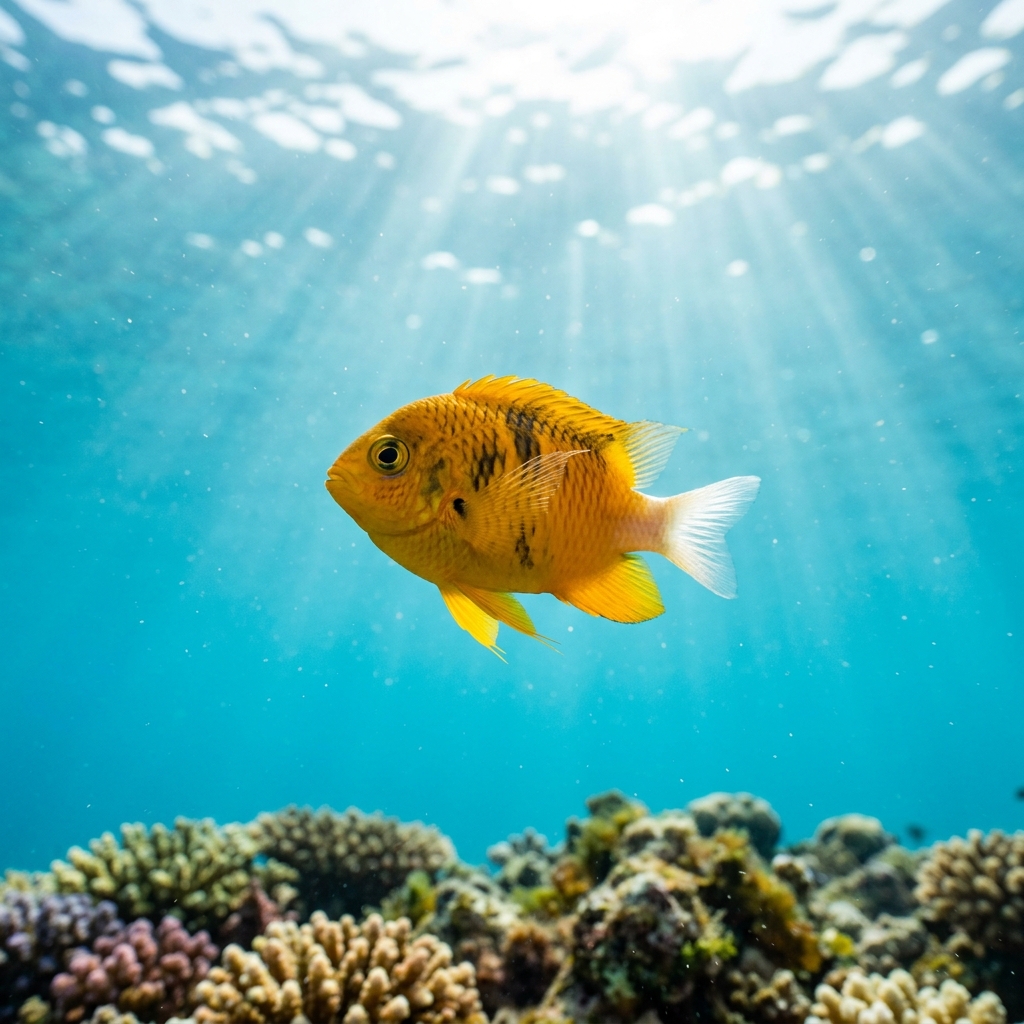
A small, deep-bodied fish around 10 cm long, the canary damsel is almost entirely vivid yellow, making it one of the most eye-catching fish on its home reefs. Look for the compact oval profile and the uniform sunny colouration without bold stripes or spots, that consistency is the clearest field mark. It typically hovers close to the reef surface, rarely straying far into open water.
Canary damsels are reef-hugging carnivores typically seen patrolling a small patch of rocky or volcanic reef, rarely venturing far from cover. Like most damselfishes, they can be territorial and will hold their ground when you approach rather than bolting, which makes close observation relatively straightforward. They tend to be most active during daylight hours, picking at small invertebrates along the reef surface.
Its vivid yellow colouration appears to have evolved in the cool, clear waters of the eastern Atlantic rather than the coral-rich tropics, making it an unusual example of a brightly coloured damselfish thriving in a temperate rather than tropical reef system.
Sightings are concentrated from July through to May, suggesting the species is present for most of the year with only a brief mid-year lull. The water temperatures where it is most commonly observed range from roughly 19 to 24 °C, which aligns well with the Canary Islands' temperate Atlantic conditions year-round.
This is fundamentally a Macaronesian species, the vast majority of logged sightings come from the Canary Islands, with Tenerife, Gran Canaria, Lanzarote, and Fuerteventura the standout islands. The Azores and Madeira also hold reliable populations, and smaller numbers are recorded from Cape Verde, mainland Spain, France, and Portugal.
Mapping where Canary Damsel is logged…
The Canary Islands are by far the best place to look, with Tenerife, Gran Canaria, Lanzarote, and Fuerteventura all logging strong populations. The Azores and Madeira are solid alternatives, and there are scattered sightings from Cape Verde, mainland Spain, France, and Portugal.
Logged sightings concentrate from July through to May, so most of the diving year is productive. Summer through spring in the Canary Islands and Azores covers the bulk of recorded observations.
Look for a small, roughly 10 cm, deep-bodied fish that is uniformly bright yellow with no bold markings or stripes. It stays close to rocky or volcanic reef surfaces in the eastern Atlantic and Macaronesian islands. That consistent all-yellow colouration on a temperate reef is a strong identifier.
Adults typically reach around 10 cm in length. At that size they are small but very visible against the darker volcanic rock of Atlantic reefs thanks to their yellow colouration.
No. They are harmless to divers. Like many damselfishes they may act territorial and hold their position rather than fleeing, but they pose no threat.
At most sites where it is recorded, divers describe it as uncommon, you may not see one on every dive even in the Canary Islands. A smaller number of sites, particularly in Tenerife and Gran Canaria, report it as common or very common, so targeted dives in those areas improve your odds.
Site and sighting data is aggregated from diver logs, iNaturalist and GBIF. For taxonomy and conservation status:
Dascyllus
3,697 sites