Caloria indica
Spot Caloria indica in the warm 26-29 °C waters of the Philippines and Indonesia. Best bet: Visayas reefs Dec, Apr. ID tips and top sites inside.
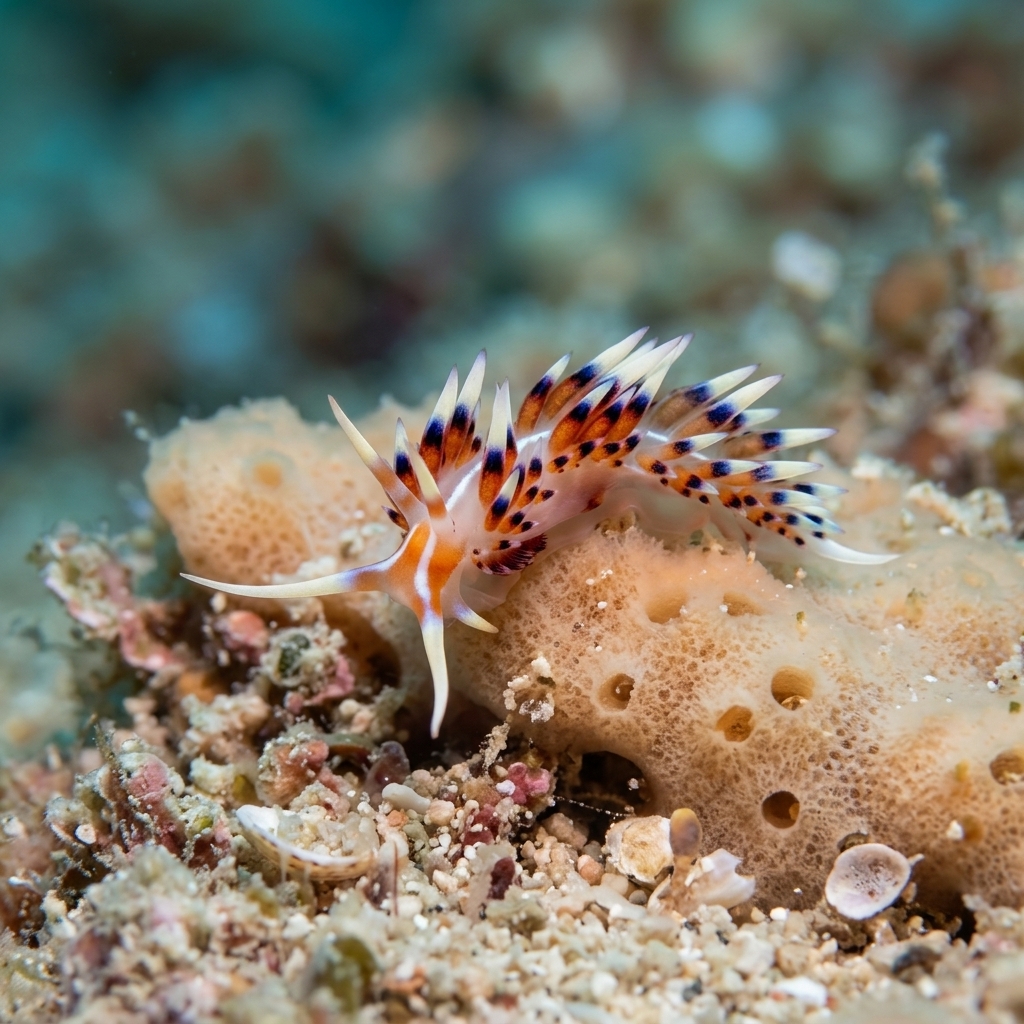
Look for a slender aeolid nudibranch body lined with rows of cerata (the finger-like projections along the back) that carry vivid orange or reddish tips, often contrasting sharply against a translucent to pale white base. The oral tentacles and rhinophores (sensory head appendages) tend to pick up the same warm orange colouring, giving the animal a cohesive warm-toned look from head to tail. It is a small nudibranch, so getting close and slowing right down is essential before the detail resolves.
Like most aeolid nudibranchs, it is a slow, deliberate crawler, typically found working its way across rubble, coral rubble slopes, or encrusted hard substrate in search of prey such as hydroids or anemones. It rarely reacts to divers and will continue feeding or moving at the same measured pace even when approached closely, which makes for patient but rewarding macro photography. Look low on the reef structure and keep your torch at an angle to catch the reflective cerata tips.
Aeolids in general are able to sequester nematocysts (stinging cells) from their cnidarian prey and store them in the tips of their cerata as a chemical defence, those bright orange tips are likely a warning to would-be predators.
In the Northern Hemisphere, covering the bulk of Philippines and Indonesian dive destinations, sightings concentrate from December through April. Southern Hemisphere sites show a peak from July through October.
The Sunrise Tentacle Aeolid is most consistently logged across the Philippines, with the Central Visayas, Western Visayas, and Luzon being the standout regions by far. Bali and the broader Indonesian archipelago represent the next strongest showing, followed by the Rock Islands of Palau and the Perhentian and Redang Islands of Malaysia. Sightings also turn up in Australian waters, Oman, and the United Arab Emirates, pointing to a broad Indo-Pacific distribution.
Mapping where Sunrise Tentacle Aeolid is logged…
The Philippines leads by a wide margin, with Central Visayas, Western Visayas, and Luzon producing the most sightings. Bali and other parts of Indonesia are the next best bet, followed by Palau's Rock Islands and Malaysia's Perhentian and Redang Islands. Smaller numbers of records exist from Australia, Oman, and the UAE.
In the Philippines, Indonesia, and other Northern Hemisphere destinations, December through April is the peak window. Divers visiting Southern Hemisphere sites should aim for July through October. It favours warm water in the 26-29 °C range, so outside these windows sightings drop off noticeably.
Focus on the rows of cerata running along the back, they end in bright orange or reddish tips on a translucent body, and the oral tentacles and rhinophores carry the same warm colour. It is a small, slow-moving aeolid nudibranch, so approach slowly and let your eyes adjust to the scale before scanning the reef surface.
No. It poses no risk to divers whatsoever. As with all nudibranchs, simply observe and photograph without touching, handling can damage the animal and disturb its mucus coating.
Those vivid orange tips are thought to serve as a warning signal. Aeolid nudibranchs can store stinging cells (nematocysts) harvested from cnidarian prey inside their cerata, and the bright colouration advertises that defence to potential predators. It is one of the more elegant recycling tricks in the nudibranch world.
Site and sighting data is aggregated from diver logs, iNaturalist and GBIF. For taxonomy and conservation status:
Light-spotted Aegires
3,168 sites