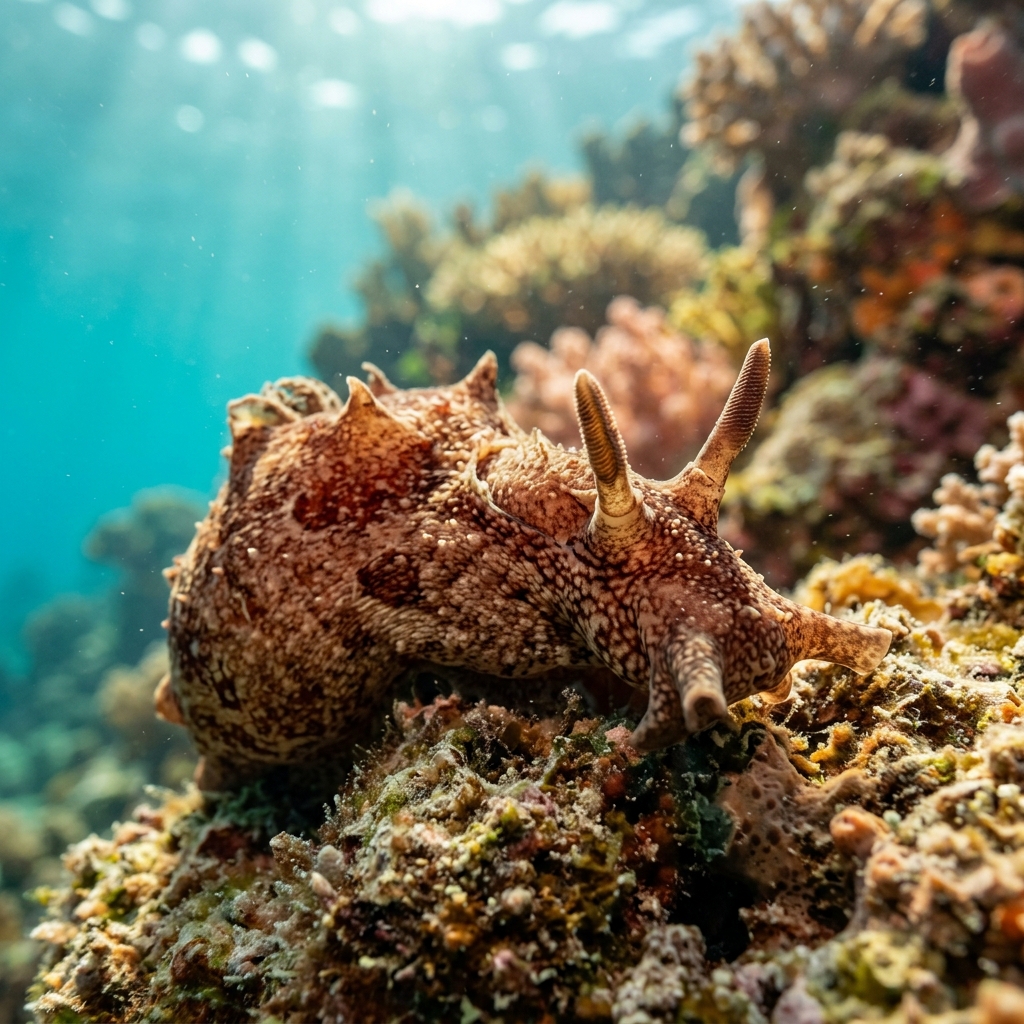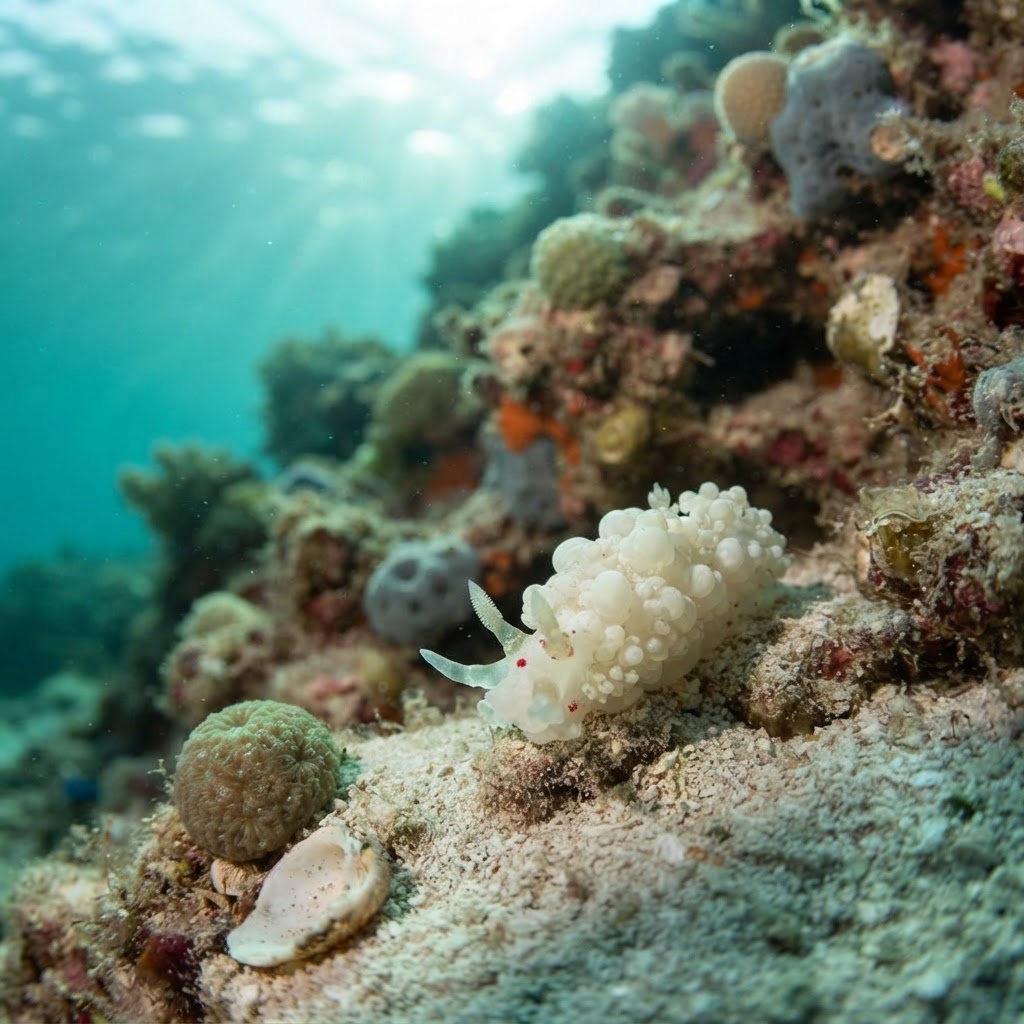
Bulbaeolidia oasis
An uncommon little nudibranch found year-round on Guadeloupe's reefs, especially around Basse-Terre and Îles des Saintes in warm 25 to 31C water.
A small aeolid nudibranch (a group of sea slugs bearing finger-like projections called cerata along the back), recognised by the dense clusters of slender, tapering cerata covering its body rather than a smooth or gilled back. Body colour tends toward pale or translucent tones with the cerata often carrying a subtle contrasting tip, giving it a slightly bristly, textured silhouette against bare rock or rubble. It stays small and easy to miss unless you are scanning slowly with a torch or magnifier, since there is no bold pattern to catch the eye from a distance.
Found moving slowly across rock, rubble and encrusted surfaces where divers have logged it, typically at a measured, unhurried pace as it forages. It shows no reaction to divers beyond retracting slightly if touched, and like most aeolids it is easiest to spot with a slow, close-focus search rather than a swim-by.
Its cerata likely double as both gill surface and a store for stinging cells borrowed from the prey it feeds on, a common aeolid trick for turning a meal into a defence.
Sightings show no detected season, and with water logged between roughly 25 and 31C, conditions stay comfortable for it year-round. Plan around Guadeloupe's diving calendar generally rather than chasing a specific month.
Every logged sighting so far comes from Guadeloupe, making it the only confirmed place to look for this species. Within the island, Basse-Terre carries the strongest record, with Îles des Saintes also producing a steady number of sightings.
Mapping where Oasis Bulbaeolidia is logged…
So far it has only been logged in Guadeloupe, with the strongest records around Basse-Terre and a good number also seen at Îles des Saintes.
There is no clear season in the sighting data, and water temperatures stay in a comfortable 25 to 31C range year-round, so it can turn up on any dive trip to Guadeloupe.
Look for a small nudibranch covered in dense, slender cerata rather than smooth skin or feathery gills, usually pale-toned and easy to overlook against rubble unless you search closely.
Exact size figures are not documented, but like most Bulbaeolidia species it stays on the small side, easily overlooked without a slow, close-up search of the substrate.
It is logged as uncommon at every site where divers have found it, so it is not something you will see on most dives, but patient reef-scanning in Guadeloupe has a real chance of turning one up.
Site and sighting data is aggregated from diver logs, iNaturalist and GBIF. For taxonomy and conservation status:
Light-spotted Aegires
3,168 sites