Doto columbiana
A 1cm nudibranch logged in the cold waters of the Pacific Northwest and California, at 9.6 to 15.6C, year-round.
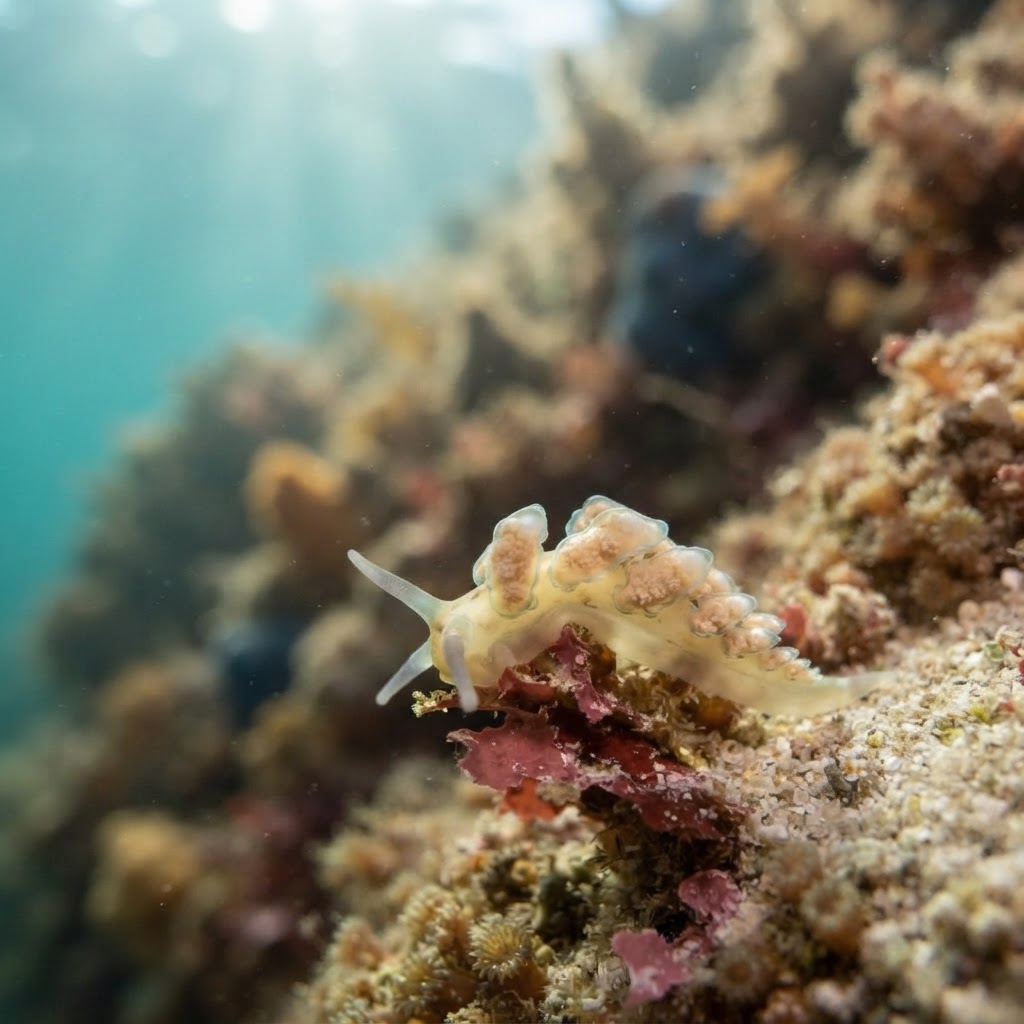
At around 1cm long, this is a nudibranch you find by looking closely at hydroid stems rather than by scanning open reef. The body is slender and translucent to pale, with clusters of bumpy projections (cerata) along the back that give it a knobbly, almost fuzzy outline under a torch or macro lens. There is no bold colour pattern to key on here, so the giveaway is the shape: rounded cerata in tight groups, sitting directly on the fine branches of the hydroids it feeds on.
Look for it clinging to hydroid colonies, where it grazes slowly and stays put for long stretches, making it a good subject once you spot one. It shows no real reaction to divers or lights beyond the usual slow nudibranch retreat, and it is easiest to find during a deliberate macro search rather than on a drift past the reef.
Like other Doto species, it feeds almost exclusively on hydroids, and the bumpy cerata on its back are thought to help it blend into the stinging branches it lives on.
There is not enough seasonal data to point to a particular window, so treat it as a year-round find for divers working the cold Pacific Northwest and California coast. Its recorded temperature range of 9.6 to 15.6C matches the cool water these regions hold most of the year.
Sightings so far come entirely from the United States, concentrated in the Pacific Northwest with an additional record from California. It is logged as uncommon at most of these sites and rare at one, so this is a species you search for deliberately on a hydroid-covered wall or piling rather than one you expect to stumble into.
Mapping where British Columbia Doto is logged…
Records so far are from the United States, mainly the Pacific Northwest with an additional site in California. It is an uncommon find even there, so it takes a dedicated macro search of hydroid-covered structure.
There is no clear seasonal pattern in the data, so it appears to be a year-round species in the cold waters where it has been logged, consistent with its recorded 9.6 to 15.6C range.
It is a tiny, pale, translucent nudibranch around 1cm long with clusters of bumpy cerata along its back. Look for it sitting directly on hydroid branches rather than out on open substrate.
It is a very small nudibranch, typically around 1cm in length, so a magnifying lens or macro lens helps a lot when searching for it.
Like other members of its genus, it feeds on hydroids, grazing slowly along the branches of the colony it lives on. This diet is also why it is almost always found directly on hydroid growth rather than free-swimming.
Site and sighting data is aggregated from diver logs, iNaturalist and GBIF. For taxonomy and conservation status:
Blue Dragon
3,163 sites