Facelina bostoniensis
Tiny cold-water nudibranch common in Zeeland's diving sites, Norway, and the UK, spotted year-round in waters as cold as 7 to 13 C.
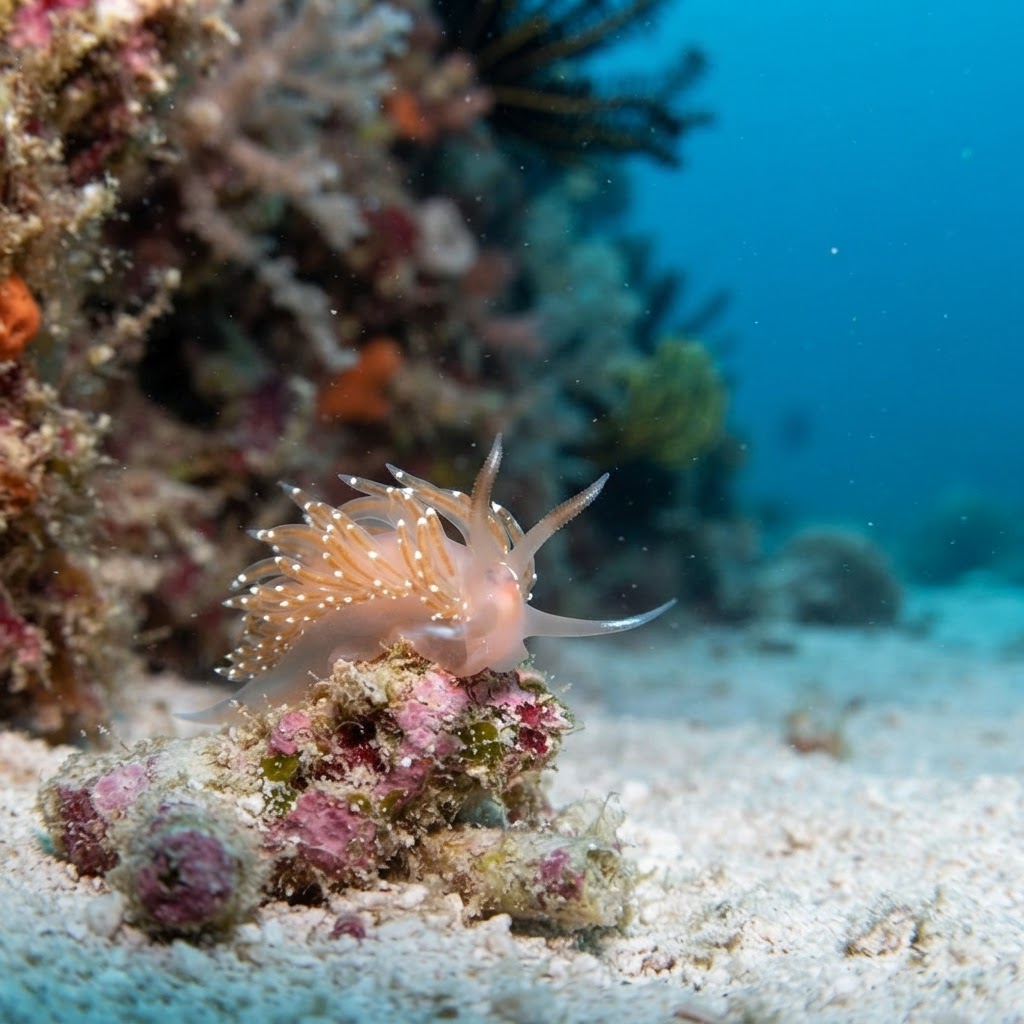
Look for a slender, translucent-bodied nudibranch barely 2 cm long, covered in rows of finger-like projections (cerata) along its back that glow orange to reddish-brown with white tips. The head carries two pairs of tentacle-like appendages (rhinophores and oral tentacles) that give it a bristly, almost feathery silhouette against bare rock or algae. Its small size and slim build mean you are usually looking closely at a wall or boulder rather than spotting it from a distance.
Divers find it grazing slowly over rock, algae, and hydroid growth, feeding on the small stinging animals it lives among. It shows no reaction to divers beyond simply continuing to crawl, since at this size and speed avoidance is not really an option, so a steady light and a macro lens are all you need for a good look. Most sightings come from close scanning of walls and boulder fields rather than mid-water encounters.
Like other aeolid nudibranchs, it can steal stinging cells from the hydroids it eats and store them in the tips of its own cerata, turning its prey's defences into its own.
Sightings show no clear seasonal spike, so it is logged across the year wherever cold water sits in its 7.4 to 13.4 C comfort range. In practice that means it is a realistic find on any dive trip to its core regions rather than something tied to a particular month.
This is very much a cold-water Atlantic species, with the strongest sightings by far in Zeeland in the Netherlands, followed by reliable logs across Northern Ireland and other parts of the UK. It also turns up consistently in Norway's Østlandet region, Denmark's Jutland, Sweden's Bohuslän, and along Nova Scotia in Canada, making it a species you can reasonably expect on temperate rock and wreck dives across northern Europe and the northwest Atlantic.
Mapping where Boston Facelina is logged…
Zeeland in the Netherlands has by far the most logged sightings, with strong numbers also in Northern Ireland, Norway's Østlandet region, Danish Jutland, Sweden's Bohuslän, and Nova Scotia in Canada.
There is no strong seasonal pattern in the sightings, so it is found year-round in its cold-water range wherever temperatures sit roughly between 7 and 13 C.
Look for a tiny, translucent nudibranch around 2 cm long with rows of orange to reddish cerata tipped in white running down its back, and two pairs of head tentacles giving it a bristly look.
They stay small, typically around 2 cm long, so most divers spot them during a slow, close look at rock or algae rather than from a distance.
It feeds on stinging hydroids and can transfer their unfired stinging cells into the tips of its own cerata, using borrowed weapons for its own defence.
No, they pose no threat to divers. They are harmless to handle-viewing distance for a camera and are far too small to interact with beyond a close look.
Site and sighting data is aggregated from diver logs, iNaturalist and GBIF. For taxonomy and conservation status:
Light-spotted Aegires
3,168 sites