
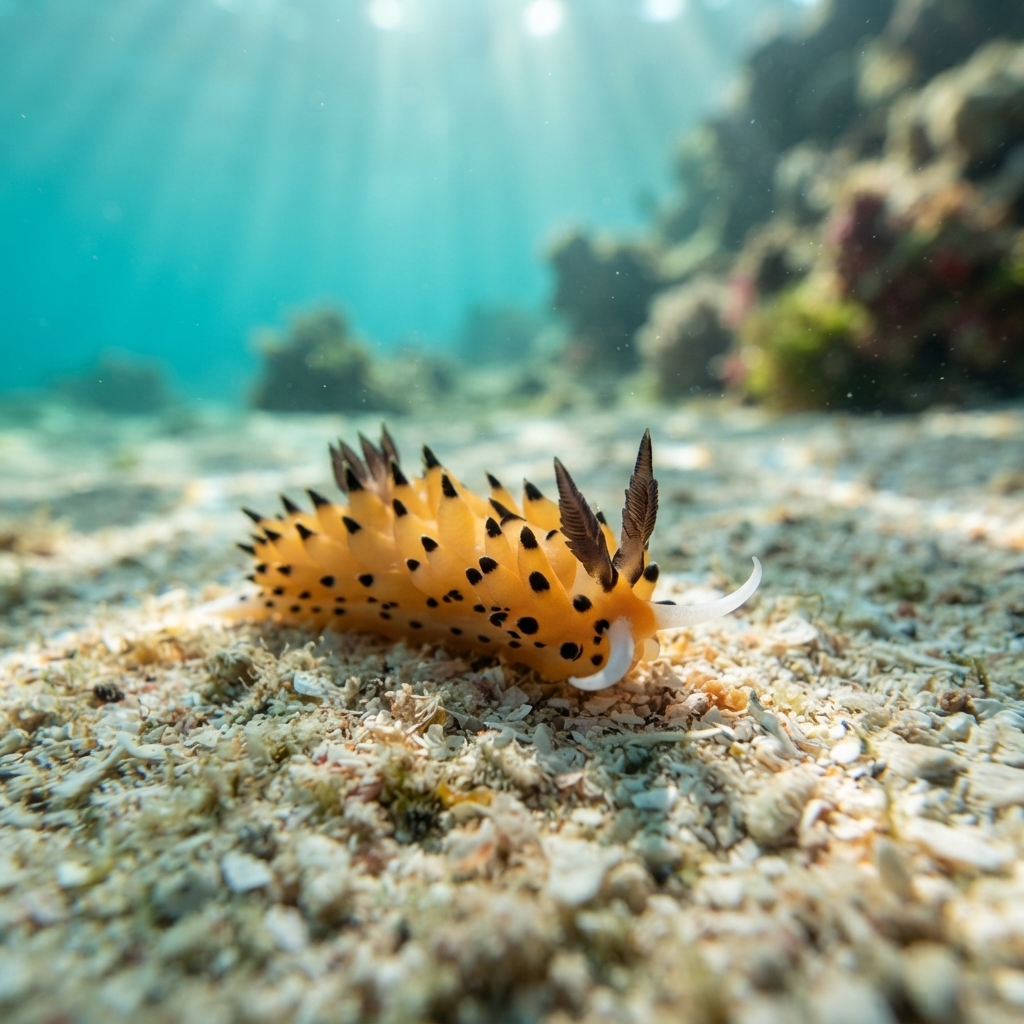
Favorinus tsuruganus
A small egg-hunting nudibranch turning up reliably on Luzon reefs, with fair numbers in Bali too, in warm 25.5 to 31.5C water year-round.
Small, slender-bodied nudibranch with a translucent to pale cream body and dark, near-black tips on its rhinophores (the paired sensory horns on the head), which is where the common name comes from. Look closely at the horns first since the body itself is easy to mistake for reef debris at a glance. Size stays modest, and it is usually found sitting still or slow-crawling rather than out in the open swimming.
Divers typically find this one parked on the reef substrate, moving slowly and paying no attention to a torch or a close look, which fits a benthic (bottom-dwelling) animal with nowhere urgent to be. It shows up most often on muck and rubble style dive sites rather than open coral walls, the kind of terrain favoured by divers doing slow, macro-focused searches. Expect an uncommon rather than everyday sighting even at its best sites.
True to its common name, this genus specialises in eating the egg masses of other sea slugs rather than sponges or hydroids like most nudibranchs, making it one of the few dedicated egg-predators in the group.
No clear seasonal pattern shows in the sighting data, and with a comfortable range of 25.5 to 31.5C it has no thermal reason to disappear at any time of year, so treat it as a year-round find on Luzon and Bali reefs.
Most reliably logged across Luzon in the Philippines, which carries the bulk of sightings, with a smaller but steady population in Bali, Indonesia. A single confirmed sighting comes from Longdong in Taiwan, and Mindanao in the Philippines also turns up regular reports, so the species leans heavily Philippine-Indonesian in its known range.
Mapping where Black-horned Egg-eater is logged…
Luzon in the Philippines has the strongest record of sightings, with Mindanao also producing regular reports. Bali in Indonesia holds a smaller but steady population, and a single sighting has been logged at Longdong in Taiwan.
There is no detected season in the sighting data, and its observed water-temperature range of 25.5 to 31.5C is present on tropical reefs all year, so it can turn up in any month.
Check the rhinophores first: dark, near-black tips on an otherwise pale, translucent body are the giveaway. It stays small and moves slowly over rubble and muck substrate rather than open coral.
Exact size figures are not well documented for this species, but like most Favorinus nudibranchs it stays small, typically only a centimetre or two, and easy to miss without a careful look at the substrate.
Unlike most nudibranchs, which graze sponges or hydroids, this species and its close relatives specifically hunt down and eat the egg masses of other sea slugs, making it a dedicated egg-predator on the reef.
No. It has no means of harming divers and simply sits or crawls slowly across the substrate when approached.
Site and sighting data is aggregated from diver logs, iNaturalist and GBIF. For taxonomy and conservation status:
Light-spotted Aegires
3,168 sites





