Bermudella brunneomaculata
A rare find on Luzon's reefs in the Philippines, this small nudibranch turns up year-round in warm water around 25-31C.
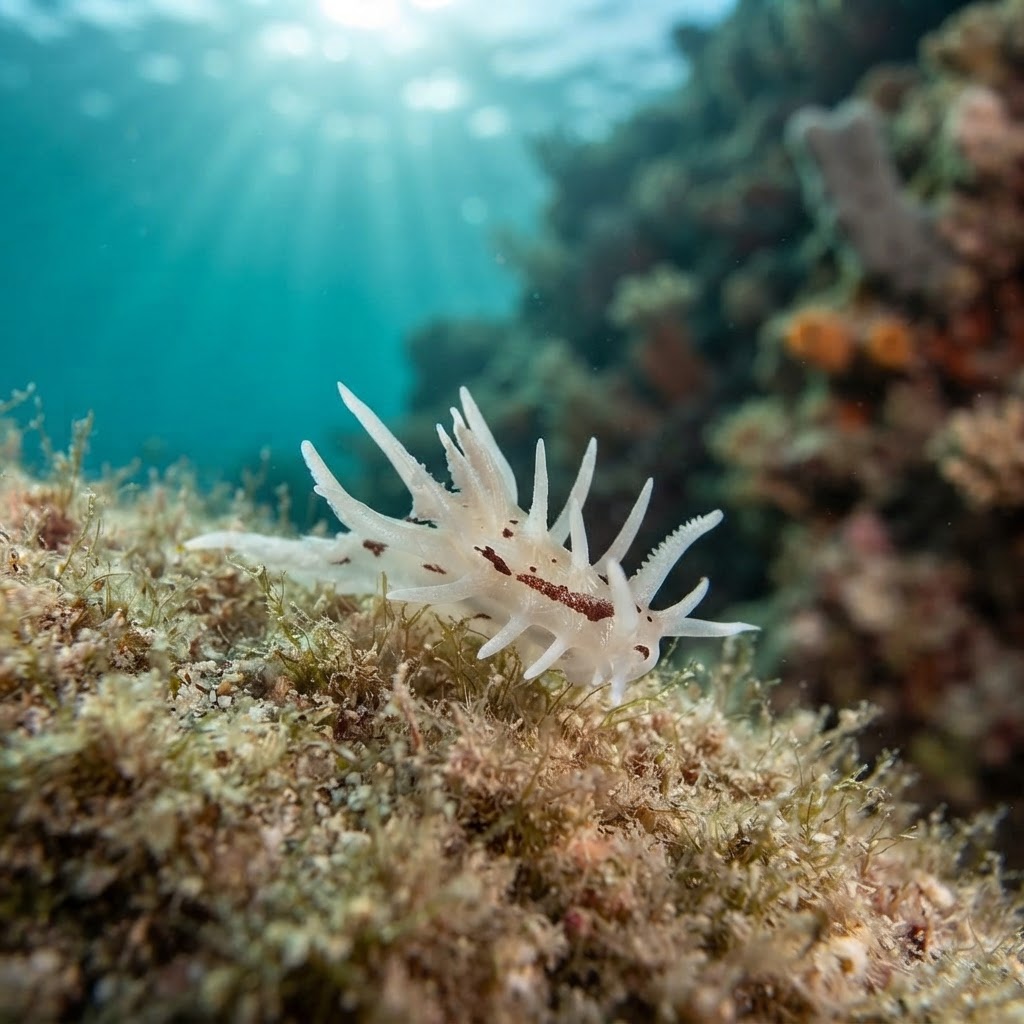
A small, low-profile nudibranch with a pale to translucent body scattered with brownish spots, giving it the mottled look that gives the species its name. It moves slowly across rubble and encrusting growth, staying close to the substrate, with no obvious frilly gills or bright accent colours to catch the eye from a distance. Divers usually spot it only when scanning closely, since its size and muted patterning blend into the reef surface it sits on.
Expect to find it grazing slowly over rubble, sponge, or algae-covered substrate rather than out in the open water column. It shows no reaction to divers beyond continuing its slow crawl, and because it sits low and is small, most sightings come from divers doing deliberate close-focus or macro searches rather than casual reef swims. Given how rarely it is logged even at sites where it does occur, it seems to be a uncommon find rather than one that is simply overlooked.
Like other goniodorid nudibranchs, it likely feeds on encrusting bryozoans or sponges using specialised mouthparts, grazing slowly across a small patch of reef for extended periods rather than roaming widely.
Sightings are spread across the year with no clear seasonal peak, and the observed water temperatures of 25.3 to 31.3C suggest it is present on these warm tropical reefs in every month. Plan around a Luzon or Bali muck-diving trip rather than a specific season.
This one is most reliably logged around Luzon in the Philippines, which accounts for the bulk of recorded sightings, with a smaller but consistent presence in Bali, Indonesia. Outside these two regions it has not turned up in diver logs, so Luzon is the strongest bet if you are hunting for it specifically.
Mapping where Bermudella brunneomaculata is logged…
It is most commonly logged around Luzon in the Philippines, with a smaller number of sightings in Bali, Indonesia. These two regions are currently the only confirmed locations from diver records.
There is no detected seasonal pattern, and it has been recorded in water from 25.3 to 31.3C, so it appears to be present year-round on tropical reefs in the Philippines and Indonesia.
Look for a small, low-lying nudibranch with a pale to translucent body covered in brownish spots, crawling slowly over rubble or encrusting reef surfaces. It lacks bright warning colours, so a close, deliberate search is usually needed to spot it.
Exact size data is not documented, but like most species in the goniodorid nudibranch family, it is a small animal typically measured in millimetres to a couple of centimetres, easy to miss without close inspection.
Yes, it is logged as rare at most of the sites where it has been recorded, with only a handful of sites reporting it as uncommon. Even in its known range around Luzon and Bali, sightings are infrequent.
Site and sighting data is aggregated from diver logs, iNaturalist and GBIF. For taxonomy and conservation status:
Blue Dragon
3,163 sites