Onchidoris bilamellata
Spot the barnacle-eating dorid in Zeeland and along the British Columbia coast from October to May. Here's how to find and identify this small, rare nudibranch.
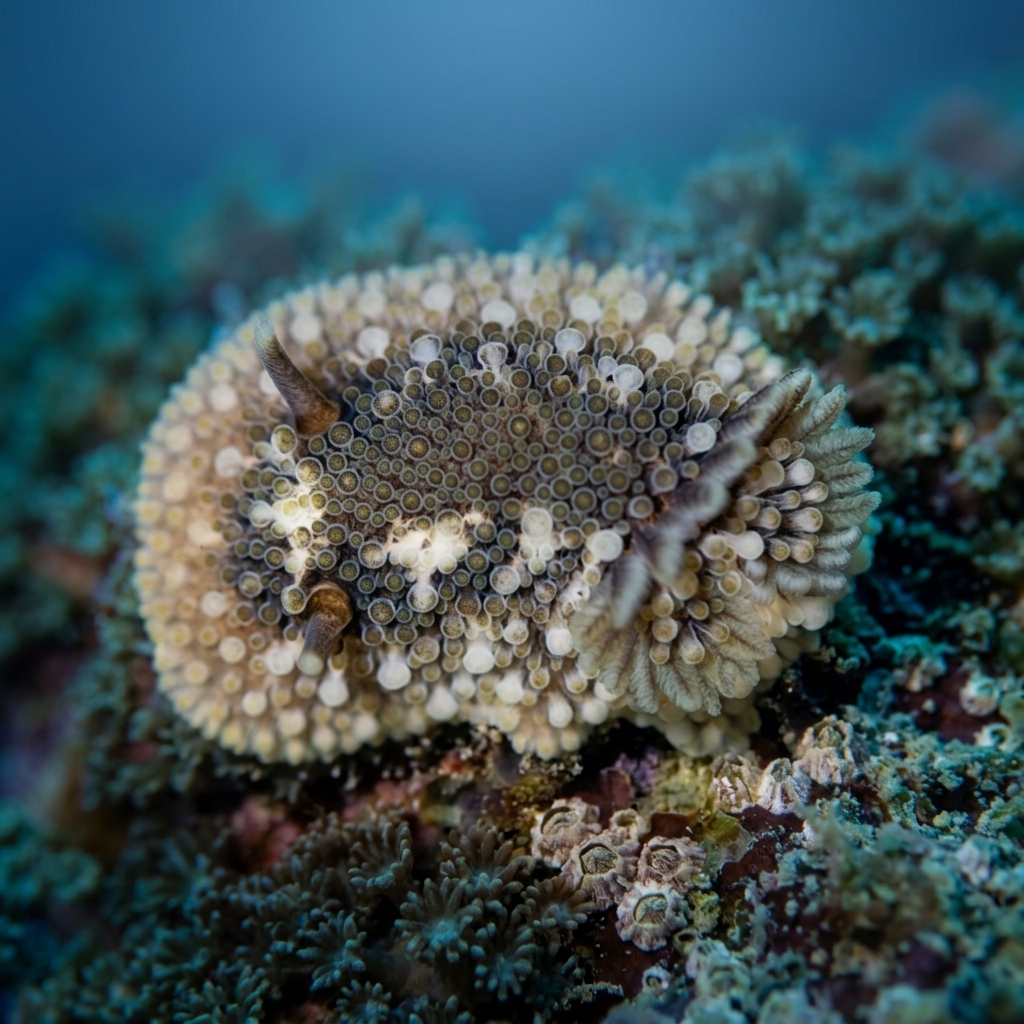
At around 2 cm, this is a small, flattened dorid nudibranch with a pale cream to whitish body covered in soft, brownish tubercles (rounded bumps) that give it a rough, textured look. A ring of feathery gills sits at the rear of the mantle and is usually held open when the animal is actively feeding. Look for it clinging tightly to barnacle-encrusted rocks and harbour walls, where its mottled colouring blends in almost perfectly with the substrate.
When you find one, it will almost certainly be grazing slowly across barnacle-encrusted rock, rasping away at its prey with no interest whatsoever in you or your camera. It moves at a leisurely crawl and does not flinch from torchlight, so close observation is easy as long as you avoid disturbing the substrate around it. Encounters are typically solitary; finding two together is unusual.
Its entire diet is barnacles, and it is specialised enough to track barnacle aggregations by chemoreception (detecting chemical signals in the water), which is why it turns up on pier pilings, harbour walls, and rocky intertidal zones rather than on coral or open reef.
In the Northern Hemisphere, sightings concentrate from October through May, suggesting this nudibranch is most active or most visible during the cooler months of the year.
Most sightings come from temperate northern European and North American waters. Zeeland in the Netherlands accounts for an outsized share of logged encounters, making it the single strongest region, followed by the British Columbia coast in Canada and the Pacific Coast of the United States. The United Kingdom, particularly Northern Ireland, and sites across Norway and Germany also appear regularly in the records.
Mapping where Barnacle-eating Dorid is logged…
They are most commonly logged in temperate northern Europe and the northeastern Pacific. Zeeland in the Netherlands is the standout region, with strong records also from the British Columbia coast in Canada, the US Pacific Coast, Norway, and Northern Ireland. Look for them on barnacle-covered pier pilings, harbour walls, and rocky shallows.
In the Northern Hemisphere, sightings peak between October and May. They appear to be most active or most detectable during autumn, winter, and spring rather than the summer months.
Look for a tiny (around 2 cm), flattened, cream to whitish nudibranch covered in brownish tubercles, pressed flat against barnacle-covered rock. The feathery gill plume at the rear is visible when it is feeding. Its camouflage is good, so scan barnacle patches slowly and methodically.
They typically reach about 2 cm in length, making them quite small even by nudibranch standards. At that size they are easy to overlook unless you are actively searching barnacle-encrusted surfaces.
As the name promises, they feed almost exclusively on barnacles. They are thought to locate barnacle aggregations by detecting chemical cues in the water, which explains why they turn up on artificial structures like harbour walls and pier pilings as readily as on natural rocky reef.
Site and sighting data is aggregated from diver logs, iNaturalist and GBIF. For taxonomy and conservation status:
Nudibranch
3,168 sites