Pterapogon kauderni
Long-finned, black-and-white striped fish found on Sulawesi's shallow reefs, usually hovering near sea urchins and anemones year-round.
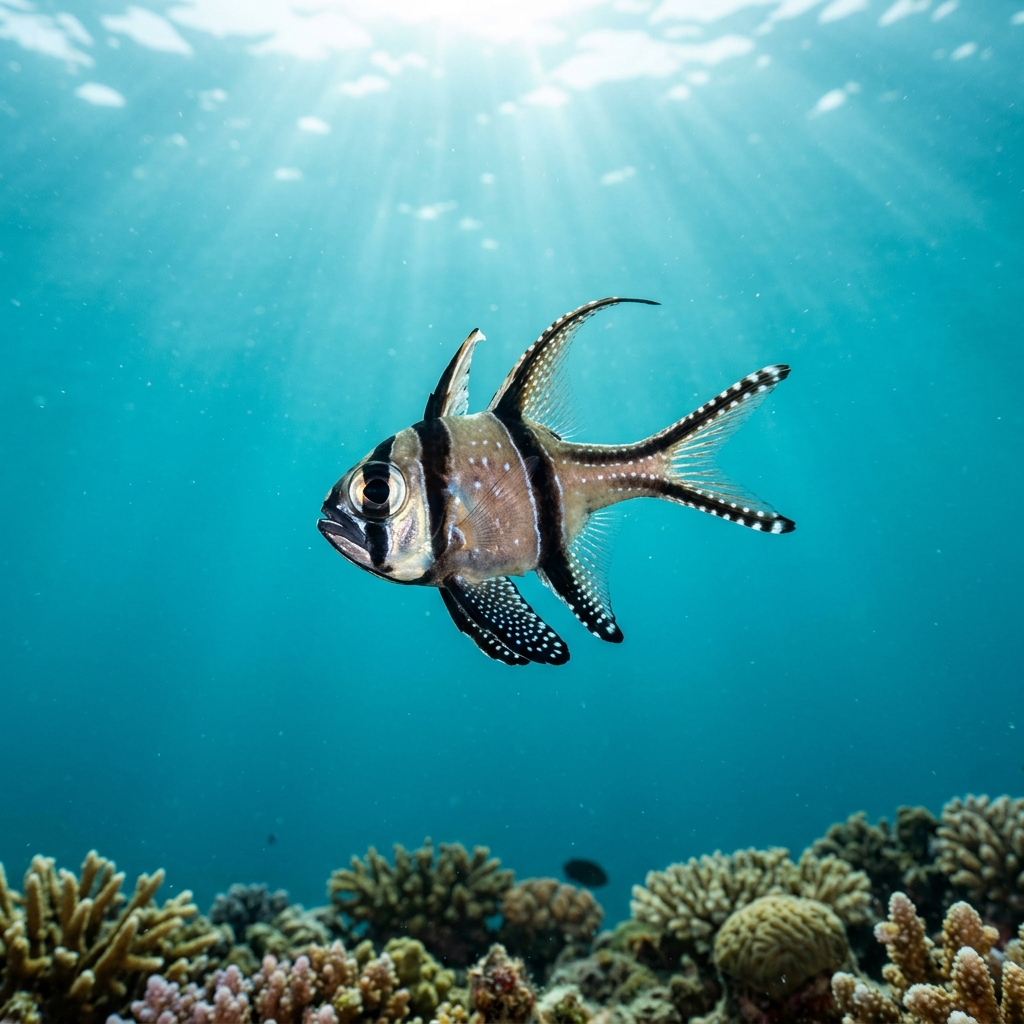
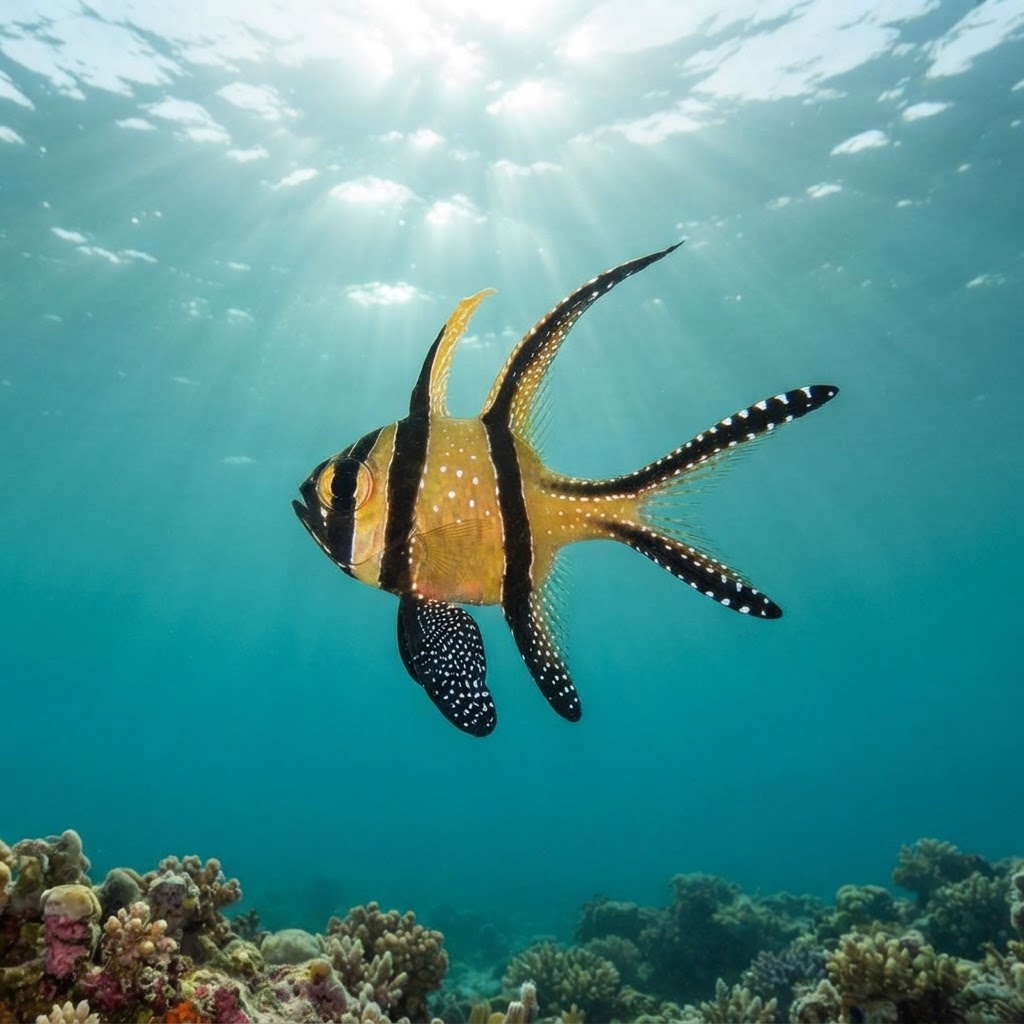
Small, laterally flattened fish with three long black bars crossing a silvery body, trailing exaggerated filamentous fins on the second dorsal, anal and tail lobes. White spots scatter across the fins and rear body, giving it a distinctive dotted look no other cardinalfish in the region shares. It hangs almost motionless in the water column rather than darting, which makes the shape and long fin streamers easy to pick out even at a distance.
Look for small groups hovering close to a perch, often near sea urchins, anemones or soft coral branches that they retreat into when threatened. They tend to hold station rather than flee outright, drifting back to the same shelter after a diver passes, and are most often spotted in calm, shallow water rather than out on current-swept walls.
Males are mouthbrooders: they carry a full clutch of eggs, and then the newly hatched young, inside their mouth for several weeks until the juveniles are ready to fend for themselves.
Water temperature at the sites where it's recorded sits between about 26 and 32C, and there isn't enough monthly data to show a clear season, so treat it as a year-round sighting on Sulawesi's warm shallow reefs.
Every logged sighting in this dataset comes from Sulawesi, Indonesia, which is also the only place this species occurs naturally, so that's the region to target. Within Sulawesi it turns up on shallow, sheltered reef and seagrass patches rather than exposed walls, and sightings are logged as uncommon even at sites where it's known to live, so don't expect it on every dive.
Mapping where Banggai Cardinalfish is logged…
Sulawesi, Indonesia is the only confirmed region for this species, and every logged sighting in the data comes from there. It's a Sulawesi speciality rather than a fish you'll encounter on a broader Indo-Pacific reef trip.
There's no strong seasonal pattern in the sightings, and water temperatures at its sites stay in the warm 26 to 32C range year-round, so any time on a Sulawesi dive trip works.
Look for three bold black bars on a silvery body, white spots scattered on the fins and tail, and long trailing fin filaments that set it apart from other small reef fish nearby. It usually hovers in place rather than swimming actively.
They're a small reef fish, only a few centimetres in body length, though the long trailing fins can make them look larger in photos than they actually are.
Males brood the eggs and then the hatched fry inside their mouth for several weeks, a strategy that gives the tiny young a much better survival start than fish that simply scatter eggs into the water.
Site and sighting data is aggregated from diver logs, iNaturalist and GBIF. For taxonomy and conservation status:
Iridescent Cardinalfish
1,781 sites