
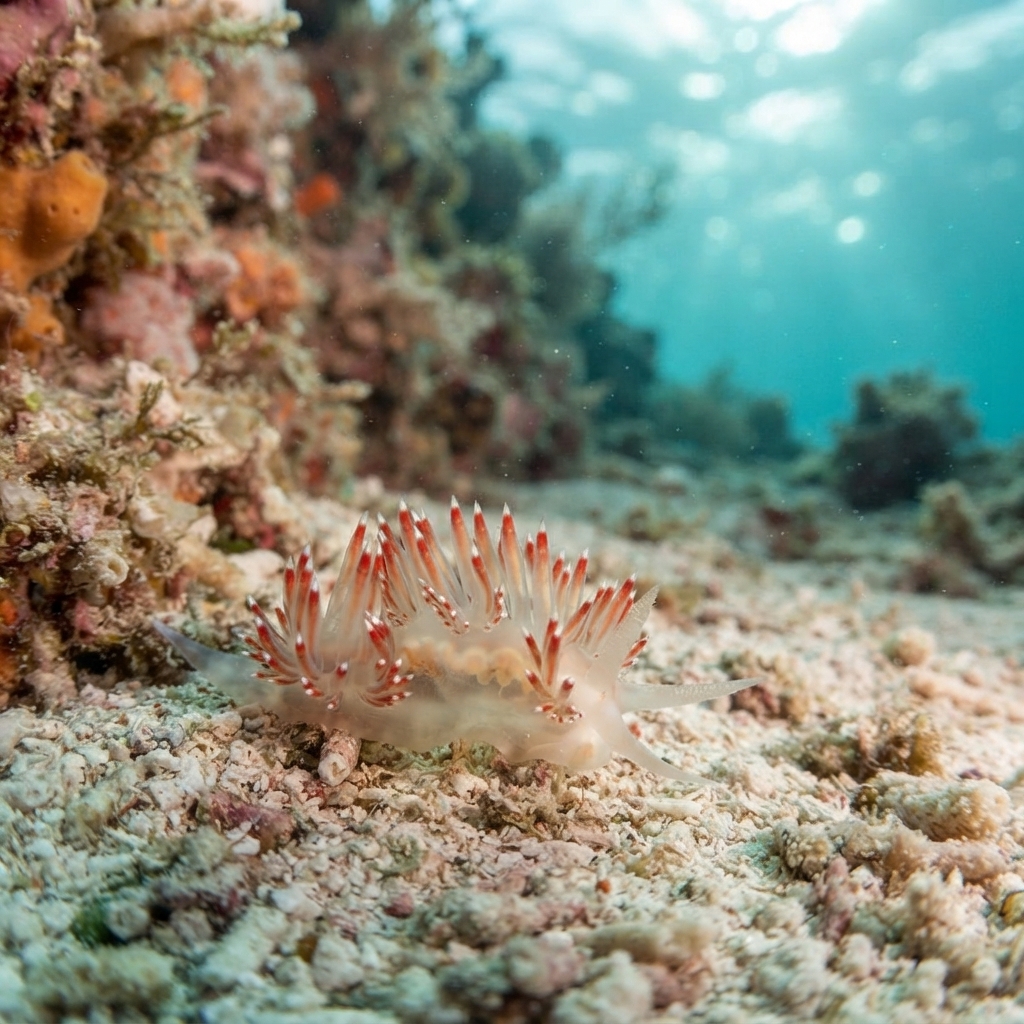
Baenopsis baetica
A small, uncommon nudibranch logged almost exclusively in Andalusia, Spain, in waters between 15 and 21°C.
A small, slender nudibranch with an elongated body typical of the flabellinopsid group, usually spotted by patient divers scanning rock and rubble rather than open sand. Look for the narrow tapering body shape shared across this family rather than a bold single colour patch, since exact colouring for this species is not well documented. Size and depth range are not well recorded, so treat any individual you find as worth a close look and a photo for confirmation.
Divers log this one as an uncommon find, meaning it takes a deliberate slow-paced search of rock and rubble to spot rather than a chance encounter on a drift. Like most small nudibranchs it moves at a crawl over the substrate and shows no reaction to divers beyond continuing to graze, so a close macro approach with a torch is the way to find and photograph it.
As with other flabellinopsid nudibranchs, it likely feeds on hydroids and may store stinging cells from its prey in its own tissue for defence, though this has not been specifically confirmed for this species.
Sightings show no detectable seasonal pattern, and with observed water temperatures spanning 15.4 to 21.4°C it appears to turn up across the cooler-to-mild range typical of Andalusian diving through the year.
Every logged sighting of this species comes from Spain, with Andalusia standing out as the one region where divers have reliably found it. If you are hunting for it specifically, Andalusian dive sites are currently the only known bet.
Mapping where Andalusian Baenopsis is logged…
All confirmed sightings come from Spain, concentrated in Andalusia. It has not been logged at dive sites outside this region.
There is no clear season in the data, and it has been recorded across a temperature range of roughly 15 to 21°C, so it appears to be a year-round find in Andalusian waters.
Look for a small, slender nudibranch with an elongated body, typically found on rock or rubble rather than open sand. Detailed colour markings are not well documented, so photograph any candidate for a closer identification check.
Exact size data for this species has not been recorded, though it fits the small, slender body plan typical of its nudibranch family.
No. This is a small, harmless nudibranch that poses no risk to divers and will not react aggressively if approached.
Site and sighting data is aggregated from diver logs, iNaturalist and GBIF. For taxonomy and conservation status:
Light-spotted Aegires
3,168 sites





