
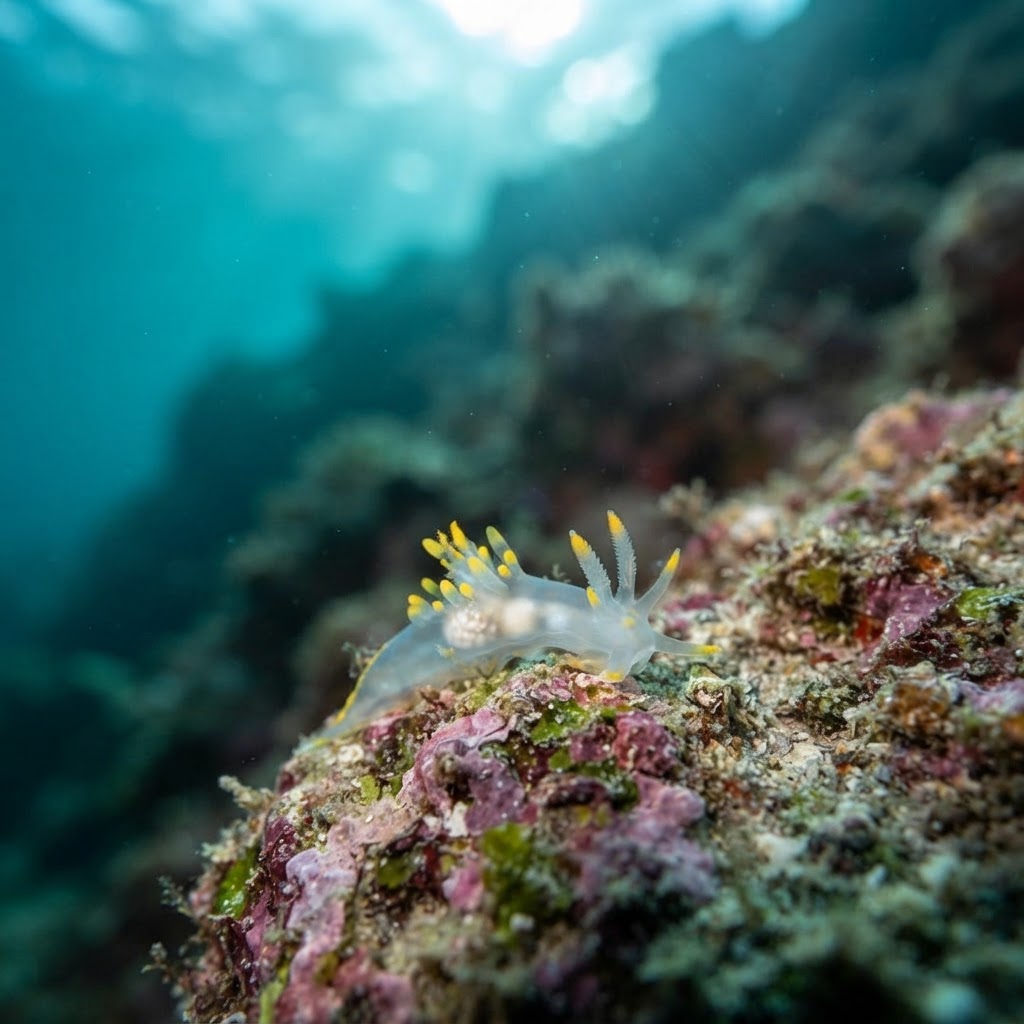
Ancula gibbosa
A 1cm white nudibranch with yellow-tipped gills, most reliably found in Wales, Nova Scotia and Jutland's cold water year-round.
At around 1 cm long, this is a translucent white to cream nudibranch with scattered yellow or orange tips along its back projections and rhinophores (the paired sensory horns on its head). Look closely at the edge of the body for the small finger-like gills and tentacles tipped in that same yellow-orange, which is the easiest tell against the plain white body. It moves slowly across rock and algae, so divers usually spot it by scanning for the colour contrast rather than movement.
Divers find this one parked on rock, kelp holdfasts, or hydroid-covered surfaces, moving at a typical nudibranch crawl and paying no attention to torches or cameras hovering close by. It's small enough that most sightings come from divers doing a slow, deliberate macro search rather than stumbling across it mid-swim. Look at night dives too, since many goniodorid nudibranchs are more active after dark.
Like other goniodorid nudibranchs, it likely feeds on hydroids and bryozoans, using their stinging or chemical defences borrowed from prey to protect its own soft body, a common trick across this family.
No clear seasonal pattern shows up in the sightings, and given its narrow cold-water niche of roughly 8 to 14 C, it's worth looking for year-round at these temperate sites rather than timing a trip around a season.
Most commonly logged in the United Kingdom, particularly Wales and elsewhere in England, with strong showings in the Pacific Northwest of the United States, Nova Scotia in Canada, and Jutland in Denmark. It's a cold-water species throughout, so don't expect it on tropical reef dives.
Mapping where Atlantic Ancula is logged…
It's most reliably found in Wales and other parts of the UK, along with Nova Scotia in Canada, Jutland in Denmark, and the Pacific Northwest of the United States. All of these are cold-water sites, so pack a thicker wetsuit or drysuit.
There's no strong seasonal pattern in the sightings, so it appears to be a year-round find at cold-water sites within its 8 to 14 C comfort range.
Look for a translucent white body about 1 cm long with yellow or orange tips on the rhinophores, gills, and body projections. That colour contrast against the pale body is the main giveaway underwater.
It's tiny, typically around 1 cm long, so it's easy to swim straight past without a slow, close look at rock and algae surfaces.
No. It poses no threat to divers and has no means of harming anyone; the only challenge is spotting something this small.
Like related goniodorid nudibranchs, it most likely grazes on hydroids and bryozoans, taking on some of their chemical defences in the process.
Site and sighting data is aggregated from diver logs, iNaturalist and GBIF. For taxonomy and conservation status:
Light-spotted Aegires
3,168 sites





