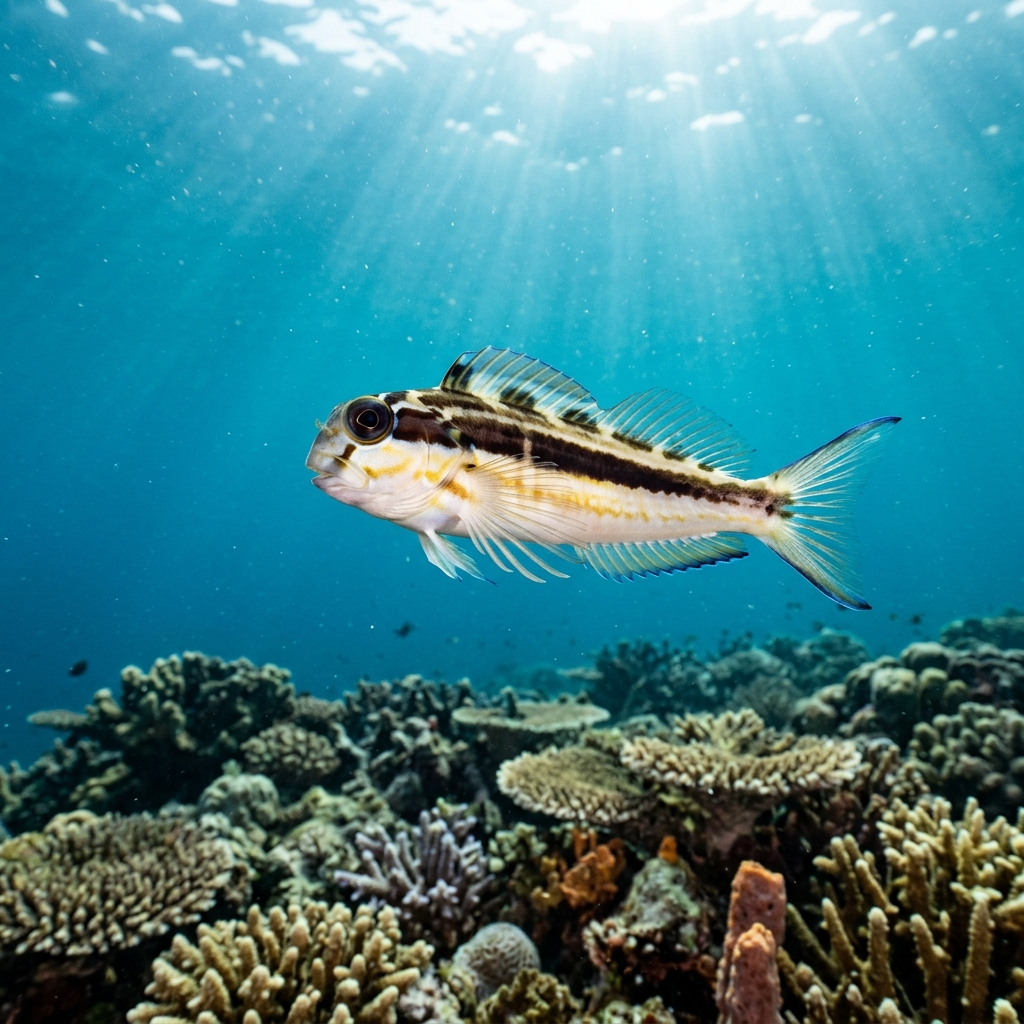
Aspidontus taeniatus
Spot the False Cleanerfish in the Philippines and French Polynesia. A rare but rewarding find in warm Indo-Pacific reefs between 19 and 29°C.
A slender, elongated fish with a bold dark stripe running from snout to tail, closely resembling the cleaner wrasse in colour and pattern, which is precisely the point. The body is pale to yellowish above the stripe and white below, and it typically hovers head-down or peers out from a crevice rather than swimming openly. Look for the blunt, rounded head and the way it moves in short, jerky darts rather than the smooth undulation of the wrasse it imitates.
Almost always seen alone, tucked into a small hole or crevice in the reef with just the head visible, scanning for passing fish. When it does venture out, it swims in that distinctive, exaggerated side-to-side wriggle that mimics the cleaner wrasse, approaching other fish close enough to nip their scales or mucus before retreating. It is not bothered by divers but will retreat into its hole if approached too directly, so slow, patient hovering at distance gives the best views.
This species is a aggressive mimic of the bluestreak cleaner wrasse (Labroides dimidiatus). It copies the wrasse's colours, pattern, and swimming style so convincingly that reef fish approach it expecting a cleaning service, at which point the blenny bites off a scale or chunk of fin and bolts. It is one of the textbook examples of aggressive mimicry in the ocean.
No strong Northern Hemisphere season emerges from the data, so the Philippines and Red Sea sites are worth trying any time conditions suit. In the Southern Hemisphere, sightings in Australia and New Caledonia concentrate between February and May, suggesting that is the most productive window in those regions.
Most sightings come from the Philippines, particularly the Visayas Central region and the sites around Palawan and Apo Reef, making it the single best country to target. Australia, especially New South Wales, and French Polynesia centred on Tahiti are the next most consistent locations, followed by the Red Sea around Jeddah in Saudi Arabia.
Mapping where False Cleanerfish is logged…
The Philippines, particularly the Visayas Central region and Palawan, offer the most logged sightings. French Polynesia around Tahiti, New South Wales in Australia, and the Red Sea around Jeddah are also solid options. It is a rare find at most sites, so patience helps.
In the Southern Hemisphere, including Australia and New Caledonia, sightings peak between February and May. For the Philippines and Red Sea, no single season stands out, so diving when conditions are good is the practical approach.
Look for a slender fish with a bold dark stripe from snout to tail and a pale body, typically peering from a crevice or making short darting swims with an exaggerated wriggle. The blunt head and jerky movement distinguish it from the smoother-swimming cleaner wrasse it copies.
It is one of the ocean's most accomplished cheats. It has evolved to look and swim almost identically to the bluestreak cleaner wrasse, luring unsuspecting fish that expect a cleaning. Instead of removing parasites, the blenny bites off a scale or piece of fin and escapes. This is called aggressive mimicry.
Site and sighting data is aggregated from diver logs, iNaturalist and GBIF. For taxonomy and conservation status:
Rusty Blenny
2,605 sites