Amphorina farrani
A rare find on cool-water reefs, most logged along the French Riviera and the coasts of Wales at 11-18°C year-round.
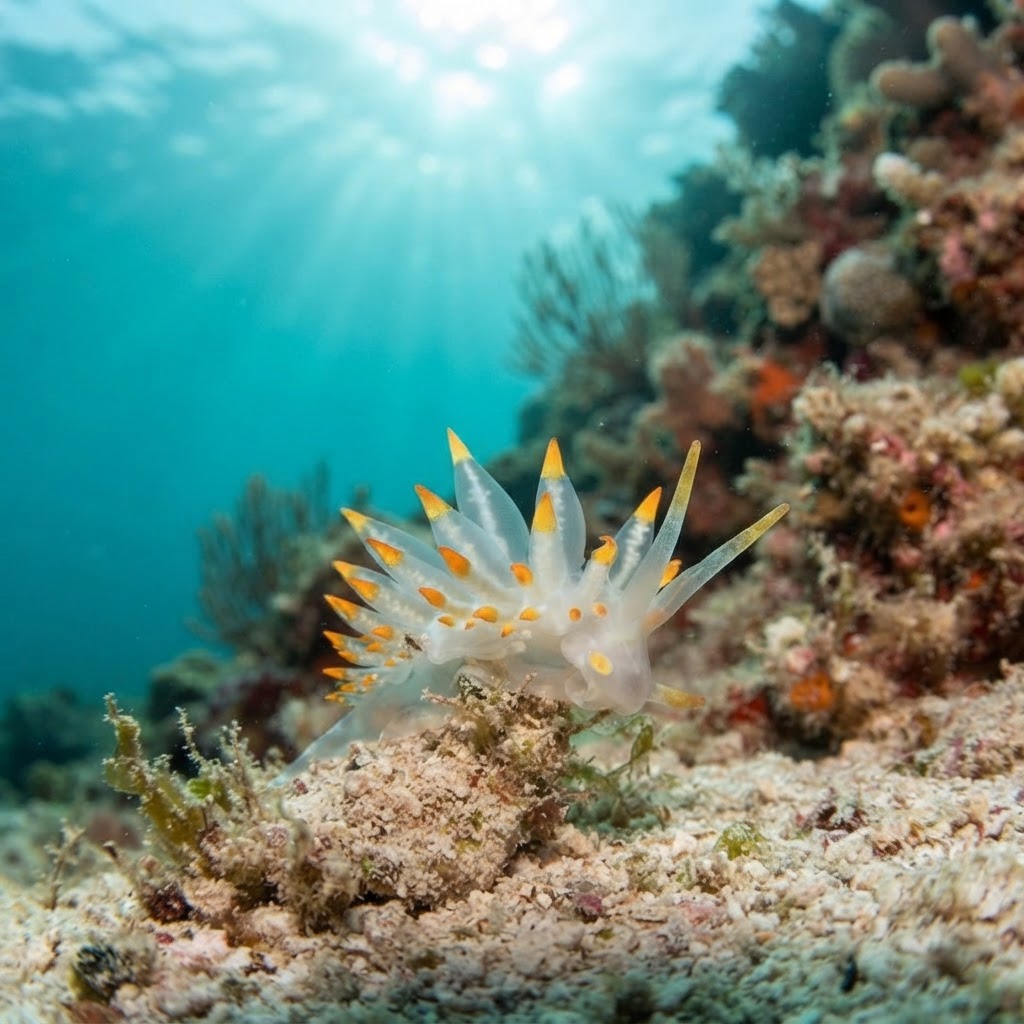
A slender, translucent-bodied nudibranch (sea slug) rarely more than a couple of centimetres long, identified mainly by the rows of finger-like projections (cerata) along its back, often tipped in orange or reddish-brown. The body is pale to whitish, letting the coloured cerata tips stand out against dark rock or algae. It moves slowly over its hydroid prey, so look for a small patch of movement rather than a fast-swimming animal.
Divers find it grazing slowly over hydroid colonies on rock walls and under ledges, moving at the unhurried pace typical of small sea slugs feeding rather than travelling. It shows no reaction to divers beyond continuing to feed, so a slow, close look with a torch is usually all it takes to get a good view. Most logs come from macro-focused dives where divers are already searching rock and kelp holdfasts inch by inch.
Like other aeolid nudibranchs, it likely stores stinging cells from the hydroids it eats in the tips of its cerata, turning its prey's own defences into its own protection.
Sightings don't show a clear seasonal pattern, and with a comfortable range of 11.2 to 18.3°C it can turn up across the diving year in these temperate waters. Treat it as a year-round possibility rather than a seasonal target.
Most consistently logged along the French Riviera and Provence coast, with a further reliable presence in Wales, England, and Brittany. Norway's Nordland region adds a cooler-water northern outpost, making this a species tied to temperate European rock and hydroid habitats rather than tropical reefs.
Mapping where Farran's Amphorina is logged…
It's most often logged along the French Riviera and Provence coast, with further sightings in Wales, England, and Brittany, plus a northern outpost in Norway's Nordland region. It favours temperate rocky reefs rather than tropical waters.
There's no strong season in the sighting data, and it tolerates a wide range from about 11 to 18°C, so it's a year-round possibility at its usual sites rather than a seasonal event.
Look for a small, translucent-bodied slug with rows of cerata along its back, often tipped orange or reddish-brown against a pale body. It moves slowly over hydroids on rock or kelp holdfasts, so scan closely rather than expecting fast movement.
Exact size data isn't confirmed, but like most Amphorina species it's small, typically only a centimetre or two long, making it a macro-photography subject rather than an easy spot from a distance.
No. It poses no threat to divers and simply feeds on hydroids, unbothered by close observation.
It grazes on stinging hydroids and is thought to repurpose their stinging cells for its own defence, storing them in the coloured tips of its cerata, a trick shared by many aeolid nudibranchs.
Site and sighting data is aggregated from diver logs, iNaturalist and GBIF. For taxonomy and conservation status:
Light-spotted Aegires
3,168 sites