
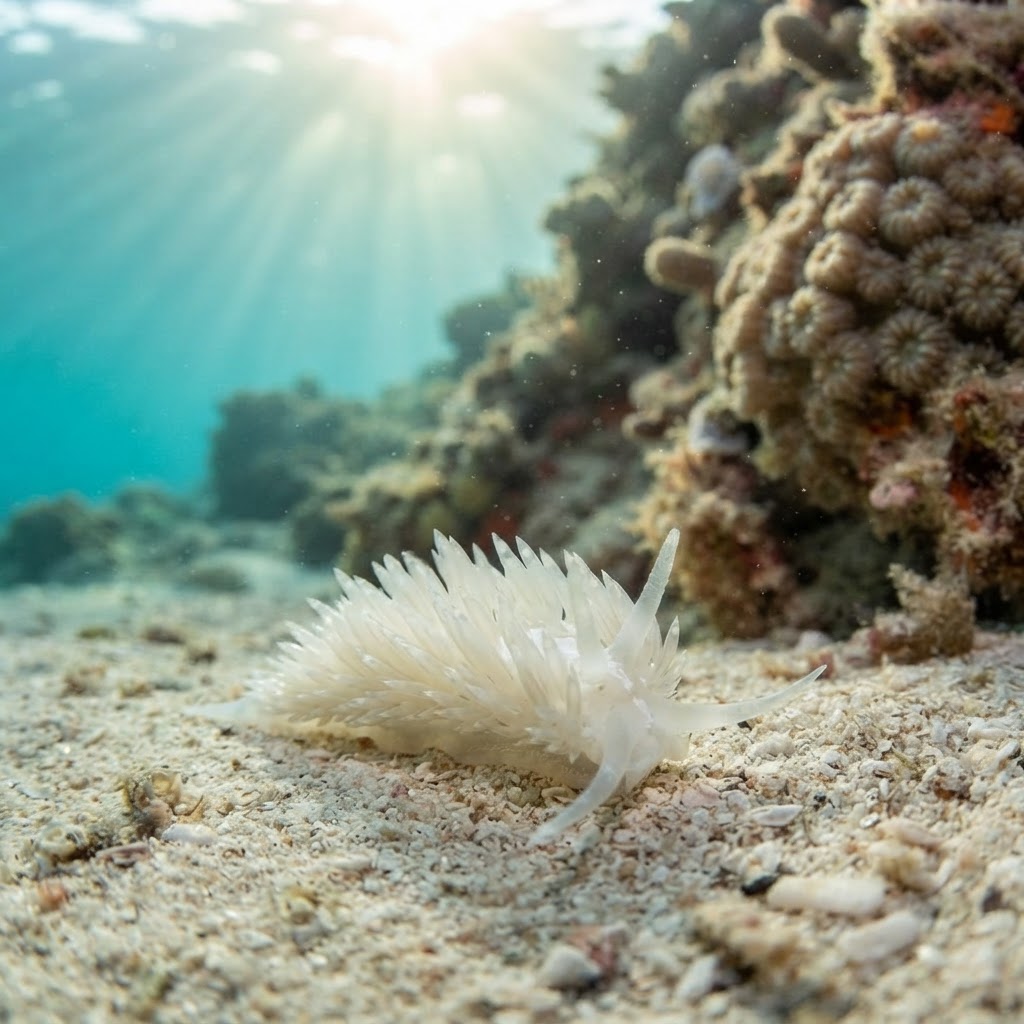
Aeolidia loui
A rare cold-water find off California and the Pacific Northwest, most active in water between 8.7 and 18.9C.
Look for a soft-bodied sea slug covered in dense, finger-like projections (cerata) along its back, giving it a fuzzy, textured outline rather than a smooth one. Colouration tends toward muted browns, greys or creams that blend into the rocky, low-light habitats it favours. It moves slowly across rock and rubble, low to the substrate, and lacks the bold, high-contrast patterning of many tropical nudibranchs.
Divers typically find it moving slowly over rocky substrate and rubble, grazing rather than swimming, and it shows little reaction to a diver's presence beyond continuing its unhurried crawl. It is logged as rare at most sites and only occasionally uncommon, so finding one usually means deliberately searching low on the reef rather than spotting it in open water.
Like other aeolid nudibranchs, it likely feeds on anemones or hydroids and can incorporate stinging cells from its prey into its own cerata for defence, a trick shared across the aeolidiidae family.
Sightings show no clear seasonal pattern, so treat it as a year-round possibility wherever the water sits in its comfortable 8.7 to 18.9C range. In practice that means most temperate Pacific coast dives, any month, give you a shot at finding one.
This is a cold-water species most commonly logged along the US Pacific coast, with the strongest presence in California and the Pacific Northwest. It also turns up in British Columbia, Canada, making the Pacific Northwest corridor from Northern California up through BC the reliable stretch to search for it.
Mapping where Warty Shag-rug Nudibranch is logged…
It is most reliably found along the US Pacific coast, especially California and the Pacific Northwest, with additional sightings in British Columbia, Canada. It has not been widely logged outside these cold-water regions.
There is no strong seasonal pattern in sightings, so it can be found year-round wherever water temperatures sit between roughly 8.7 and 18.9C, which covers most of the temperate Pacific coast diving season.
Check for a slug covered in dense, finger-like cerata giving it a fuzzy rather than smooth back, in muted brown, grey or cream tones. It moves slowly over rocky, cold-water substrate and lacks bright contrasting markings.
No. It is not considered dangerous to divers and poses no known risk if observed without handling it.
It is logged as rare at most sites where it has been recorded, with only a handful of locations reporting it as uncommon or common. Finding one usually takes a deliberate search along rocky, low-light substrate.
Site and sighting data is aggregated from diver logs, iNaturalist and GBIF. For taxonomy and conservation status:
Light-spotted Aegires
3,168 sites





