Myliobatis spp.
Eagle rays glide through cooler waters off Australia, the Canary Islands and New Zealand. Here's when and where divers spot them most.
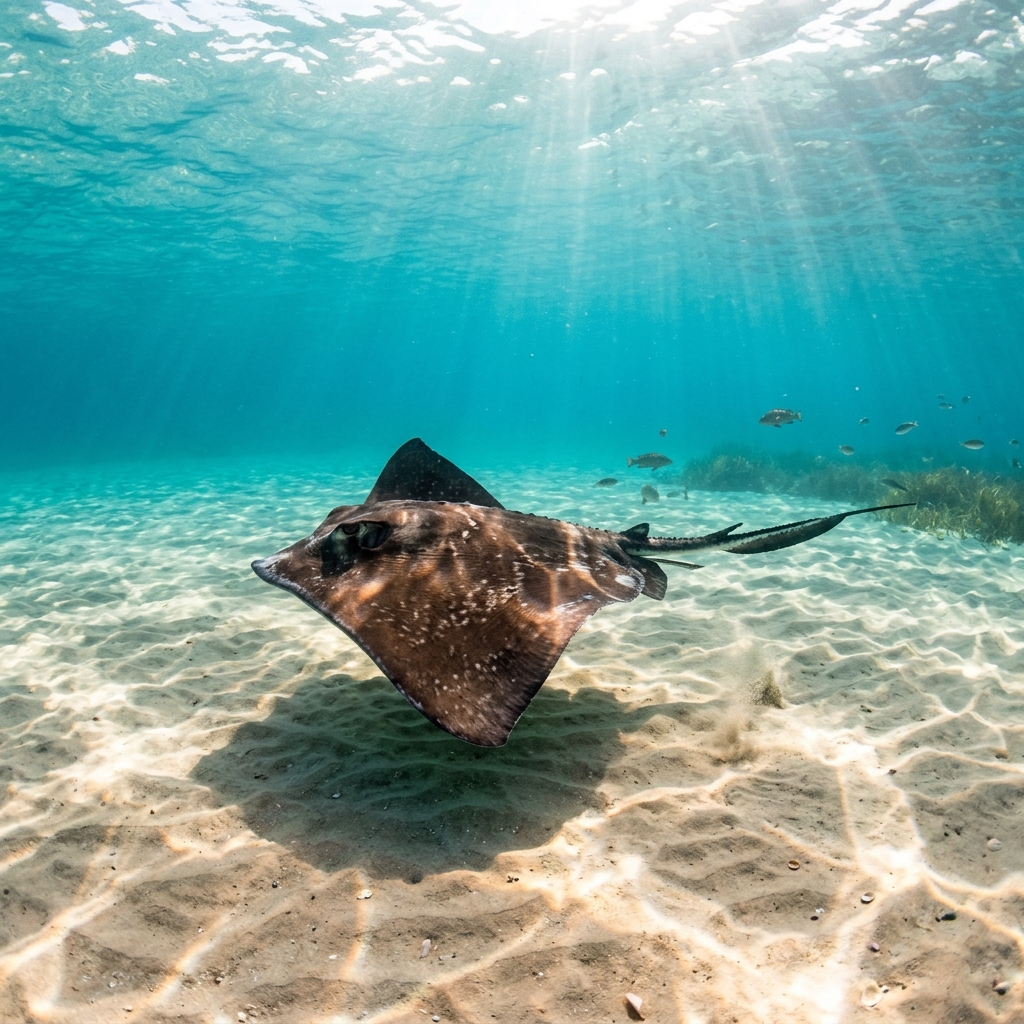
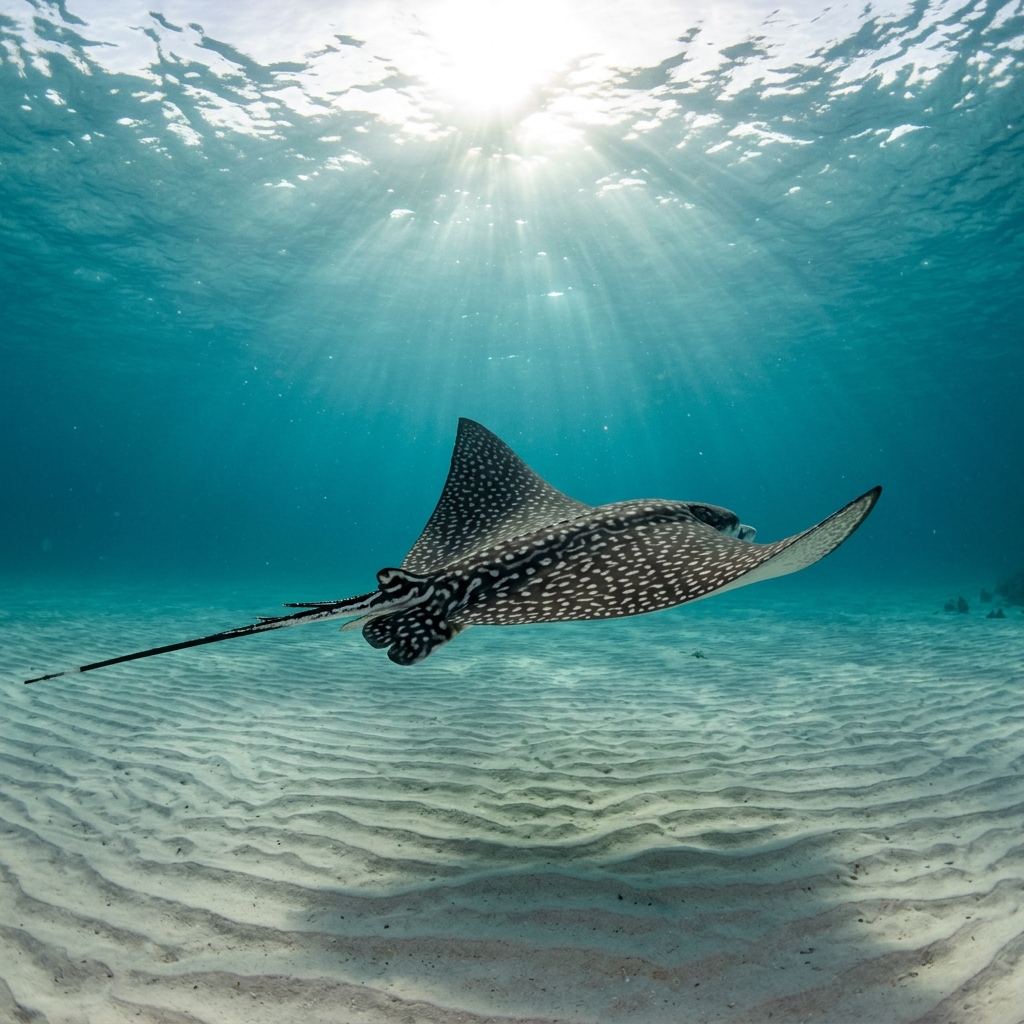
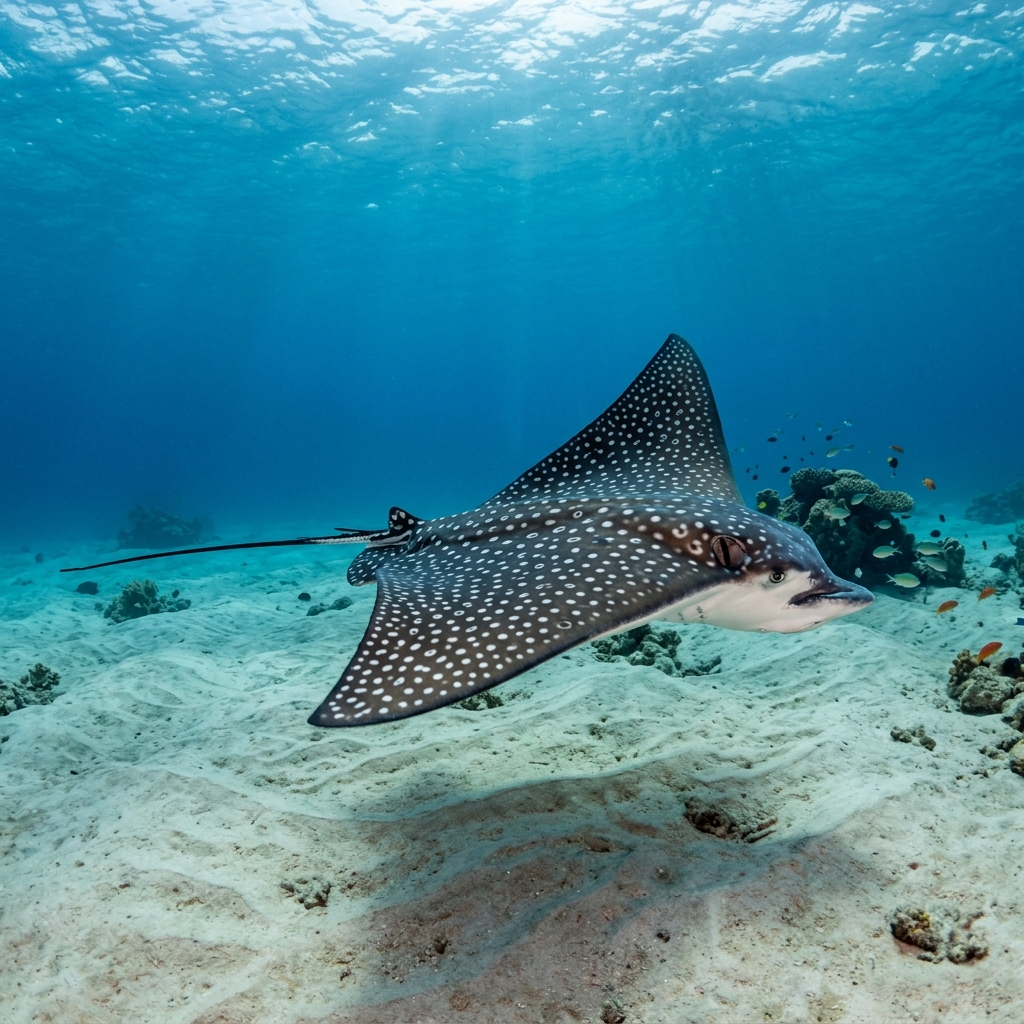
Eagle rays are immediately recognisable by their wide, pointed pectoral fins (the 'wings') that form a diamond or kite shape, giving them an effortless soaring look as they move through the water column. The dorsal surface is typically dark brown, olive, or greyish, contrasting with a white or pale underside. A distinctive head that protrudes forward like a duck's bill, rather than blending smoothly into the body, separates them from other rays at a glance. The long, whip-like tail, often considerably longer than the body, is another reliable marker underwater.
Divers most often encounter eagle rays cruising mid-water or gliding low over sandy or rubble seabeds, sometimes pausing to root through sediment with their distinctive snouts in search of buried molluscs and crustaceans. They are generally unhurried around divers and will often continue on their path without bolting, though sudden movements or close approach will prompt them to accelerate away with powerful wingbeats. Occasionally they are seen in loose aggregations, but single animals are the more typical sighting.
Eagle rays are powerful enough swimmers to breach the surface entirely, launching themselves clear of the water, a behaviour that has been observed repeatedly but is still not fully explained, with theories ranging from parasite removal to communication.
In the Northern Hemisphere, including the Canary Islands and the US Pacific Coast, sightings concentrate from May through December. In the Southern Hemisphere, including Australia and New Zealand, the peak period runs from November through April, the local warmer months that sit within this genus's observed temperature range of roughly 15 to 23°C.
Reef neighbours a diver could mistake it for. Use the identification notes above to tell them apart.
Eagle rays are most commonly logged in Australia, particularly along the New South Wales coast and in Western Australia, making it the strongest country overall. The Canary Islands, especially Tenerife and Lanzarote, hold a large number of recorded sites, as does the US Pacific Coast. New Zealand, particularly the Northland and Auckland region and the Coromandel Peninsula, rounds out the best destinations.
Mapping where Eagle Ray is logged…
The strongest sighting records come from Australia (especially New South Wales and Western Australia), the Canary Islands (particularly Tenerife and Lanzarote), the US Pacific Coast, and New Zealand's Northland and Auckland region. These cooler, temperate waters suit the genus well.
In the Canary Islands and along the US Pacific Coast, sightings peak between May and December. In Australia and New Zealand, the best window is November through April. These patterns align with water temperatures in the 15 to 23°C range that eagle rays favour.
Look for the kite-shaped body with long, pointed wingtips, a clearly projecting snout that looks almost beak-like, and a tail noticeably longer than the disc. The dark topside against a pale belly is visible even from a distance as they cruise mid-water.
Eagle rays are not considered dangerous to divers. Like most rays they carry a venomous tail spine, but they use it defensively and only when handled or cornered. Give them space, avoid grabbing or cornering them, and encounters are reliably calm.
Disc width across the pectoral fins varies by species within the genus but commonly reaches 1.5 to 2 metres in larger individuals. The tail can more than double the total length of the animal, making them appear considerably larger in the water than the disc measurement alone suggests.
Site and sighting data is aggregated from diver logs, iNaturalist and GBIF. For taxonomy and conservation status: