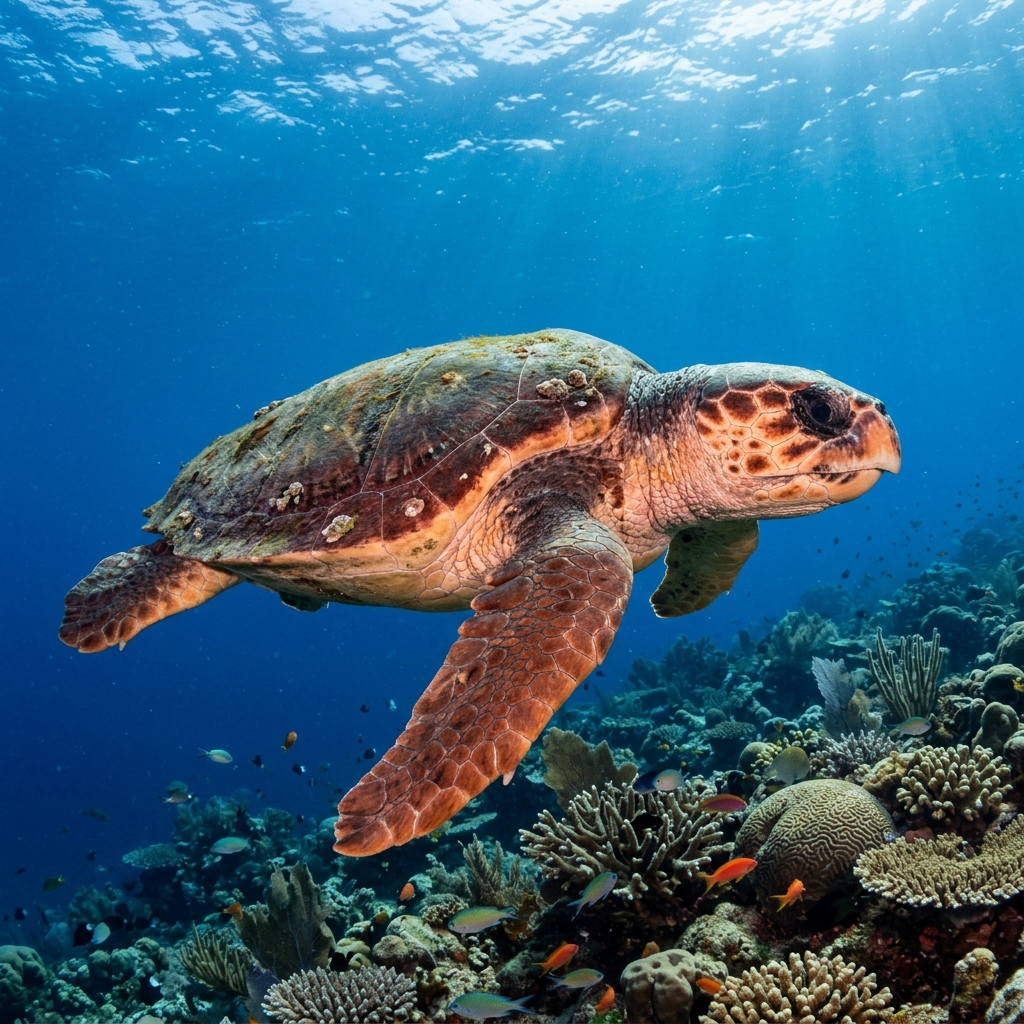
Caretta caretta
Spot loggerhead sea turtles across Florida, Greece, and Croatia. Here's how to ID them underwater and when to look.
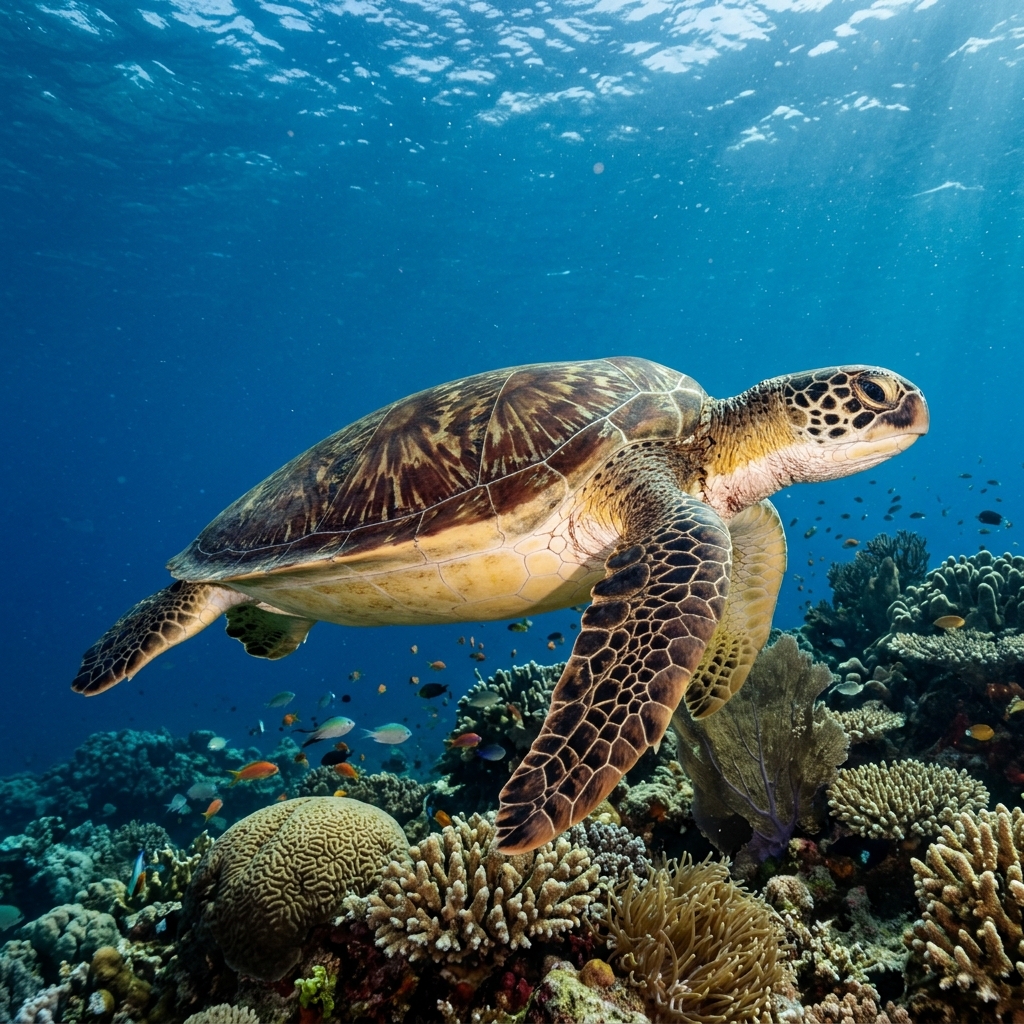
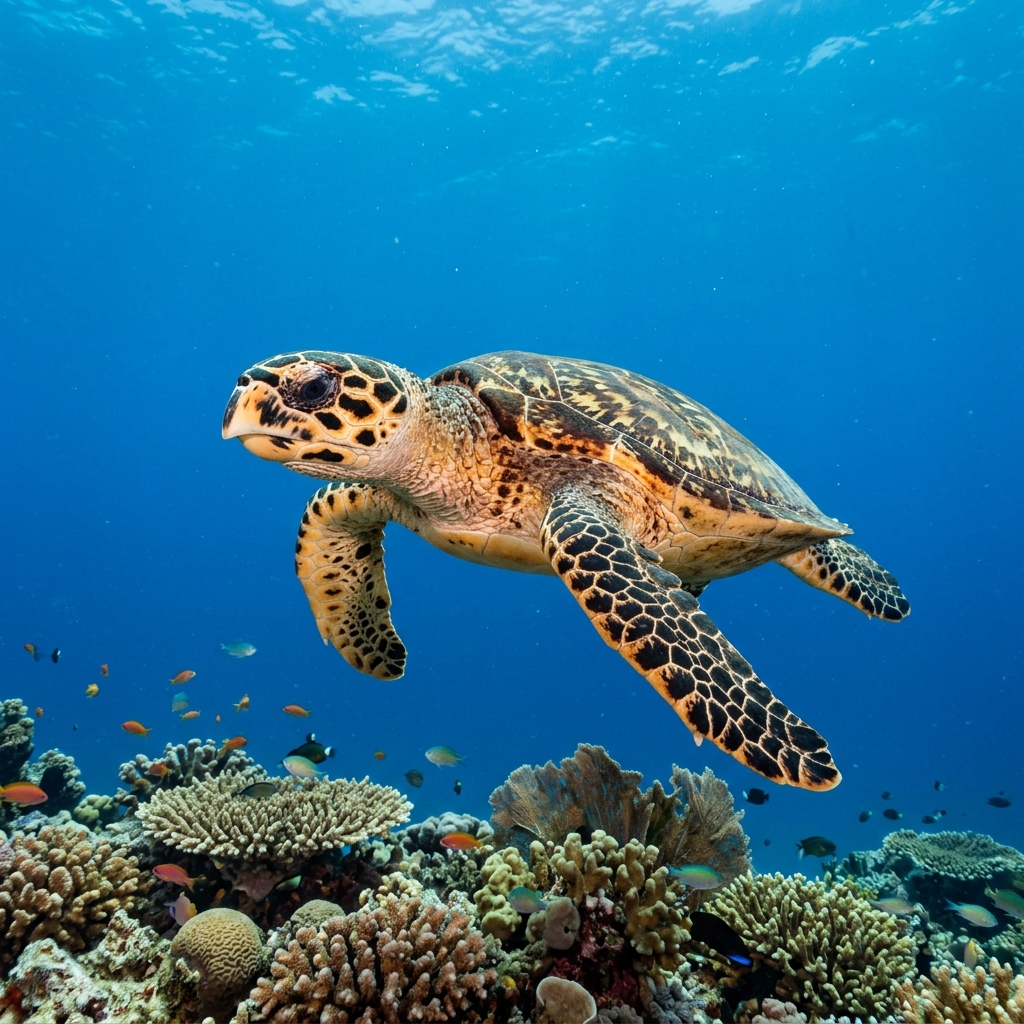
A large, reddish-brown to amber shell paired with an unusually large, blocky head is the key feature to lock onto underwater. At around 87 cm shell length, it sits notably bigger than most reef fish but slightly more compact than a green turtle. The head is proportionally much wider than any other sea turtle you are likely to encounter, housing the powerful jaw muscles it uses to crunch hard-shelled prey. Adult males can be identified by a long, thick tail extending well past the rear of the shell; females have a short tail that barely clears the shell edge.
Most encounters find loggerheads cruising the seafloor in search of crabs, sea urchins, and other hard-shelled prey, or making purposeful climbs to the surface to breathe. Reactions to divers vary by individual: some are entirely indifferent, especially when locked onto a meal, while others drift away if approached too directly. Daytime dives give the best chance of finding them actively foraging rather than resting.
That oversized head is not just for show. Loggerheads can generate enough bite force to crush heavily armoured prey like conch and horseshoe crabs that most other sea turtles cannot access, giving them a dietary niche all their own.
No clear seasonal peak has emerged from the sighting data, so loggerheads are treated as a year-round encounter across their range. Their observed water temperature niche spans 12.6 to 27.4 °C, which means they tolerate both temperate and warm-tropical conditions and are not confined to any single season.
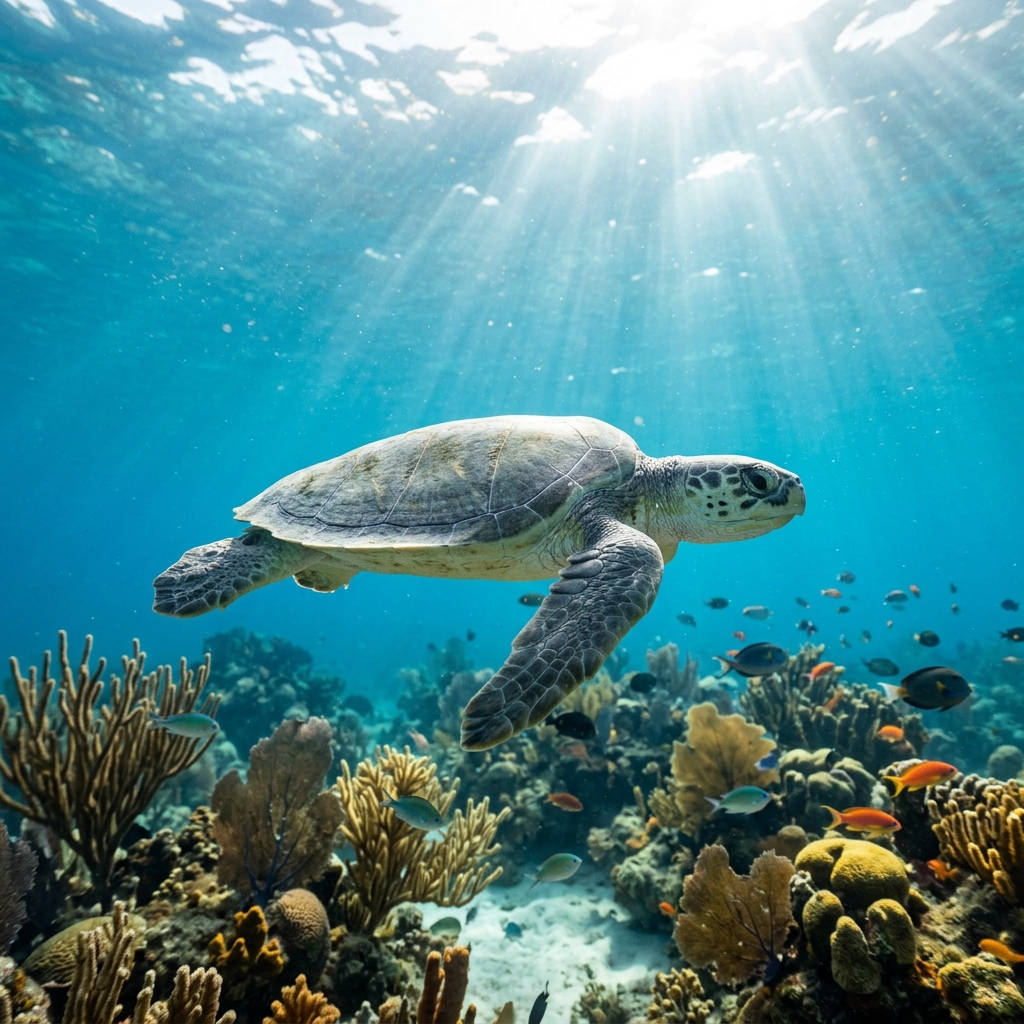
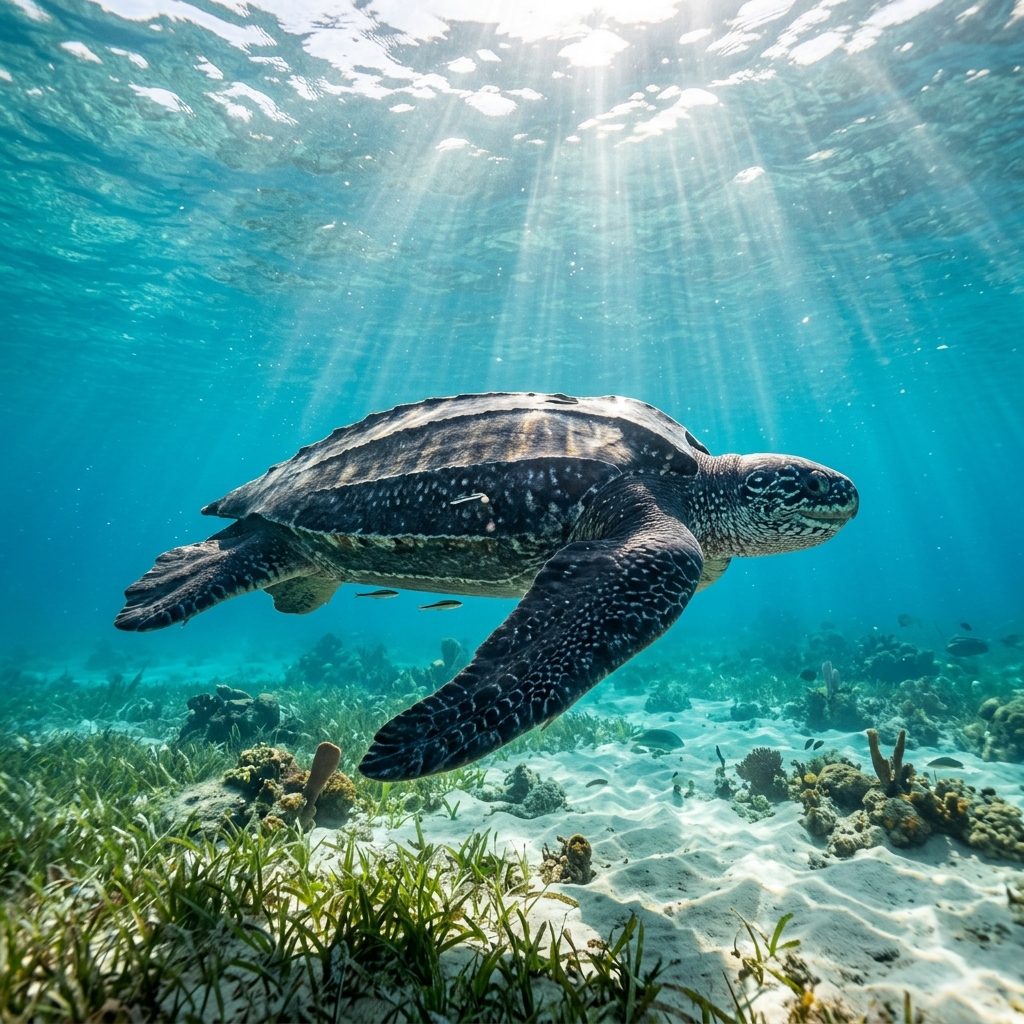
Reef neighbours a diver could mistake it for. Use the identification notes above to tell them apart.
Most commonly logged in Florida and the Southeast US, with strong site coverage across Greece, Croatia, Italy, Turkey, and Australia's Queensland. The Mediterranean is a particular stronghold, where Attica, Central Dalmatia, and the Aegean Coast all regularly produce sightings. Brazil's Northeast Coast and Brittany in France round out a remarkably wide global footprint.
Mapping where Loggerhead Sea Turtle is logged…
Loggerheads turn up across a wide range of destinations. Florida and the Southeast US lead in logged sites, followed closely by Greece (especially Attica), Croatia's Central Dalmatia, Turkey's Aegean Coast, and Queensland in Australia. The Mediterranean is particularly productive, with Italy and France also featuring regularly.
There is no single peak season in the dive data, so encounters are possible year-round across their range. Loggerheads tolerate water temperatures from roughly 12 to 27 °C, meaning they appear in both warm tropical and cooler temperate seas depending on the location.
Focus on the head. Loggerheads have an exceptionally large, wide head compared to any other sea turtle, with a reddish-brown to amber shell. Adult males are identifiable by a long, thick tail extending past the shell edge, while females have a short tail. If the head looks proportionally small, you are probably looking at something else.
Most adults have a shell length around 87 cm, though larger individuals do occur. They are solidly built animals, and underwater their bulk is immediately apparent, notably larger than hawksbill or ridley turtles but generally smaller than a leatherback.
Loggerheads are classified as Vulnerable globally. Key threats include accidental capture in fishing gear, disturbance and light pollution on nesting beaches, and ingestion of marine debris. Giving them space underwater and reporting any entangled individuals to local authorities are the most useful things a diver can do.
The Loggerhead Sea Turtle is listed as vulnerable by the IUCN. Observe from a distance, avoid touching or feeding it, and report sightings to local marine research organisations.
Loggerheads are listed as Vulnerable on the IUCN Red List, facing pressure from bycatch, coastal development on nesting beaches, and marine debris ingestion. Divers should keep a respectful distance, avoid touching or chasing individuals, and report entanglement or injury to local marine authorities.
Site and sighting data is aggregated from diver logs, iNaturalist and GBIF. For taxonomy and conservation status:
Leatherback
95 sites