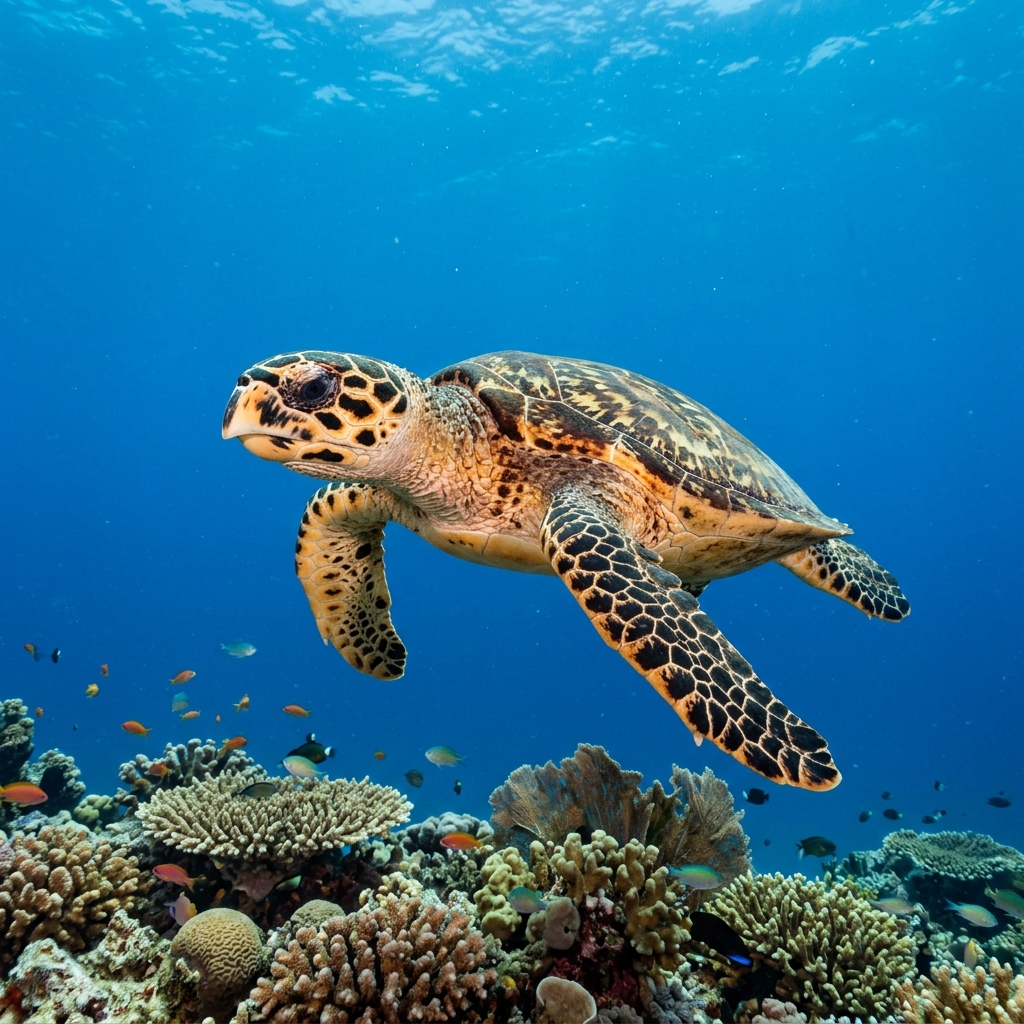
Eretmochelys imbricata
Spot hawksbill sea turtles in the Maldives, Seychelles, and Queensland. Know when to go, how to identify them, and why they're worth the search.
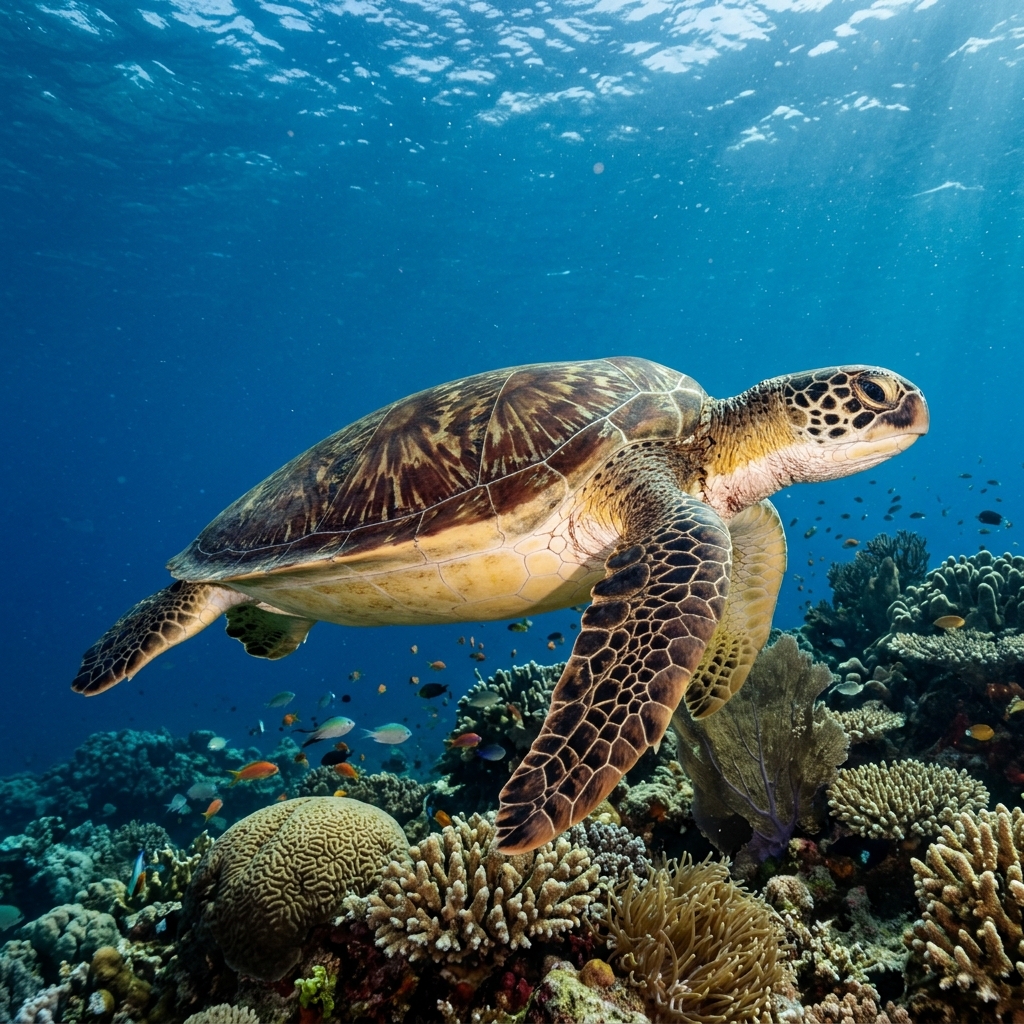
At around 60 cm, hawksbills are mid-sized turtles with one unmistakable feature: a narrow, pointed beak that curves downward like a raptor's, setting them apart from every other sea turtle at a glance. The shell (carapace) shows overlapping scute (plate) edges giving it a serrated, almost saw-tooth rear margin, and the colouring is a warm amber-brown with dark streaks and mottling. Two pairs of prefrontal scales between the eyes, rather than one pair as in most relatives, are the clinching ID mark if you get close enough.
Most encounters happen during the day, with the turtle methodically working its way across the reef, poking that narrow beak into crevices to prise out sponges, anemones, and other invertebrates that other species simply cannot reach. Individual personalities vary noticeably: some hawksbills will circle back and inspect a hovering diver with obvious curiosity, while others keep a wary distance from the start. Move slowly, stay low in the water column, and avoid cutting off their path, an unhurried approach gives you the longest, most natural view.
Hawksbills are one of the few animals that eat toxic sponges in quantity, apparently without harm. Because they selectively remove fast-growing sponges that would otherwise outcompete coral for space, a healthy hawksbill population actively helps maintain the reef structure that divers come to see.
In Southern Hemisphere destinations such as Australia and the Seychelles, sightings concentrate between July and April, with a quieter period around May and June. Tropical sites like the Maldives and Malaysia see hawksbills throughout the year, as the species is comfortable across a wide range of reef conditions.
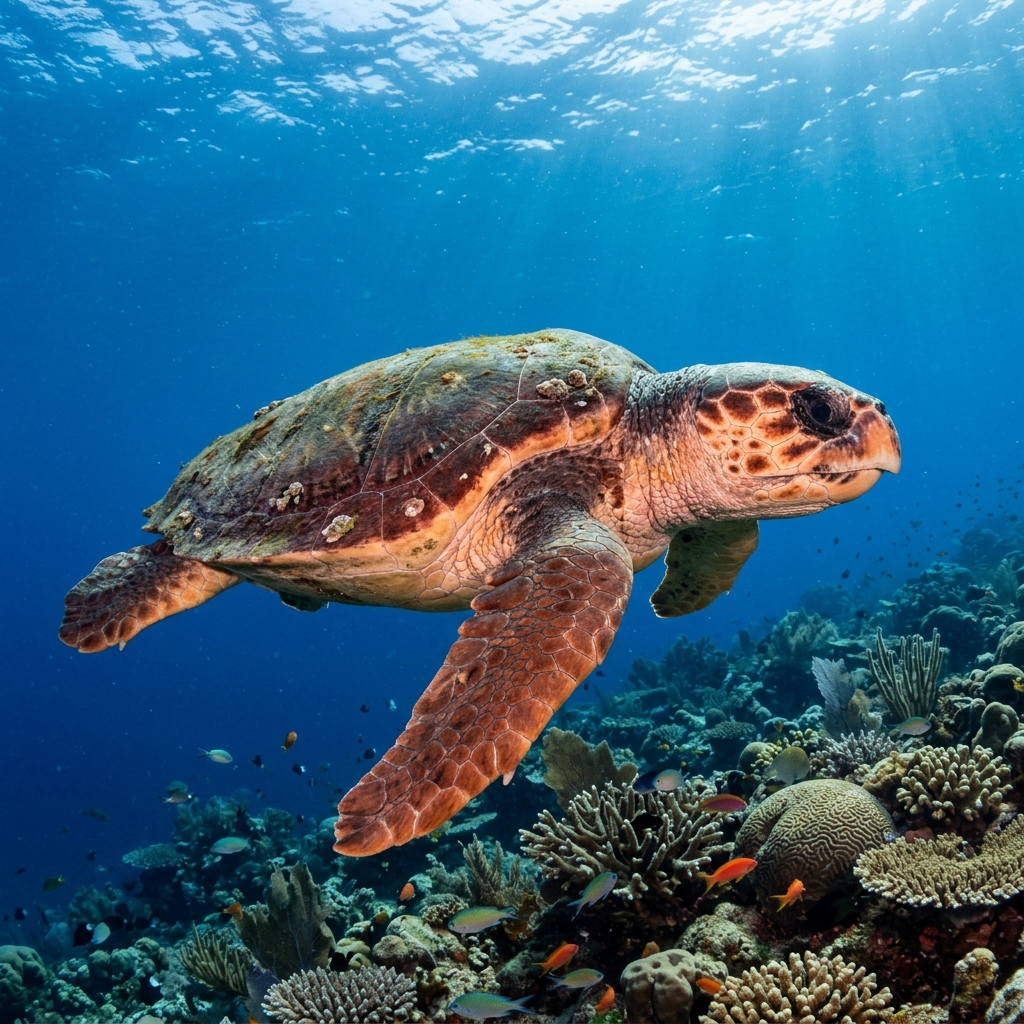
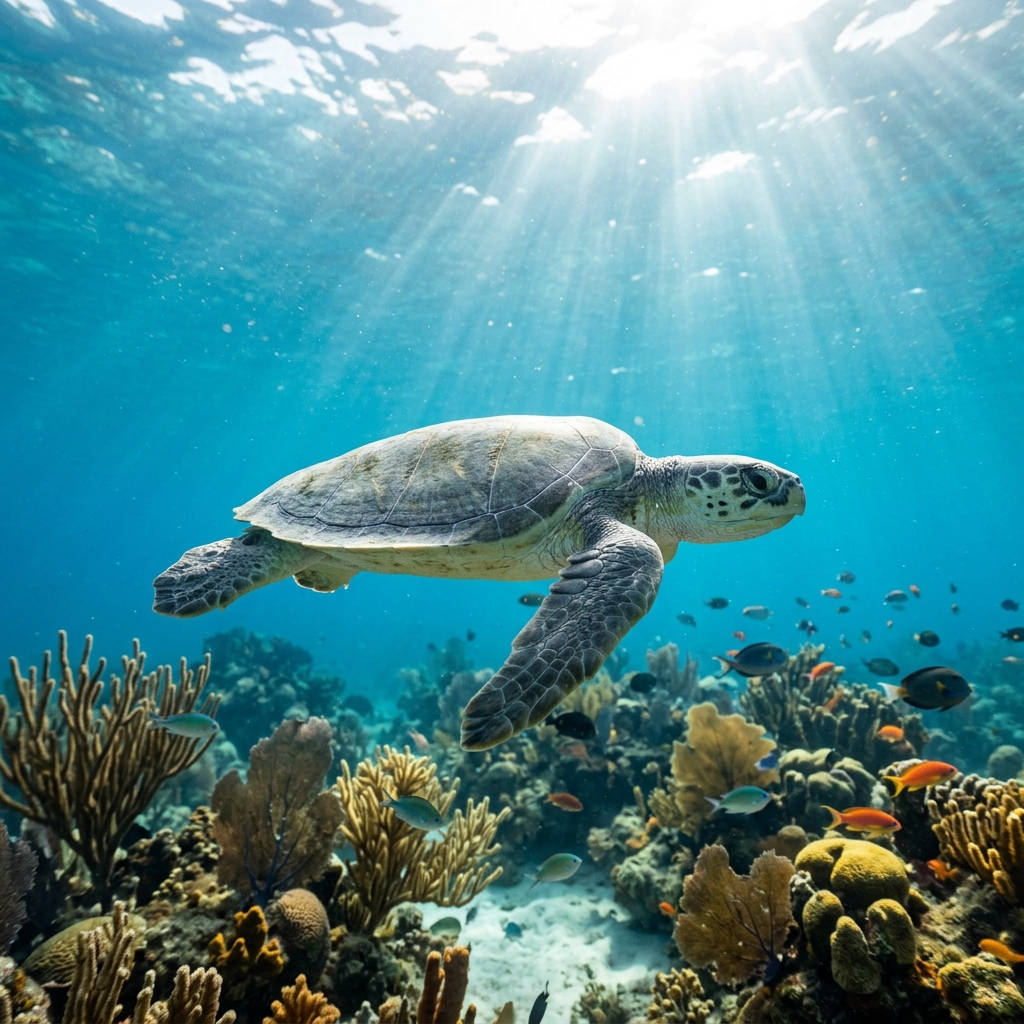
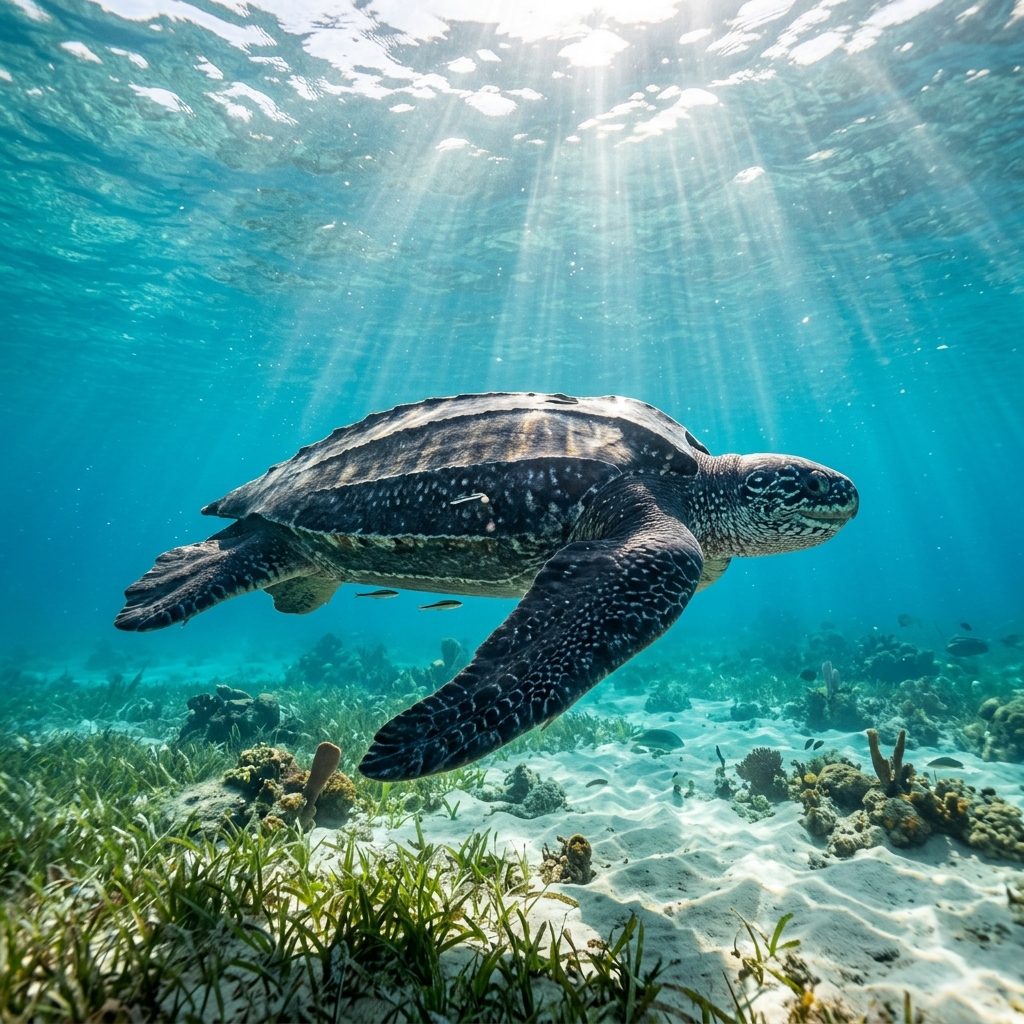
Reef neighbours a diver could mistake it for. Use the identification notes above to tell them apart.
Hawksbills are most commonly logged across the Maldives, particularly the Male and Ari Atolls, and in the Seychelles around Praslin and La Digue, where reef coverage gives them reliable foraging ground. Queensland, Australia and Pulau Tioman in Malaysia also have strong populations on record. The large volume of Canadian and north-eastern US sites in the data reflects range-model projections rather than warm-water dive tourism, so tropical Indo-Pacific and Indian Ocean destinations are where divers realistically target them.
Mapping where Hawksbill Sea Turtle is logged…
The most reliable dive destinations are the Male and Ari Atolls in the Maldives, Praslin and La Digue in the Seychelles, Queensland in Australia, and Pulau Tioman in Malaysia. All offer coral reef habitat where hawksbills actively forage.
In Southern Hemisphere destinations like Australia and the Seychelles, sightings are most frequent from July through April. At tropical sites such as the Maldives and Malaysia, hawksbills can be encountered throughout the year.
Look for the narrow, curved, bird-like beak, no other sea turtle has this. The carapace has overlapping scutes giving the rear edge a serrated look, and the colouring is warm amber-brown with dark streaking. Size is around 60 cm, making them smaller than green or loggerhead turtles.
Adults typically reach around 60 to 70 cm in shell length. They are one of the smaller sea turtle species, noticeably more compact than green or loggerhead turtles, which can exceed a metre.
Yes, they are listed as Critically Endangered on the IUCN Red List. Habitat loss, historic shell trade, and egg collection have all driven population declines. When diving with them, maintain distance, never touch them, and follow local marine park guidelines.
The Hawksbill Sea Turtle is listed as critically endangered by the IUCN. Observe from a distance, avoid touching or feeding it, and report sightings to local marine research organisations.
Hawksbills are listed as Critically Endangered on the IUCN Red List, the category just short of extinction in the wild. Keep a respectful distance, never touch or ride them, and report any entanglement or injury to local marine authorities.
Site and sighting data is aggregated from diver logs, iNaturalist and GBIF. For taxonomy and conservation status:
Leatherback
95 sites