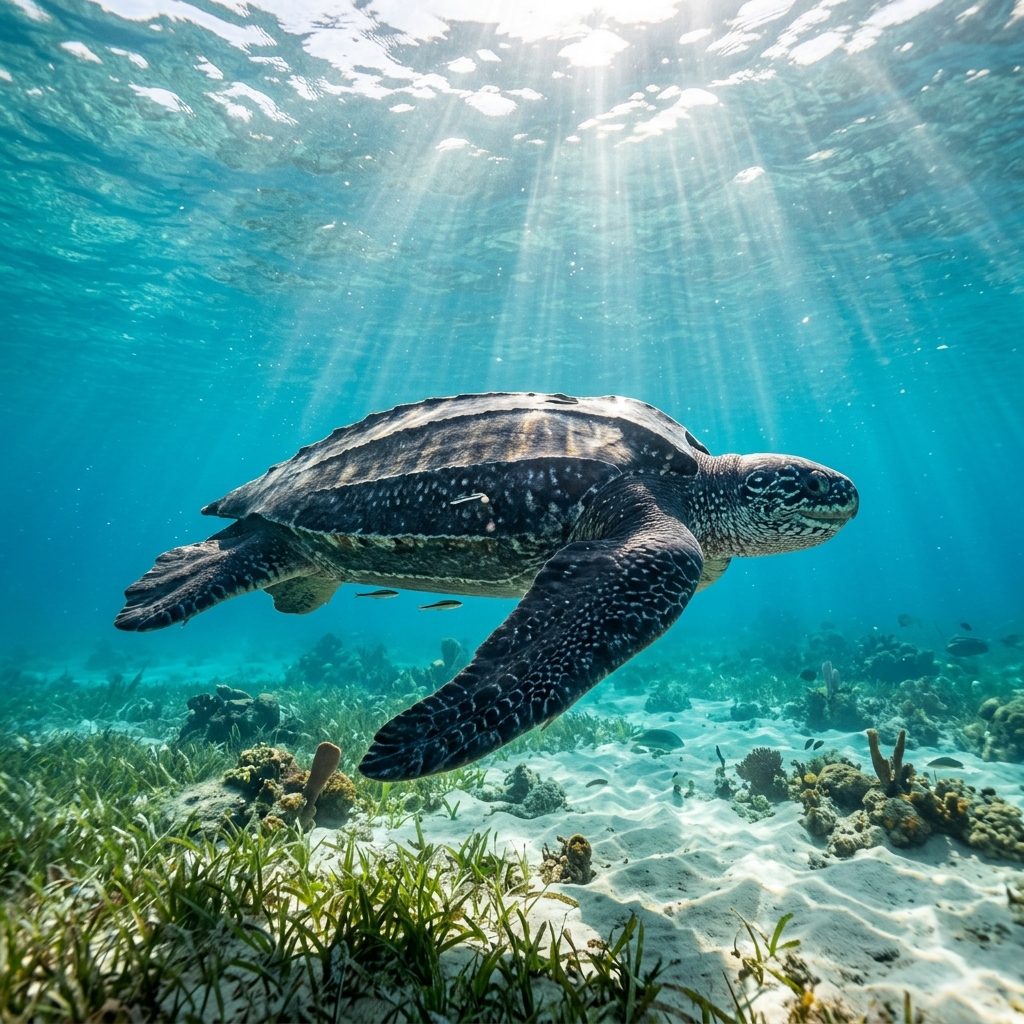
Dermochelys coriacea
Spot the world's largest turtle diving in South Australia. Rare but unforgettable, logged in water as cool as 12°C. Here's where and how to find one.
No other sea turtle looks quite like this one underwater: instead of a hard, scute-covered shell, it has a smooth, rubbery carapace (the upper shell) lined with seven raised ridges running from neck to tail. Colouration is deep black or dark grey with irregular pale or pinkish-white spots scattered across the body. Adults are enormous, easily dwarfing every other turtle species a diver is likely to encounter. The head is large and teardrop-shaped, with a distinctive notched upper jaw.
Leatherbacks are pelagic (open-water) animals and rarely linger around dive sites, so most encounters are brief passes rather than prolonged observations. They are not bothered by divers but are equally uninterested, typically maintaining a steady, powerful swimming rhythm without altering course. If you do cross paths with one, stay lateral and give it space; any attempt to approach from above or intercept its path will usually prompt it to dive deeper.
Leatherbacks can regulate their body temperature above the surrounding water temperature through a combination of their large body mass and specialised blood circulation, which is why they are the only sea turtle regularly found in cold temperate and even sub-polar seas.
There is not enough seasonal data to identify a peak month or window, so treat encounters as possible year-round. The species tolerates remarkably cool water, with logged sightings recorded down to around 12°C, so cold South Australian winters do not rule out a sighting.
Diver-logged sightings place leatherbacks in South Australia, making it the only region in the data with confirmed encounters. Sightings span several sites across the region, though all are rated rare. Anyone diving temperate South Australian waters should keep an eye on the blue water column rather than the reef itself, as leatherbacks are open-water travellers that pass through rather than reside.
Mapping where Leatherback is logged…
Diver-logged encounters come from South Australia, making it one of the few places in the world where you have a documented chance of crossing paths with one underwater. Sightings are rare at all known sites, and encounters tend to happen in open water rather than on the reef.
There is no clear seasonal peak in the available data, so sightings should be treated as possible at any time of year. Leatherbacks tolerate water temperatures well below what most sea turtles can handle, so even cold-water winter dives in South Australia are not out of the question.
No other sea turtle has a smooth, ridged, rubbery shell instead of hard plates. Look for seven prominent ridges running lengthwise along a black or dark grey back, pale spotting across the body, and an enormous size that makes every other turtle look small by comparison.
Leatherbacks are the largest turtles on Earth. Adults commonly reach 1.5 to 1.8 metres in shell length, and large individuals can exceed 2 metres. Their bulk is immediately obvious underwater; they are noticeably larger than any other turtle a diver is likely to encounter.
Unlike all other sea turtles, leatherbacks can maintain a body temperature above that of the surrounding water, a trait called gigantothermy, which works by combining their large mass with a counter-current heat exchange system in their flippers. This lets them feed in cold temperate and even sub-polar seas where jellyfish, their primary prey, are abundant.
Leatherbacks are listed as Vulnerable on the IUCN Red List, though certain regional populations are in a far more critical state. Key threats include accidental capture in fishing gear, plastic ingestion (plastic bags are mistaken for jellyfish), and nest disturbance. Logging your sightings helps researchers track where they are still occurring.
The Leatherback is listed as vulnerable by the IUCN. Observe from a distance, avoid touching or feeding it, and report sightings to local marine research organisations.
Leatherbacks are listed as Vulnerable globally, with some regional populations considered far more at risk. If you sight one, log it with as much detail as possible; citizen-science records from divers contribute meaningfully to population tracking for this species.
Site and sighting data is aggregated from diver logs, iNaturalist and GBIF. For taxonomy and conservation status:
Hawksbill Sea Turtle
1,659 sites