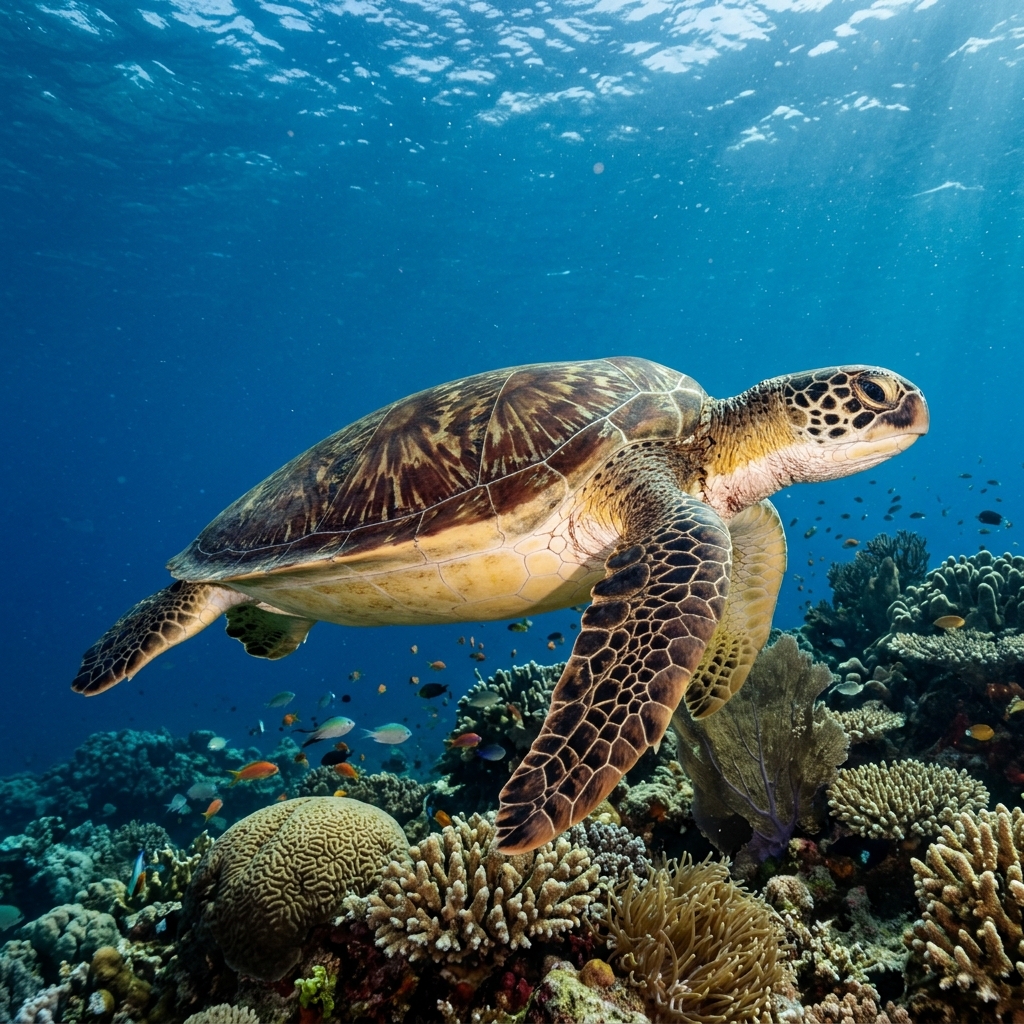
Chelonia mydas
Spot green sea turtles grazing on seagrass in Florida, Queensland, and the Maldives. Warm-water reefs between 22-28 °C hold them year-round.
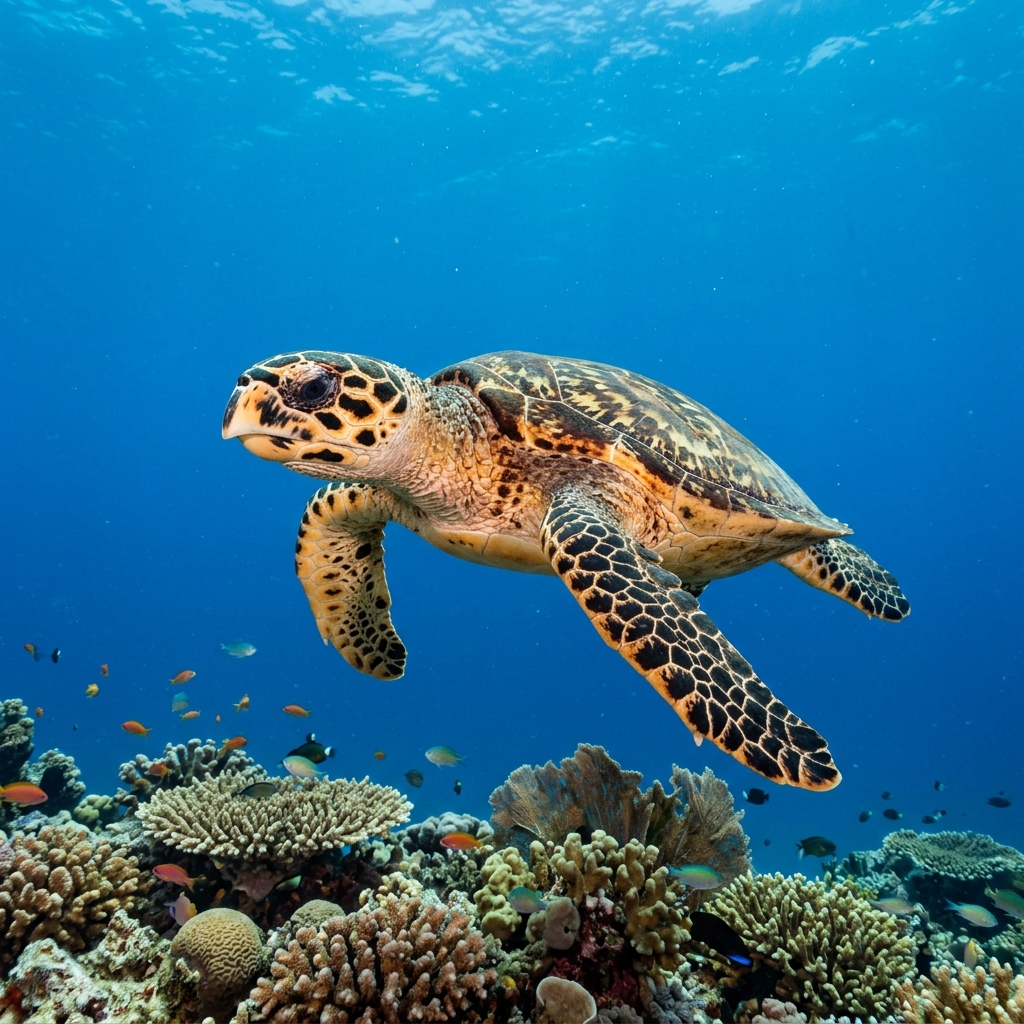
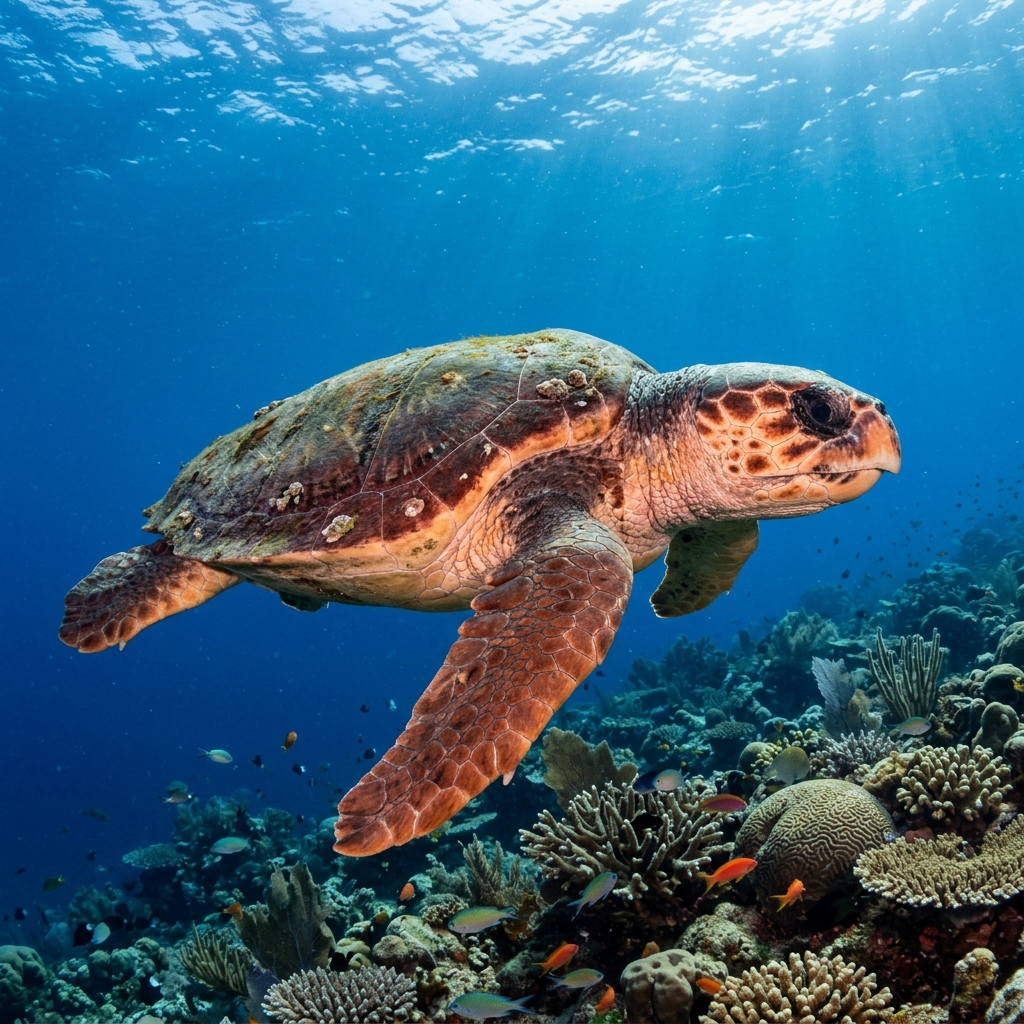
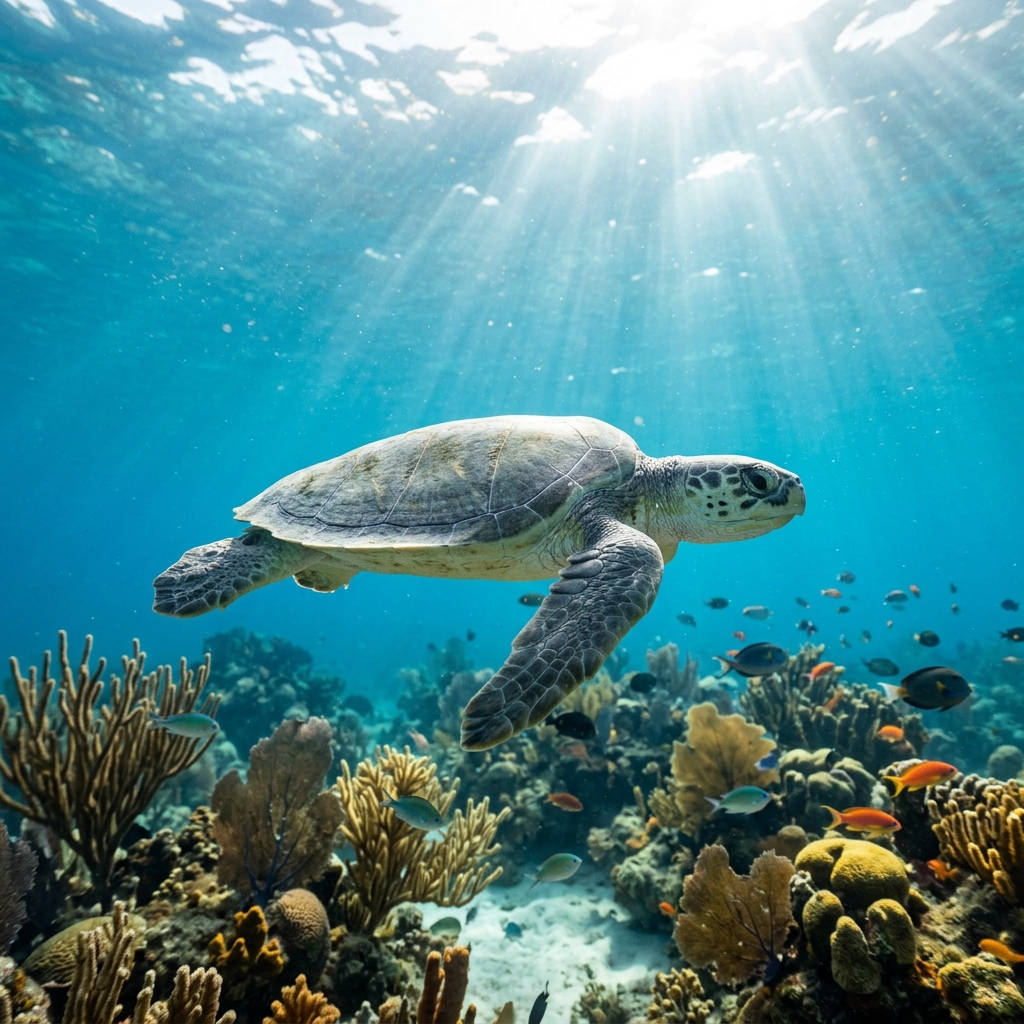
A large, smooth-shelled turtle reaching roughly 70-80 cm in the water, with an olive to dark brown carapace (upper shell) covered in warm, radiating streaks and blotches. The head is small and rounded for its body size, with a single pair of prefrontal scales between the eyes, which is the reliable field mark separating it from the hawksbill. Underwater, the overall impression is of a warm olive-brown animal with yellowish-cream undersides. Adult males are identifiable by a noticeably long, thick tail extending well beyond the rear edge of the shell, whereas females carry a short, tapered tail.
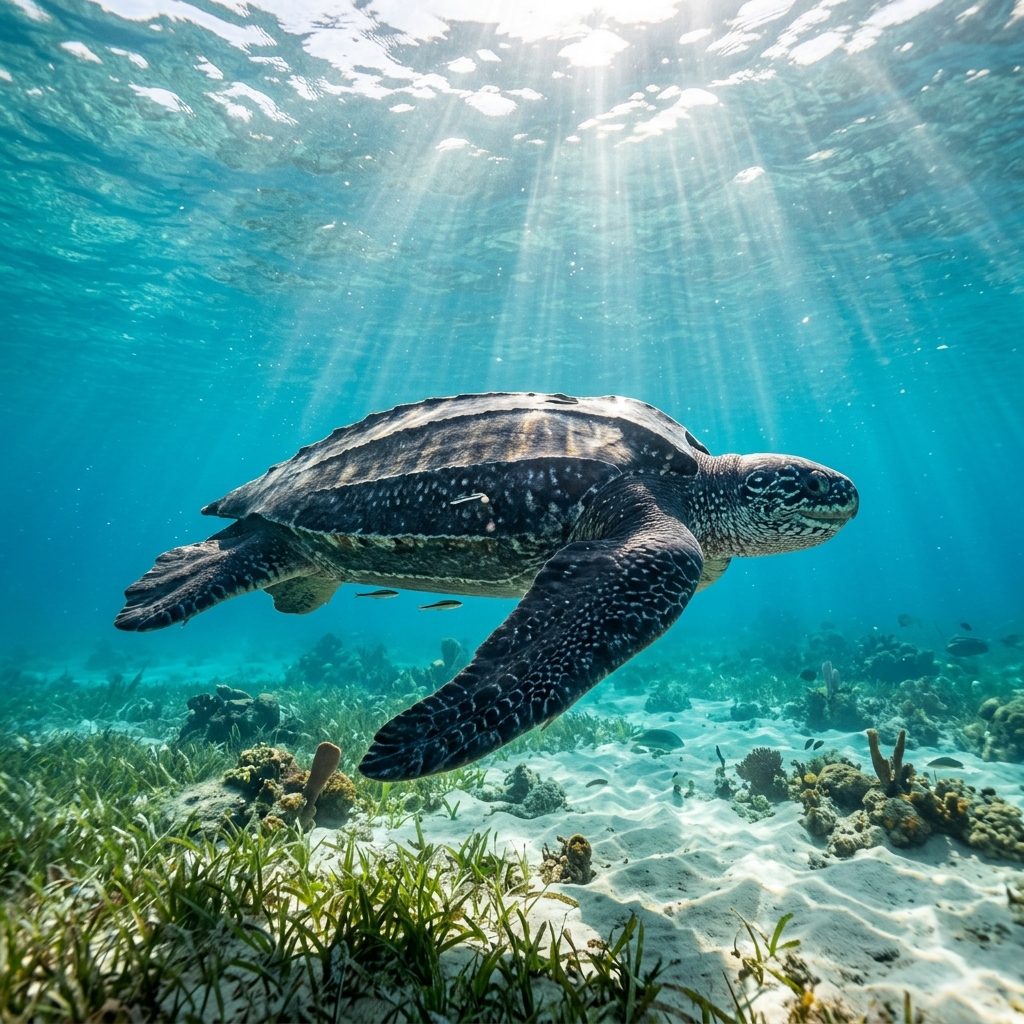
Most sightings catch green sea turtles grazing, pulling mouthfuls of seagrass or algae from the bottom with a deliberate, almost unhurried rhythm. They are notably calm around divers when feeding, often continuing to eat even when observers approach closely, though chasing or touching them disrupts that tolerance quickly. Shallower areas tend to be most productive at dawn and dusk when feeding activity picks up, but resting animals are also frequently spotted wedged under ledges or in sandy depressions at mid-depth.
Green sea turtles are unusual among sea turtles in being almost entirely herbivorous as adults. Cropping seagrass beds promotes new growth, making them active contributors to healthy seagrass ecosystems rather than simply inhabitants of them.
Their warm-water niche of roughly 23-29 °C means tropical and subtropical sites hold them year-round. In the Southern Hemisphere, sighting data concentrates from May through March, suggesting encounters thin slightly around April in those regions.
Reef neighbours a diver could mistake it for. Use the identification notes above to tell them apart.
Green sea turtles are most consistently logged across Florida and the broader US Southeast, Queensland, and the Maldives North and Central Atolls, with strong populations also recorded throughout the Philippines, Indonesia, Hawaii, and Brazil. The Yucatán Peninsula and Mexico's Caribbean coast are well-regarded encounter spots, and sightings are also regularly reported from Japan and New South Wales in Australia. With logged sites spanning more than a hundred countries, it is one of the most geographically widespread turtle encounters available to divers.
Mapping where Green Sea Turtle is logged…
The most reliable encounters are logged in Florida, Queensland, the Maldives North and Central Atolls, Hawaii, and throughout the Philippines and Indonesia. Brazil, Japan, Mexico's Yucatán Peninsula, and New South Wales also produce regular sightings. Their range spans tropical and warm-temperate seas worldwide.
On tropical reefs, green sea turtles are present year-round because their preferred water temperature of 23-29 °C matches those conditions throughout the seasons. In Southern Hemisphere locations, sighting records are strongest from May through March, with a modest dip around April.
Look for the olive-brown, smooth carapace with radiating streaks, a rounded head, and, critically, a single pair of prefrontal scales between the eyes. The hawksbill has two pairs of those scales and a noticeably hooked beak. The loggerhead has a much larger, broader head and a reddish-brown shell.
Most adults encountered on dives are in the 70-100 cm carapace length range, weighing roughly 100-150 kg, though large individuals can exceed 150 cm. The typical dive encounter involves animals around 70-80 cm, appearing solid and broad-bodied underwater.
No. Green sea turtles are peaceful herbivores and pose no threat to divers or snorkellers. Best practice is to approach slowly and avoid blocking their path to the surface, as they need to breathe every few minutes. Never touch, ride, or chase them.
Adults feed almost exclusively on seagrass and algae, which is unusual for sea turtles. This diet gives their body fat a greenish tint, the origin of their common name. You will often find them grazing slowly across seagrass beds in shallow, sheltered bays and lagoons.
Site and sighting data is aggregated from diver logs, iNaturalist and GBIF. For taxonomy and conservation status:
Leatherback
95 sites