Megaptera novaeangliae
Recognise a humpback whale underwater by its long white pectoral fins and knobbly head. Encountered in cold to warm waters from -0.5 to 26.8 °C worldwide.
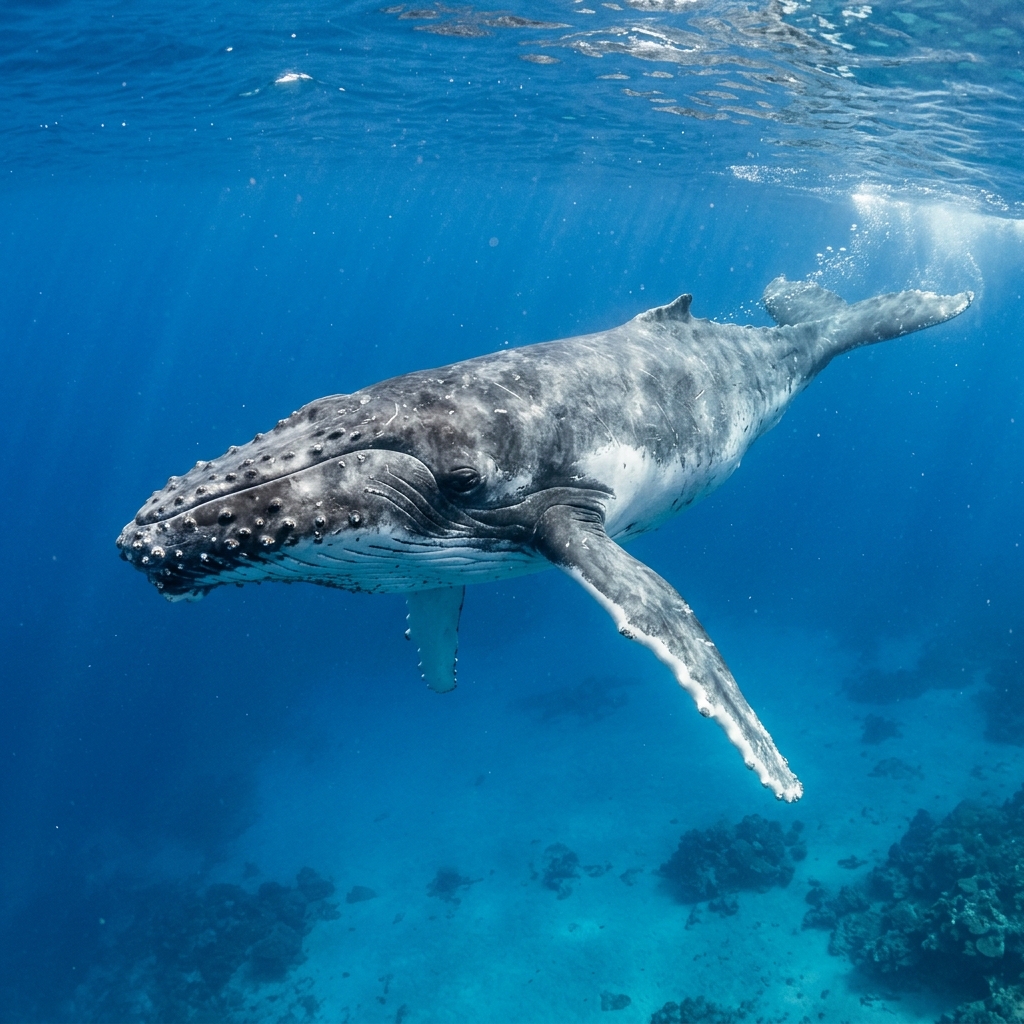
At 13 metres or more, humpbacks are unmistakable in open water. The key features to lock onto are the extraordinarily long pectoral (front) fins, which can reach a third of the body length and flash white or pale grey underwater. The head is broad and rounded, covered in fleshy knobs called tubercles, and the back shows a small, stubby dorsal fin set far down toward the tail. When diving or fluking (lifting the tail on a deep dive), the underside of the tail is uniquely patterned in black and white, like a fingerprint.
When you encounter a humpback, it is often doing one of a few things: cruising past with slow, powerful strokes, hovering curiously to investigate divers at a respectful distance, or, in breeding areas, performing rolls and lunges as males compete and display. Bubble-net feeding, where a group spirals upward releasing a curtain of bubbles to corral prey, is one of the most dramatic coordinated hunting behaviours in the ocean and can occasionally be observed from the surface. They are not aggressive towards divers, but their sheer size demands calm, unhurried movement on your part.
Male humpbacks produce some of the longest and most complex songs in the animal kingdom, lasting up to 20 minutes and audible for many kilometres underwater. During breeding season, these songs can actually be heard by divers in the water column before the whale is even visible.
Sighting data is not yet sufficient to identify a peak season on Fin, so treat encounters as possible year-round depending on location. The species tolerates water temperatures from below freezing to around 27 °C, meaning it can be present across both high-latitude summer feeding grounds and warm tropical wintering areas.
Reef neighbours a diver could mistake it for. Use the identification notes above to tell them apart.
Because our dive-site data for this species is still building, we cannot yet point to the most logged regions on Fin. Humpbacks are known to occur across all major ocean basins, from polar feeding grounds to tropical breeding areas, so encounters are possible in a wide range of destinations as more divers log their sightings.
Mapping where Humpback Whale is logged…
The long white pectoral fins are the single most reliable feature, easily visible as the whale banks or turns. Look also for the knobbly, broad head and the uniquely patterned black-and-white tail flukes when the animal dives. No other large whale combines all three of these features.
Adults typically reach around 13 metres in length, with females generally larger than males. In the water, the pectoral fins alone can stretch to around four metres, which gives an immediate sense of the animal's scale when it passes close by.
Humpbacks are not aggressive towards divers. The real consideration is their size; an accidental brush from a fin or tail could be serious. Move slowly, avoid positioning yourself directly in their path, and let the whale set the terms of any interaction.
Timing depends heavily on which population and which ocean you are in. In general, humpbacks spend summer months at high-latitude feeding grounds and migrate to warmer tropical or subtropical waters in winter to breed. Researching the specific migration cycle for your destination will give you the best chance of an encounter.
Bubble-net feeding is a cooperative hunting technique where a group of humpbacks dives below a school of fish or krill, then spirals upward while releasing a curtain of bubbles from their blowholes. The bubbles confuse and concentrate the prey into a tight column, and the whales lunge upward through it with mouths open. It is one of the few examples of coordinated tool use in non-human mammals.
Site and sighting data is aggregated from diver logs, iNaturalist and GBIF. For taxonomy and conservation status: