Parazoanthus axinellae
Bright yellow polyp colonies on Mediterranean reefs from the French Riviera to Croatia. Here's how to spot Yellow Zoanthid and where it's most reliably logged.
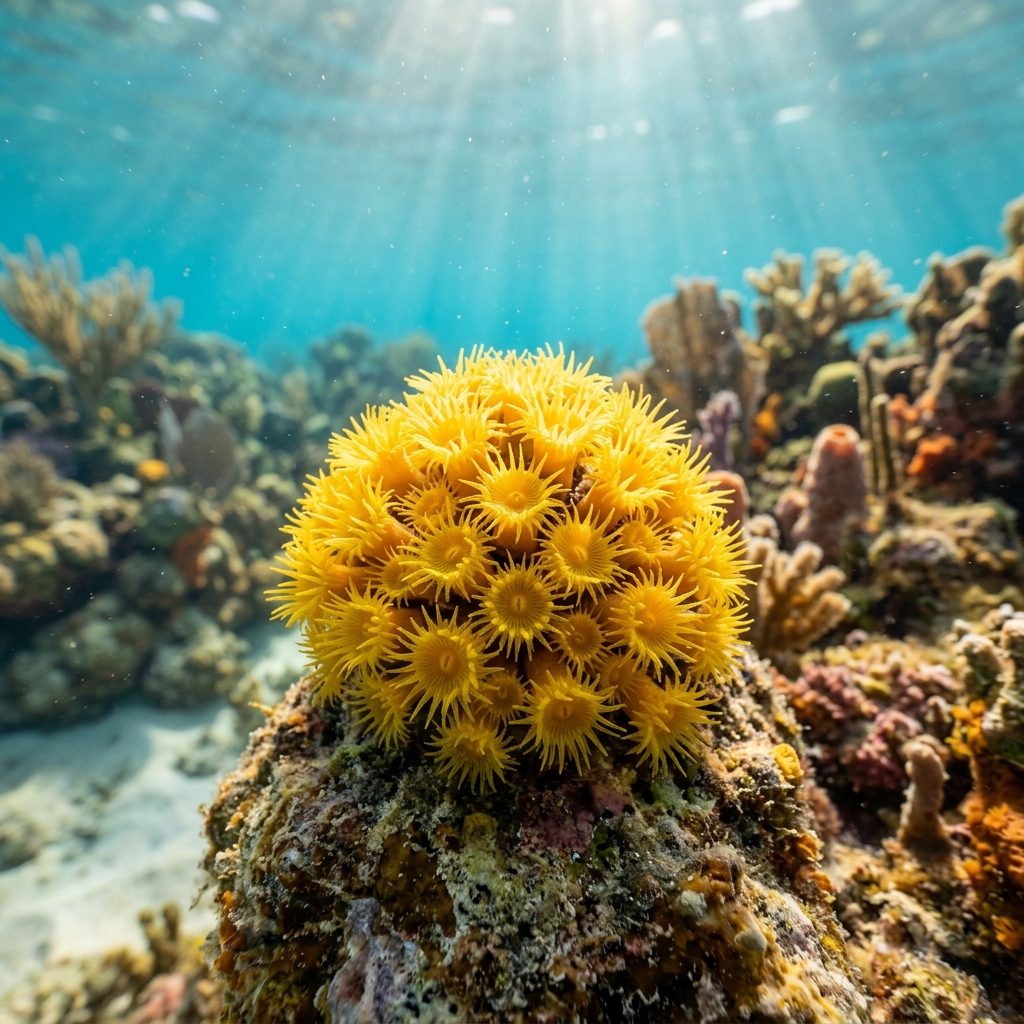
Bright sulphur-yellow is the giveaway: colonies appear as dense carpets of tiny polyps, each roughly 2 cm tall, with a ring of short tentacles framing a central disc. Look for them coating rocky walls, overhangs, and the surfaces of sponges, where the vivid yellow stands out sharply against grey or orange rock. The polyps retract when disturbed, leaving a wrinkled, bead-like surface, so approach slowly to see them fully extended.
Yellow Zoanthid does not move: the colony sits fixed to hard substrate, filter-feeding with extended polyps when conditions are calm. When a diver gets too close, brushes the colony, or stirs up silt, the polyps retract almost instantly into a contracted, dull mass. Give the colony a metre of space and hover still, and within a few minutes they will slowly reopen, making for a satisfying close-focus macro observation.
Each apparently individual polyp is connected to its neighbours through a shared tissue mat called a coenenchyme, meaning the whole colony functions as a single interconnected organism rather than a crowd of separate animals.
Sightings come in year-round with no concentrated peak season, which fits a species observed across a wide temperature window of roughly 10 to 24 degrees Celsius. As a sessile (permanently fixed) colonial coral, it is present on the reef whenever you dive there.
Reef neighbours a diver could mistake it for. Use the identification notes above to tell them apart.
Yellow Zoanthid is overwhelmingly a Mediterranean species, logged most heavily in France, Spain, and Italy, with the French Riviera and Provence, the Costa Brava, and the waters around Sardinia and Tuscany producing the strongest sighting records. Croatia's Kvarner Gulf and the Balearic Islands round out the core range, and there are solid populations in the United Kingdom and Ireland for Atlantic divers.
Mapping where Yellow Zoanthid is logged…
The Mediterranean is your best bet. France, Spain, Italy, Croatia, and Greece lead the sighting records, with particularly strong showings along the French Riviera, the Costa Brava, and around Sardinia. Atlantic populations in the UK and Ireland mean it is findable outside the Med too.
It is present year-round with no clear seasonal peak. Because it is a fixed colonial coral rather than a migratory animal, you can expect it on the reef on any dive throughout the year wherever it occurs.
Look for a carpet of tiny bright yellow polyps, each about 2 cm tall, coating rocky walls or sponge surfaces. The vivid sulphur-yellow colour is unmistakable when the polyps are extended. If disturbed they retract, leaving a dull, bumpy crust, so patience rewards you with a much better view.
Individual polyps reach around 2 cm in height, making them small but easy to spot due to their colour. The colony itself can spread across a much larger patch of rock, sometimes covering tens of centimetres of substrate.
Most divers who log it describe it as uncommon rather than common, meaning you may need to look carefully rather than expecting it front and centre. Targeted searches on rocky walls and beneath overhangs, particularly in Mediterranean sites, improve your chances considerably.
Site and sighting data is aggregated from diver logs, iNaturalist and GBIF. For taxonomy and conservation status: