Porifera
Sponges are found on reefs worldwide, from Florida to the UK to Japan. Learn what to look for and where they're most reliably seen by divers.
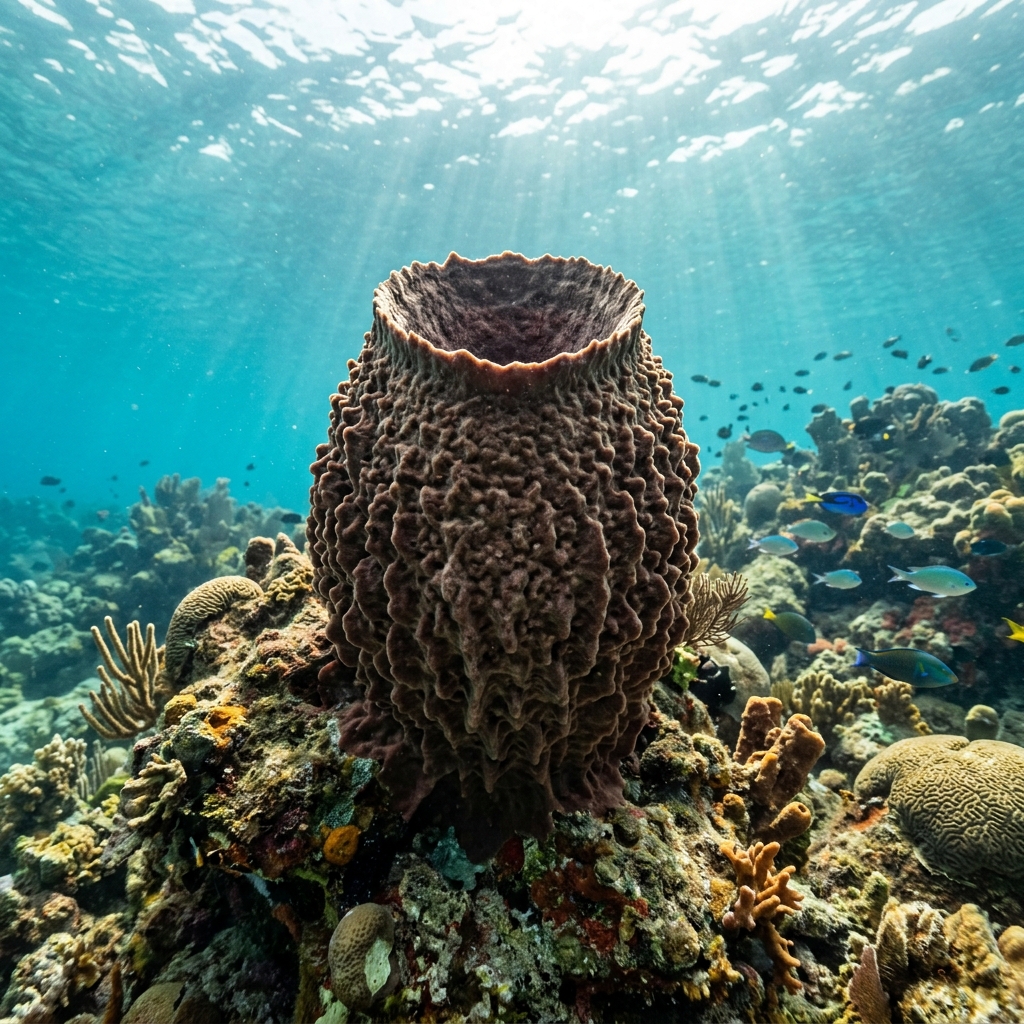
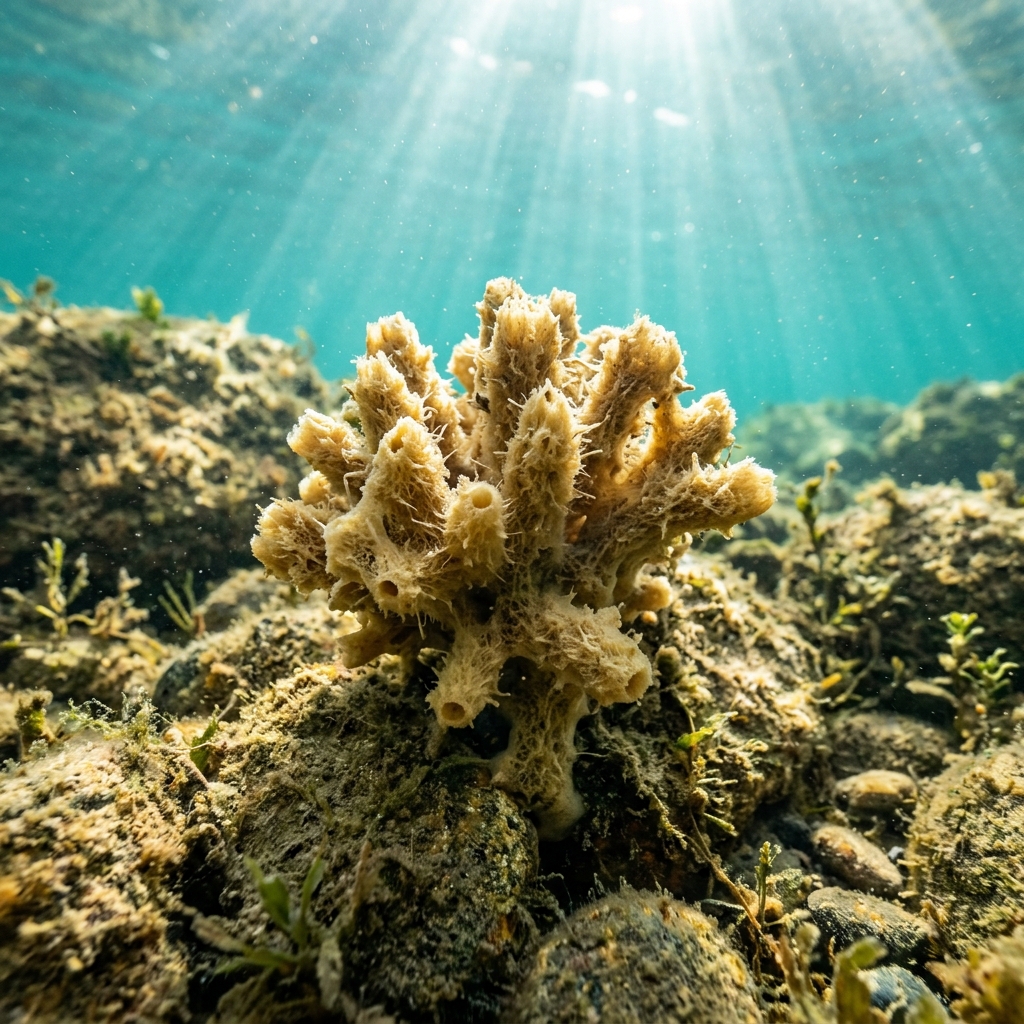
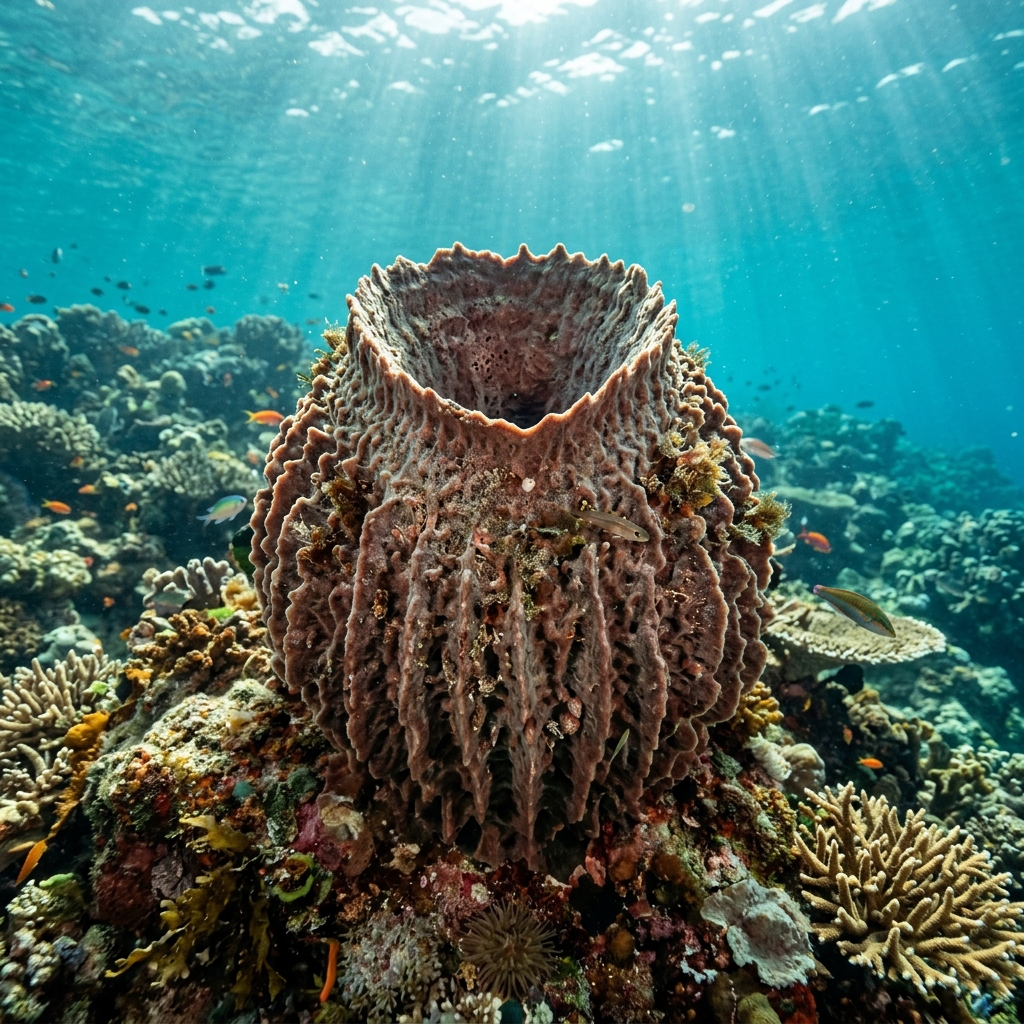
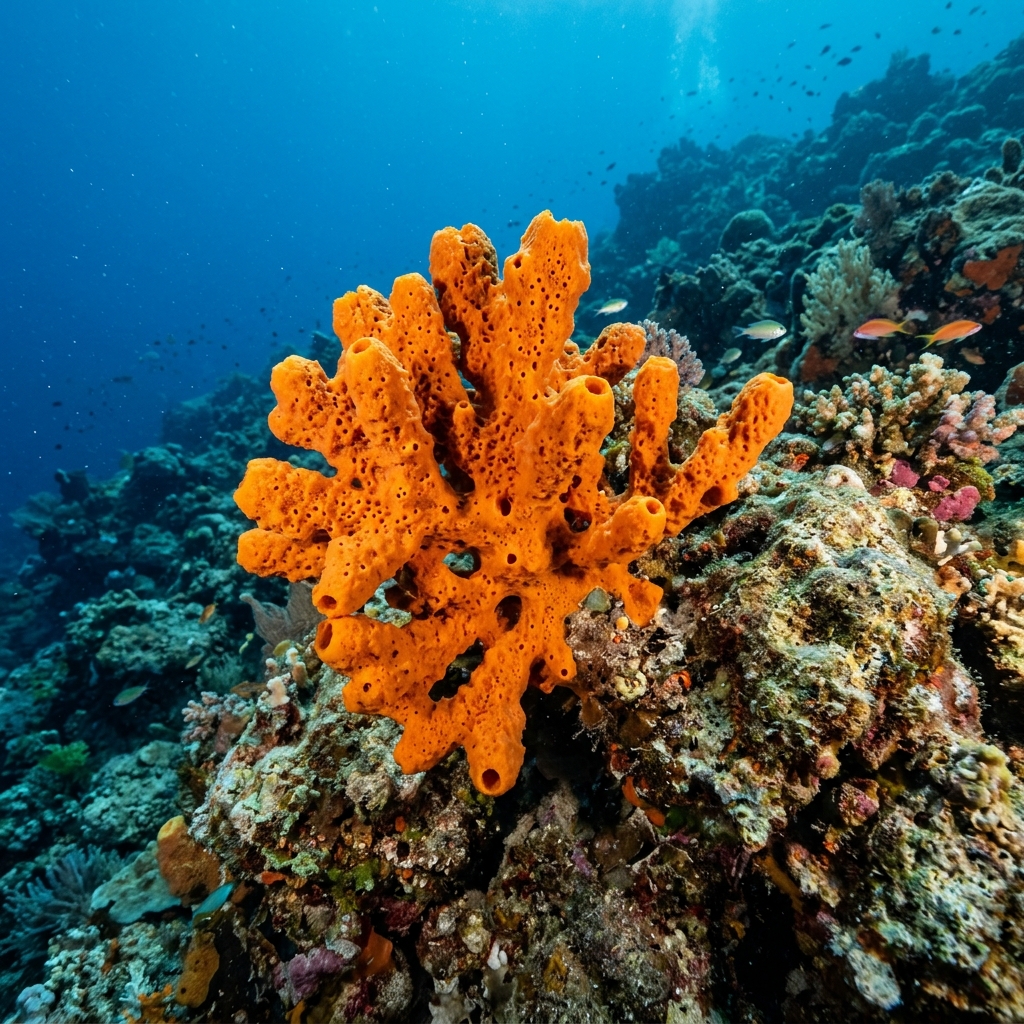
Sponges come in an enormous range of colours and growth forms, but the shapes divers most commonly key on are the barrel, tube, encrusting, and branching types. Barrel and tube sponges can grow to half a metre or more, making them some of the largest invertebrates on the reef; encrusting forms spread flat across rock surfaces in vivid reds, oranges, yellows, and purples. Look for the pores and openings (called oscula) on their surface, which are the clearest sign you are looking at a sponge rather than a coral or sea squirt. Colours vary enormously between species and even within a species, so shape and texture are more reliable ID cues than colour alone.
Sponges are permanently fixed to hard surfaces and never move, so you will always find them exactly where they were on your last dive. They feed by drawing water continuously through thousands of tiny pores to filter out bacteria and organic particles, a process happening constantly regardless of the time of day. They do not react to your presence at all, which makes them easy subjects for close observation, and it is worth pausing to look carefully at the surface and interior of larger individuals, as shrimps, gobies, brittle stars, and other small animals frequently shelter inside them.
Some of the largest barrel sponges are estimated to be hundreds of years old, making individual animals you pass on a dive among the oldest living organisms on the reef.
Sponges are present year-round at virtually every site where they occur, as they have no migration or breeding season that affects visibility and they tolerate water temperatures from below 8°C to nearly 27°C.
Reef neighbours a diver could mistake it for. Use the identification notes above to tell them apart.
Sponges are logged across an exceptionally wide range, appearing in tropical, temperate, and cold-water sites alike. They are most heavily logged in the United States, particularly across Florida and the Southeast, as well as in Italy, Australia, France, and the United Kingdom. Strong records also come from Greece, Japan, and Canada, including the cold-water sites of Nova Scotia and the Bay of Fundy, showing just how broadly tolerant sponges are as a group.
Mapping where Sponge is logged…
Sponges are logged at dive sites across more than a hundred countries, making them one of the most widely encountered invertebrate groups in diving. They are particularly well-recorded in Florida and the Southeast USA, around Italy and Greece in the Mediterranean, along the coasts of Australia, and in the cold-water sites of the UK, France, Canada, and Japan.
There is no peak season for sponges. They are year-round residents at every site where they occur and tolerate a wide temperature range, from cold temperate seas of around 7°C to warm tropical waters approaching 27°C. Any dive, any month, can produce good sponge encounters.
Look for the distinctive growth forms: barrels, tubes, fans, branching fingers, or flat encrusting sheets. The giveaway features are the visible pores and larger outflow openings called oscula on the surface. Unlike corals, sponges feel soft to compressible and have no hard calcium skeleton, though touching them should be avoided.
Most sponges divers encounter are in the 10 to 50 cm range, but large barrel and tube sponges regularly exceed a metre in height and diameter. A typical barrel sponge photographed on a Caribbean or Indo-Pacific reef is roughly the size of a car tyre or larger.
Sponges pose no direct threat to divers. Some species contain chemical compounds that can cause skin irritation if handled, so the sensible rule is look but do not touch. They do not sting or bite.
Sponges have no mouth, stomach, or digestive system. Instead, every cell in their body is in direct contact with water that is pumped continuously through a network of internal channels. They filter bacteria and dissolved organic matter directly at the cellular level, making them among the simplest multicellular animals alive.
Site and sighting data is aggregated from diver logs, iNaturalist and GBIF. For taxonomy and conservation status: