Sphyrna zygaena
Spot the smooth hammerhead in Florida, the Mediterranean, and beyond. A rare but real encounter across a wide temperature range. Here's where and how.
Safety warning
Smooth hammerheads are classed as potentially dangerous and should be treated with respect, even though unprovoked attacks on divers are extremely rare. Keep movements slow and deliberate, avoid cornering the animal, and give it a clear exit route. Do not attempt to touch or chase it, and exit the water calmly if the shark shows signs of agitation such as exaggerated swimming movements or a hunched posture.
If you're bitten
BiteGeneral first-aid guidance, not a substitute for professional medical care. In an emergency, call your local emergency number.
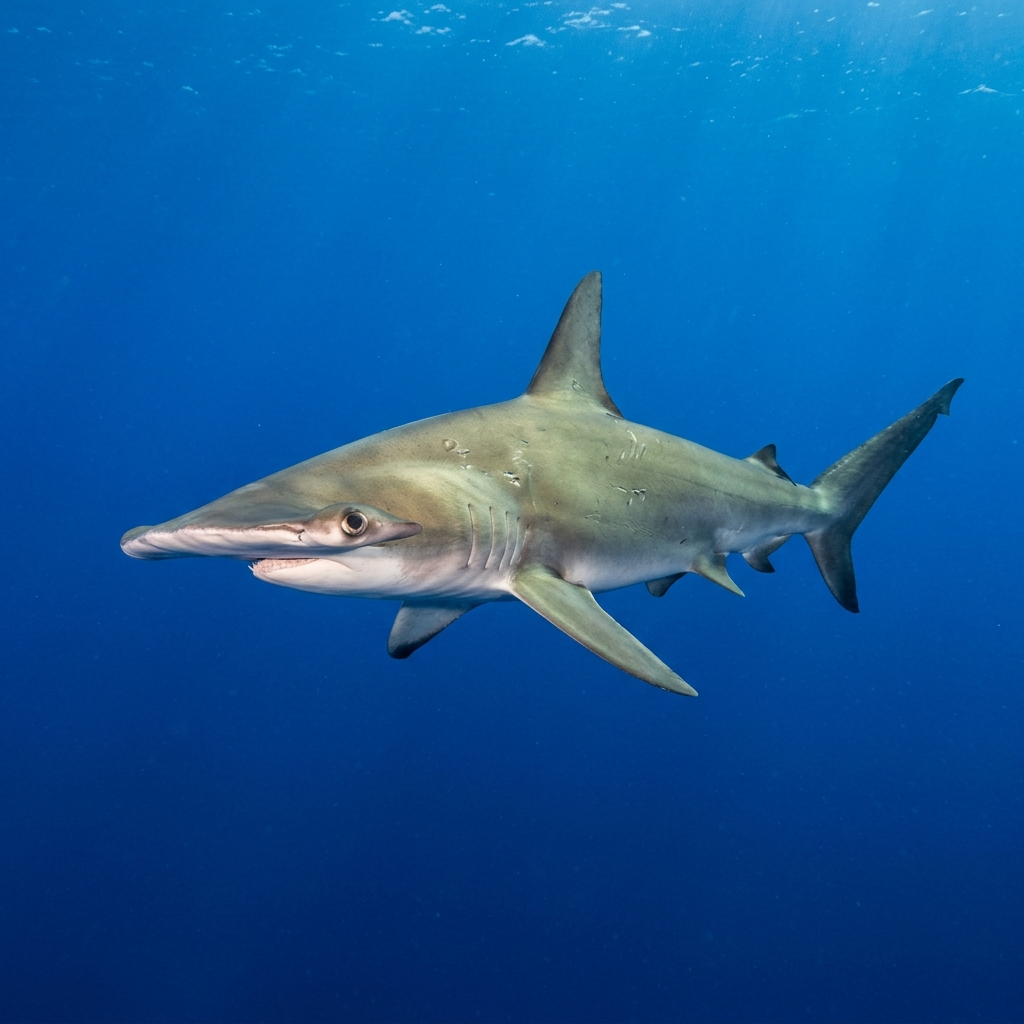
That wide, hammer-shaped head with a smoothly curved front edge and no central notch is the key mark, separating it from every other hammerhead at a glance. In the water it appears grey-brown to olive on top and pale or white underneath, and at up to 3.5 metres it is a large, slender-bodied shark. The front edge of the cephalofoil (the hammer-shaped head structure) bows gently forward in one unbroken arc, which is the fastest way to rule out the scalloped hammerhead. Females run noticeably larger than males, and males can be identified close-up by the paired claspers visible behind the pelvic fins.
When you meet one, it is usually cruising steadily through open water, tilting that wide head from side to side to sweep its widely-spaced eyes and electroreceptors across the water column. These sharks are wary rather than bold, and will typically keep their distance or swing away if you move toward them directly. Your best chance of a longer look is to stay calm, hold position, and let the shark decide how close it wants to come.
The smooth hammerhead ranges further into cold, temperate water than most other hammerhead species, which is why it shows up regularly around the Mediterranean and the English south coast rather than being confined to the tropics.
There is not enough monthly sighting data to point to a peak season, so encounters should be treated as possible year-round. The species tolerates a wide temperature band, roughly 12 to 29 °C, which matches its presence across both Mediterranean and subtropical Atlantic destinations in any month.
Reef neighbours a diver could mistake it for. Use the identification notes above to tell them apart.
Most sightings are logged from the United States, with Florida and the Southeast standing out as the strongest region by a wide margin. The Mediterranean is the next best bet, with records spread across Greece, Italy, Croatia, Turkey, France, and Spain, particularly around the Attica coast, Central Dalmatia, and Sardinia. Mexico also appears in the data, rounding out a spread that covers both temperate and warm-water coastlines.
Mapping where Smooth Hammerhead is logged…
The strongest concentration of logged sightings sits in Florida and the broader US Southeast. The Mediterranean is also well represented, with Greece, Italy, Croatia, and Turkey all featuring in the data, particularly around the Attica coast and Central Dalmatia. Mexico rounds out the top destinations.
No clear seasonal peak has emerged from available sighting data, so encounters are best treated as year-round possibilities. The species tolerates water temperatures from around 12 °C to nearly 29 °C, meaning it is active across both temperate Mediterranean winters and warmer subtropical summers.
Look at the front edge of the hammer-shaped head. On a smooth hammerhead it forms a single unbroken forward-bowing arc with no central indent or notch. The body is grey-brown above and pale below, and the animal can reach 3.5 metres. That clean, notch-free cephalofoil is the fastest field mark against other hammerhead species.
They are classed as potentially dangerous, but unprovoked attacks are very rare. They tend to be wary of divers and usually keep their distance or withdraw. Slow movements, no chasing, and giving the shark room to leave are the standard rules for a safe encounter.
They are currently listed as Vulnerable on the IUCN Red List, one step below Endangered. Populations have declined substantially due to fishing pressure across their range. Reporting diver sightings to citizen-science databases helps researchers track where populations persist.
The Smooth Hammerhead is listed as vulnerable by the IUCN. Observe from a distance, avoid touching or feeding it, and report sightings to local marine research organisations.
Listed as Vulnerable on the IUCN Red List, this species has suffered significant population declines driven by targeted fishing and bycatch pressure. Divers can help by reporting sightings to citizen-science platforms and supporting shark-focused marine protected areas.
Site and sighting data is aggregated from diver logs, iNaturalist and GBIF. For taxonomy and conservation status: