Sphyrna mokarran
Spot great hammerheads in the Maldives, Florida, and Queensland. Warm-water reef encounters year-round with one of the ocean's most distinctive sharks.
Safety warning
Great hammerheads are listed as dangerous to divers, though unprovoked attacks are rare. Their wariness often works in your favour, but a large, curious individual should be given plenty of space. Avoid blocking its path or making fast movements toward it. Do not attempt to touch or ride the shark, and if one begins making tight, repeated passes, end the dive calmly and ascend.
If you're bitten
BiteGeneral first-aid guidance, not a substitute for professional medical care. In an emergency, call your local emergency number.
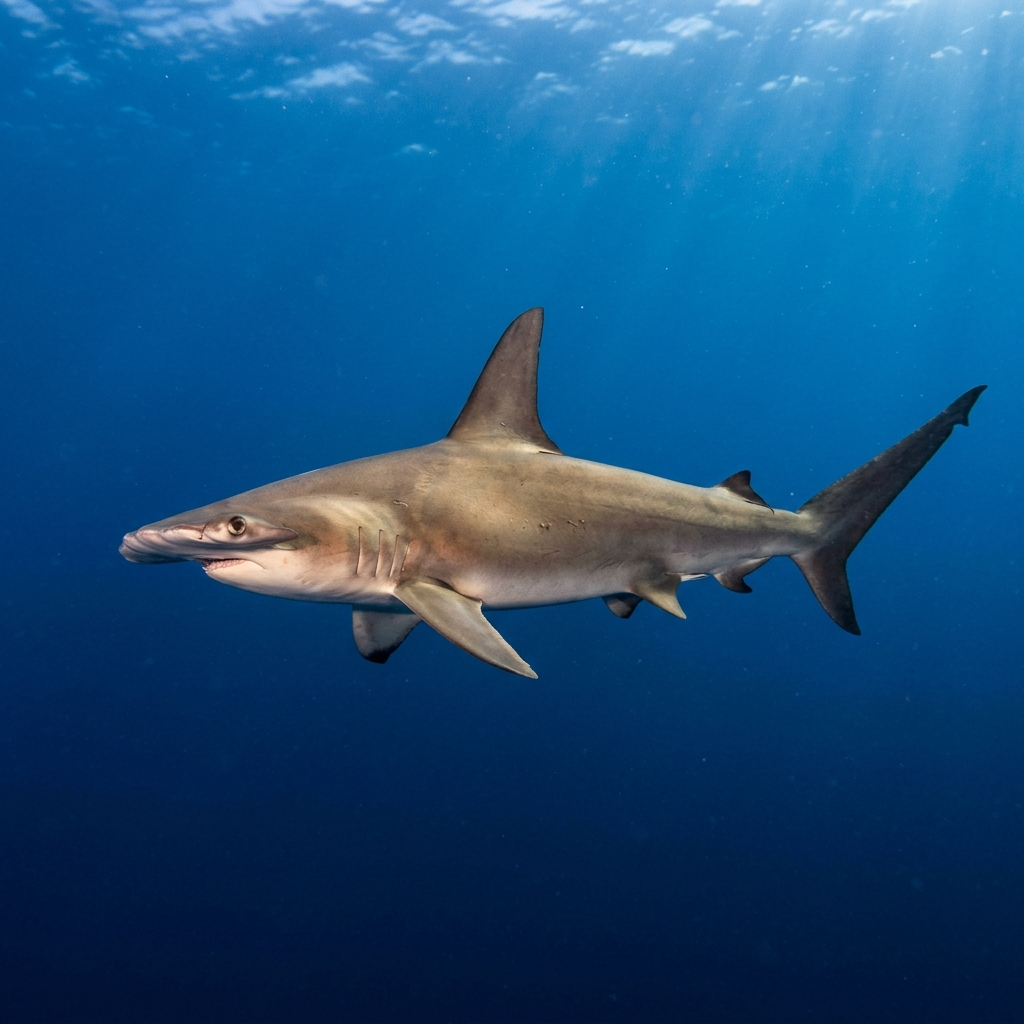
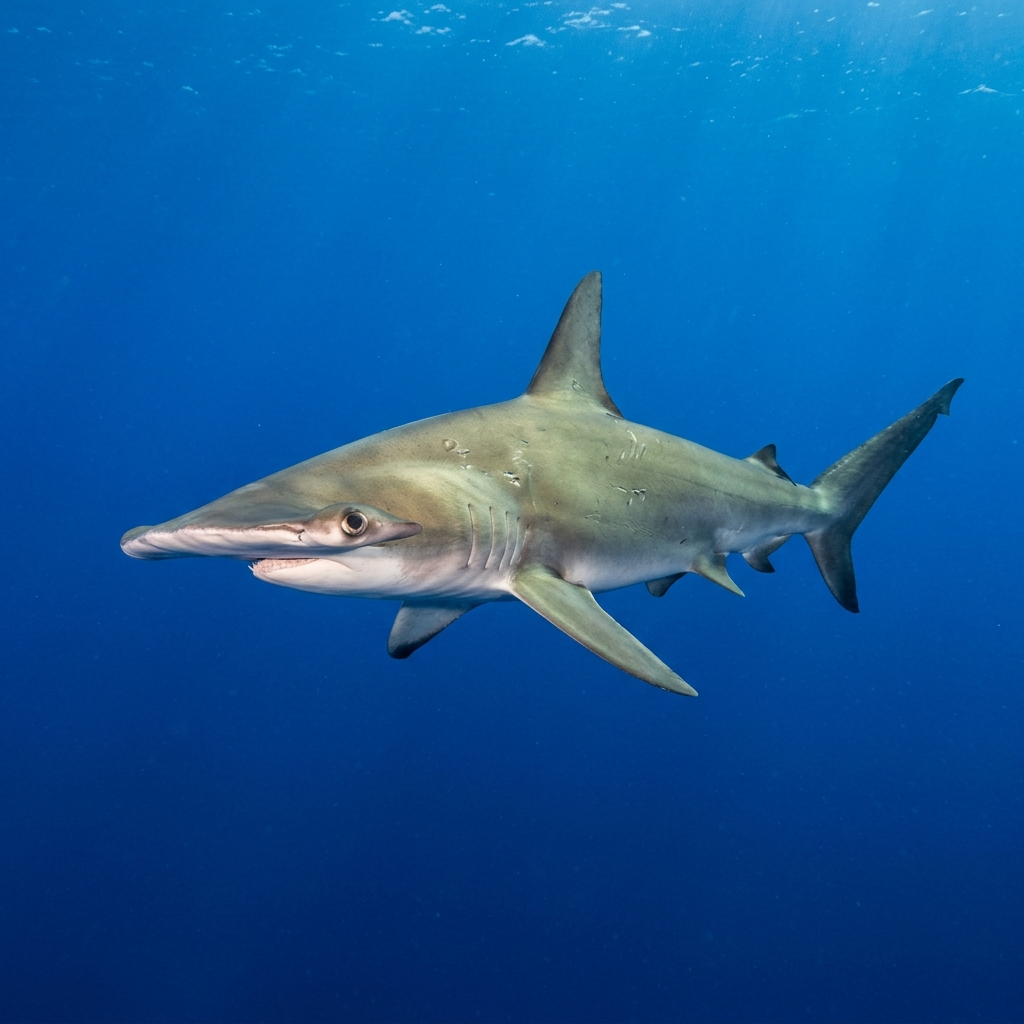
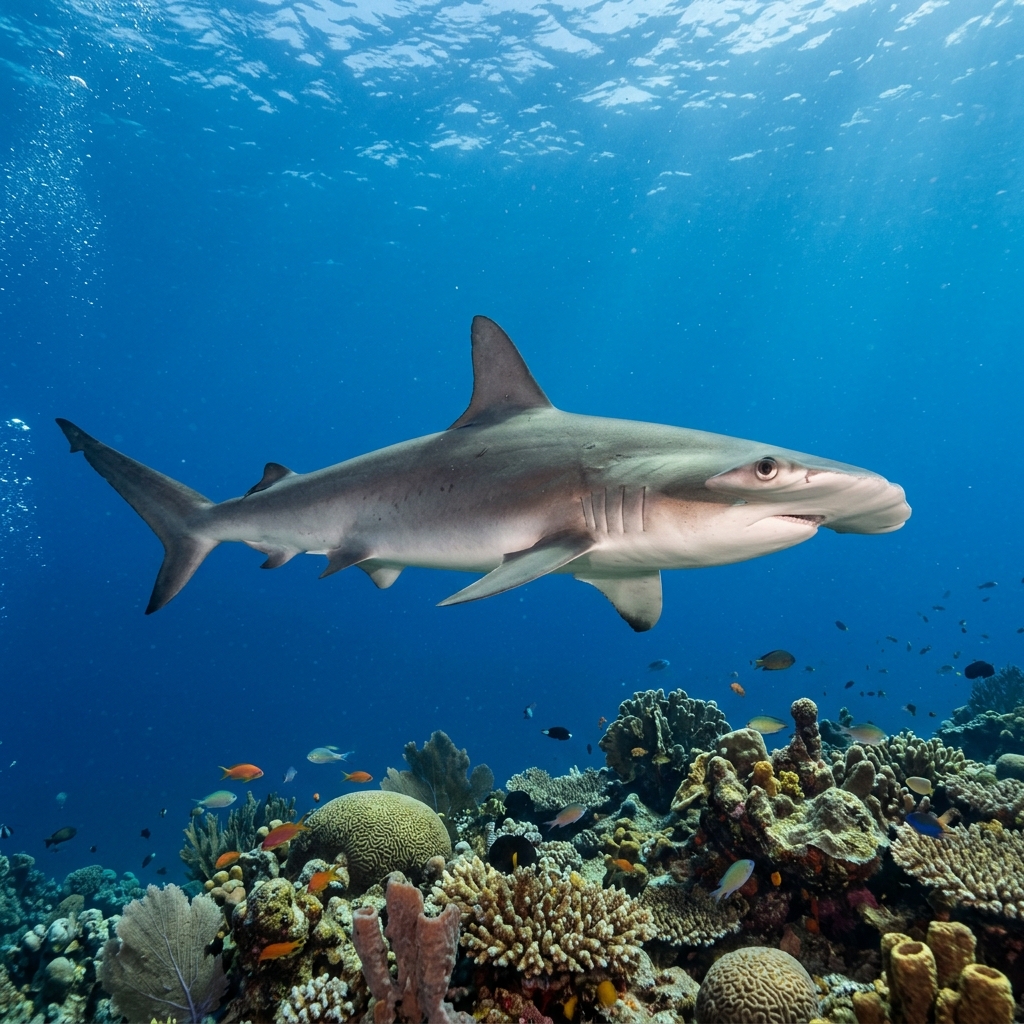
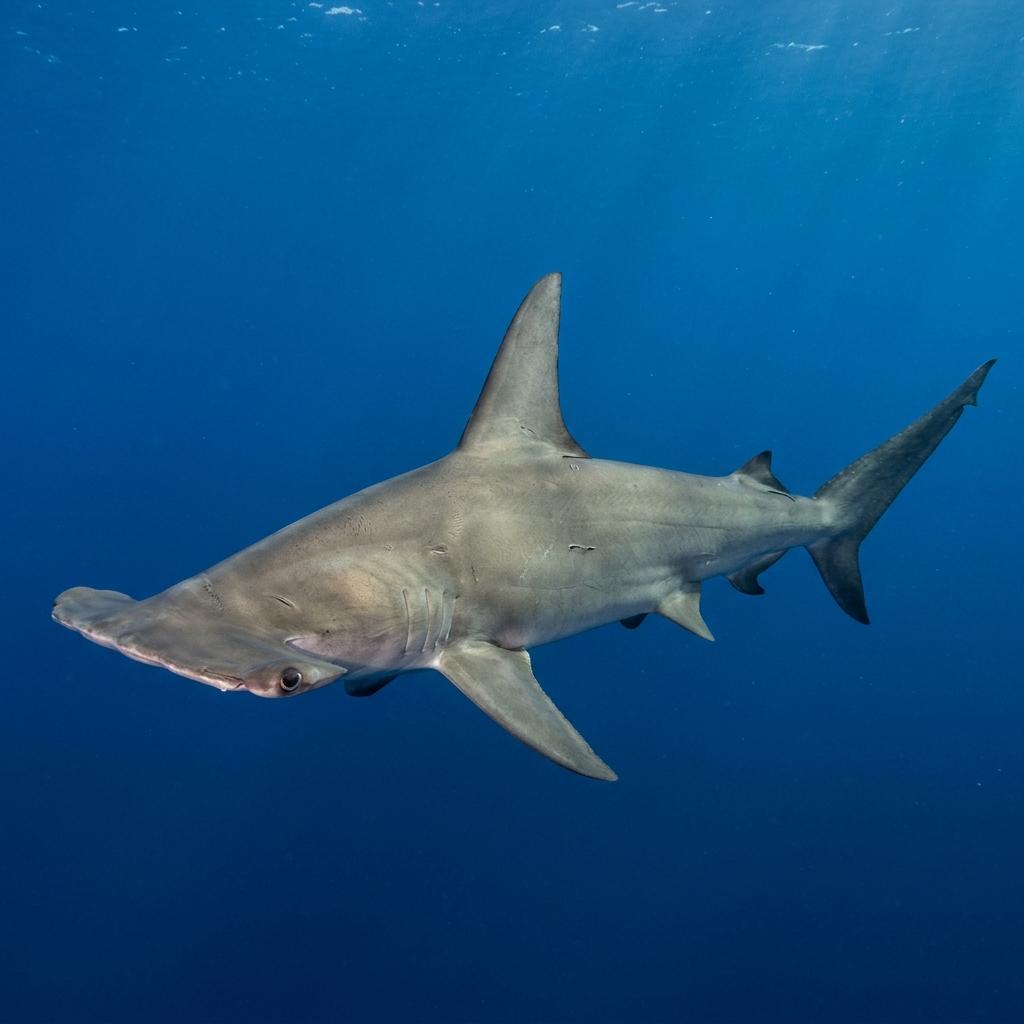
That wide, flat, nearly straight-edged hammer (cephalofoil) is the immediate giveaway - it looks squared-off compared to the arched head of a scalloped hammerhead. At up to four metres-plus, this is by far the largest hammerhead you are likely to encounter, and the tall, sickle-shaped first dorsal fin is unmistakable. Colouration is brownish-grey on top and pale white beneath, with no bold markings. Females run noticeably larger and heavier-bodied than males, so a particularly big, thick individual is almost certainly a female.
Great hammerheads are solitary patrollers - you won't find them schooling - and most encounters are one-on-one as the shark works reef edges and sandy flats. They tend to be wary, often swinging wide or peeling away if approached directly, so staying calm and still gives you a much better chance of a close pass. Watch for the characteristic side-to-side sweeping of the head across the seafloor: that's the shark using its electroreceptors to hunt for buried stingrays, and it's one of the more compelling things you can see on any reef dive.
The hammer itself acts as a hydrodynamic wing as well as a sensory array, generating lift that helps the shark make tight, rapid turns when pinning stingrays to the seafloor before biting off their pectoral fins.
Sighting data does not point to a single peak season, so encounters are treated as year-round. The species occupies water between roughly 21 and 29 °C, which matches tropical and warm subtropical reefs where most of these sites sit.
Reef neighbours a diver could mistake it for. Use the identification notes above to tell them apart.
The Maldives sees the highest concentration of logged sites, with the North and Central Atolls and Felidhoo and Mulaku among the most frequently referenced regions. Florida and the broader southeastern United States is the next strongest area, followed by Queensland, Australia. Cuba, Colombia, Venezuela, the Bahamas, and Mexico also feature across the range.
Mapping where Great Hammerhead is logged…
The Maldives is the most reliably logged destination, particularly the North and Central Atolls and the Felidhoo and Mulaku regions. Florida's southeast coast and Queensland, Australia also have strong site coverage. Cuba, the Bahamas, Colombia, Venezuela, and Mexico round out the top destinations.
Sighting records don't show a clear seasonal peak, so encounters are considered possible year-round across their range. They favour water between about 21 and 29 °C, which means tropical reef destinations in the Maldives, Queensland, and Florida can all produce sightings at any time of year.
They are the largest of all hammerhead species, commonly reaching around 3.5 to 4 metres and occasionally exceeding that. Females grow significantly larger than males. In the water, the sheer bulk and that tall first dorsal fin make a big individual look impressively large.
Look at the front edge of the hammer: on a great hammerhead it is almost straight with just a small central notch, while a scalloped hammerhead has a more curved, notched leading edge. Great hammerheads are also considerably larger and have a proportionally taller, more swept-back first dorsal fin.
They are considered potentially dangerous, but unprovoked attacks are uncommon. Most individuals are cautious and will move away if approached. Keep your distance, avoid erratic movement, never block the shark's path, and exit the water calmly if one becomes persistently close.
Yes. They are listed as Critically Endangered by the IUCN, primarily due to demand for their large fins and incidental capture in commercial fisheries. Populations have declined sharply in many parts of their range, making every dive encounter a relatively rare privilege worth documenting.
The Great Hammerhead is listed as critically endangered by the IUCN. Observe from a distance, avoid touching or feeding it, and report sightings to local marine research organisations.
Great hammerheads are Critically Endangered on the IUCN Red List, driven by pressure from the fin trade and bycatch. If you dive with them, record your sighting in citizen-science logs and choose operators who enforce a no-touch, no-feed policy.
Site and sighting data is aggregated from diver logs, iNaturalist and GBIF. For taxonomy and conservation status: