Pycnogonida spp.
Sea spiders turn up in cold water from Zeeland to Nova Scotia. Here's how to spot them, where divers log them most, and what to look for.
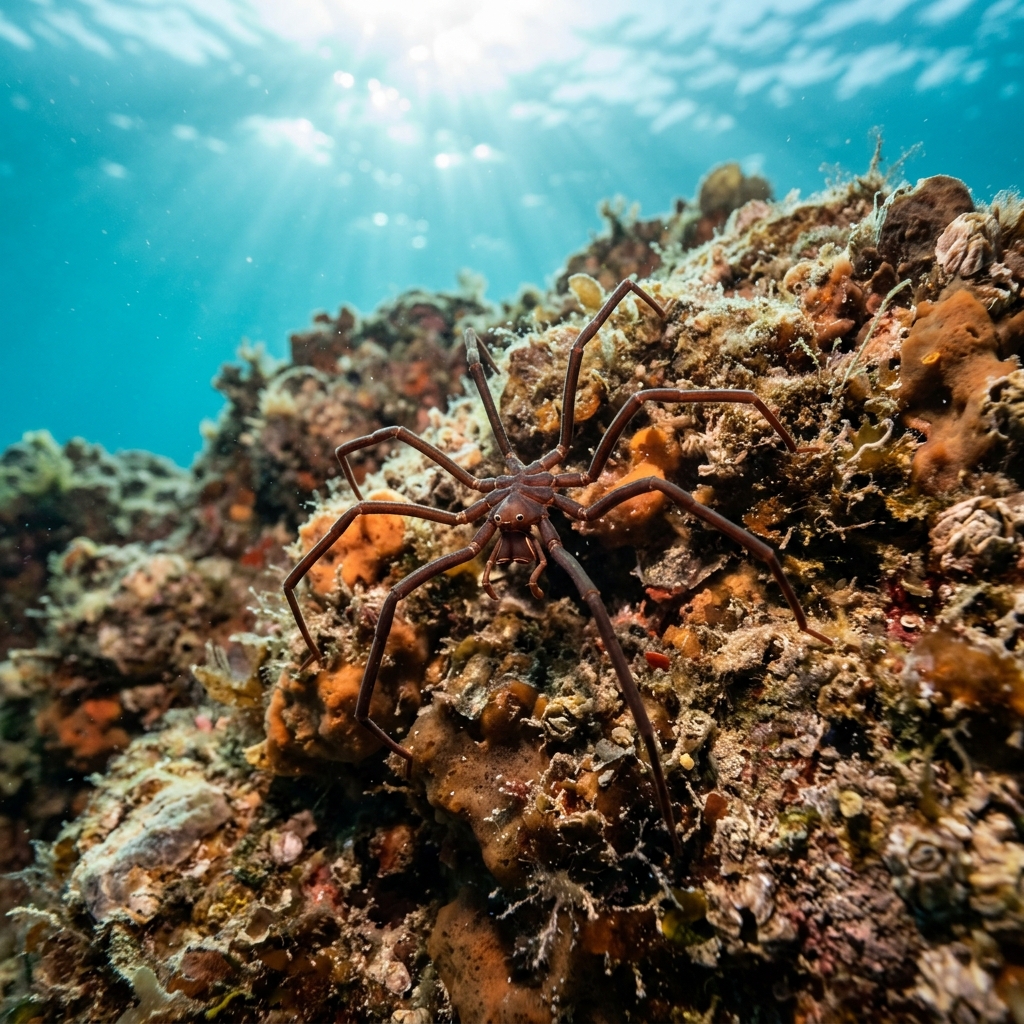
Eight (sometimes ten or twelve) extraordinarily long, thread-like legs radiating from a body so reduced it barely qualifies as a torso. The abdomen is almost non-existent, and the internal organs spill into the legs because there simply isn't room in the body proper. Colour ranges from pale cream and orange to dark brown or mottled grey depending on species, but the spider-like silhouette on rock, bryozoan (colonial animals that form lacy crusts), or hydroid is usually enough to identify the group at a glance. Most are tiny, a centimetre or two across, though polar and deep-water forms can be dramatically larger.
When you encounter one, it is almost always moving slowly across a hard substrate, picking at hydroids, bryozoans, or soft corals with its proboscis (a tube-like feeding appendage). They ignore divers entirely, so you can hover close and watch the deliberate, almost mechanical leg movements without disturbing them. Look on the underside of ledges, on sponge surfaces, and among fine branching hydroids where their camouflage makes them easy to miss.
Male sea spiders carry the eggs. After fertilisation, the father gathers the egg masses onto specialised leg-like appendages called ovigers and broods them until they hatch, a role reversal that surprises most divers who learn of it.
Northern Hemisphere data does not point to a single concentrated season, so they are potentially findable year-round in temperate waters. In the Southern Hemisphere, the limited available data suggests sightings concentrate between November and March, which aligns with the austral summer.
Sea spiders are most commonly logged across temperate and cold-water destinations, with strong records in Canada, the United States, the United Kingdom, France, Italy, Greece, the Netherlands, and Australia. Regional hotspots include Zeeland in the Netherlands, Brittany and Normandy in France, the St. Lawrence and Bay of Fundy in Canada, and the Izu Peninsula in Japan. Florida and the Southeast United States also hold notable records, showing the group reaches into warmer margins too.
Mapping where Sea Spider is logged…
They are logged across a wide spread of temperate and cold-water countries. Zeeland in the Netherlands, Brittany and Normandy in France, Nova Scotia and the St. Lawrence in Canada, and the Izu Peninsula in Japan are among the most consistently recorded regions. The United Kingdom, Italy, Greece, and Australia also hold strong records.
In temperate Northern Hemisphere destinations they are findable throughout the year, as they tolerate a wide temperature range from just below freezing to around 23°C. Southern Hemisphere divers see them most often between November and March based on current records.
Look for an animal that is almost entirely legs: eight very long, thin limbs attached to a minuscule central body. The lack of any obvious abdomen is the giveaway. They cling to hydroids, bryozoans, and sponges and move with a slow, deliberate crawl. Colour varies from cream to orange to dark brown.
Most species encountered on recreational dives are small, typically one to three centimetres across the leg span. Polar and deep-water species can reach considerably larger sizes through a phenomenon called polar gigantism, but those are rarely seen by sport divers.
No. Despite the name and the superficially spider-like appearance, sea spiders belong to their own distinct class, Pycnogonida, within the arthropods. They share a distant common ancestor with true spiders and crabs but are not closely related to either. Their most unusual feature is that their organs extend into their legs because the body is too small to contain them.
Site and sighting data is aggregated from diver logs, iNaturalist and GBIF. For taxonomy and conservation status: