Limulus polyphemus
Spot horseshoe crabs diving the US East Coast, from Florida to the Northeast. Sightings peak Dec, Sep in waters as cool as 5°C. Here's where to look.
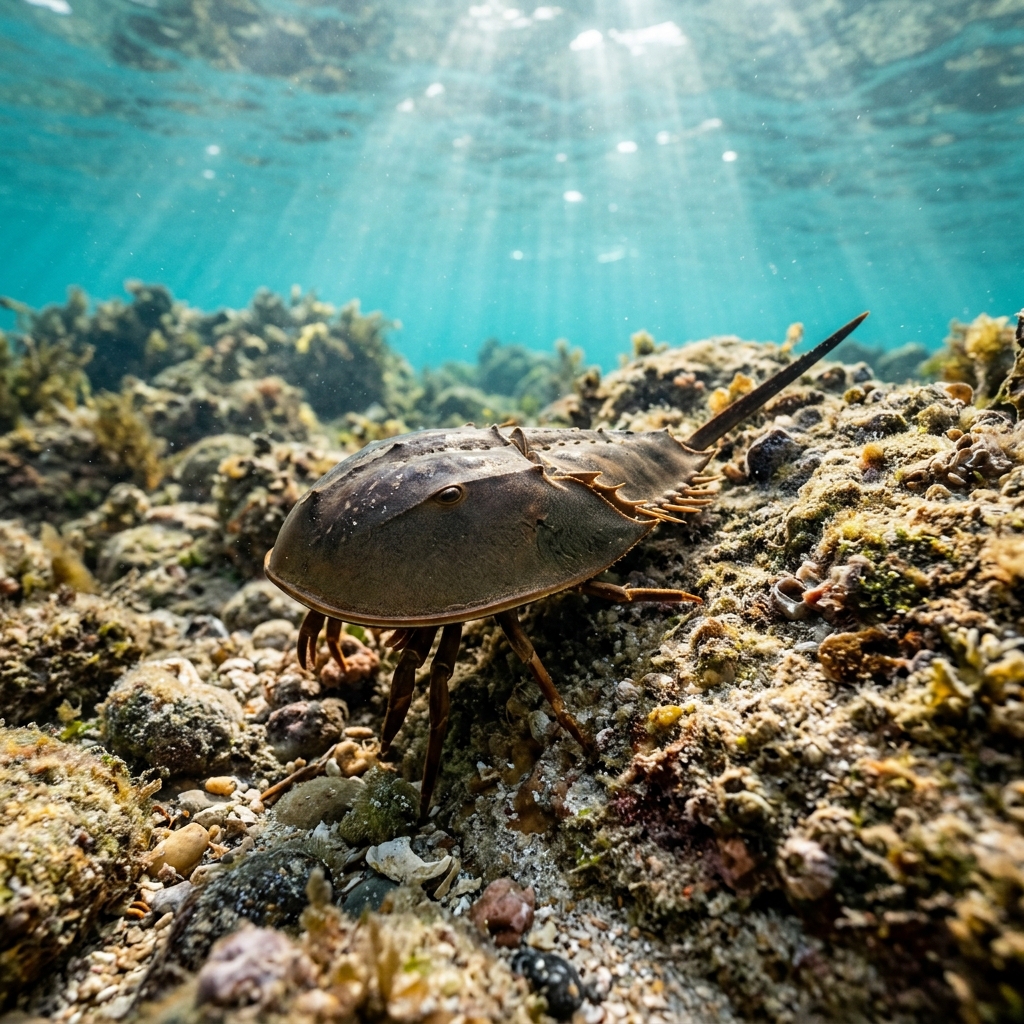
That domed, olive-brown horseshoe-shaped shell (the prosoma) is unlike anything else on the seafloor, broad at the front, tapering into a rigid, spike-like tail called a telson. Underneath, you'll see a cluster of book gills and five pairs of walking legs, all working together in an unhurried shuffle across sand or mud. Adults are sizeable animals; females are noticeably larger than males. The overall silhouette is so distinctive that misidentification is almost impossible once you've seen one.
Most encounters are of individuals ploughing slowly across sandy or muddy bottoms in very shallow water, seemingly indifferent to divers hovering overhead. During spring spawning, large numbers gather in the surf zone and just beyond, with smaller males clustering around the larger females, one of the more memorable sights in temperate coastal diving. Outside spawning season, solitary animals are the norm, foraging unhurriedly across the seabed.
Horseshoe crabs are not crabs at all, they are chelicerates (the arthropod group that includes spiders and scorpions), and their lineage stretches back roughly 450 million years, long predating the dinosaurs. Their blue, copper-based blood clots in the presence of bacterial toxins and is used in medical safety testing for injectable drugs and implants.
Sightings are recorded from December through September across the US sites, so there is no hard off-season, though spring spawning aggregations on Mid-Atlantic beaches make March to June particularly rewarding in the Northeast. The species tolerates a wide temperature range (around 5 to 28.5°C), so it turns up from warm Florida shallows in winter through cool New England waters in summer.
All confirmed sightings come from the United States, with the largest concentration in Florida and the Southeast, the single strongest region in the data by a clear margin. The Great Lakes and Northeast region also produces a solid number of records, reflecting the species' range up the Atlantic seaboard. Shallow sandy and muddy bays, estuaries, and near-shore flats are the places to look.
Mapping where Horseshoe Crab is logged…
All logged dive sightings are from the United States. Florida and the Southeast coast hold the most records, with the Great Lakes and Northeast region also well represented. Shallow, sheltered bays and estuaries along the US Atlantic seaboard are your best bet.
Sightings are spread from December through September, so there is a broad window. Spring (roughly March to June) is particularly rewarding in the Northeast, when large numbers come into the shallows to spawn. In Florida and the Southeast, winter and spring months see consistent activity.
No. Horseshoe crabs pose no threat to divers. The telson (tail spike) is used for righting themselves if flipped, not for defence. They are slow-moving and completely uninterested in divers.
The broad, domed, horseshoe-shaped front shell and long rigid tail spike make this animal unmistakable. The shell is olive to brown, and the animal shuffles slowly across sandy or muddy seabeds. Nothing else in its range looks remotely similar.
They are listed as Vulnerable on the IUCN Red List. Populations have declined due to coastal habitat loss and historical overharvesting for bait and biomedical use. Conservation efforts are ongoing along the US Atlantic coast.
No, despite the name, they are far more closely related to spiders and scorpions than to true crabs. They are chelicerates, an ancient arthropod lineage with a fossil record going back around 450 million years, making them one of the oldest animal groups still alive today.
The Horseshoe Crab is listed as vulnerable by the IUCN. Observe from a distance, avoid touching or feeding it, and report sightings to local marine research organisations.
Listed as Vulnerable on the IUCN Red List, horseshoe crabs face pressure from coastal habitat loss and historical overharvesting. If you encounter one flipped over by wave action, it's fine to gently right it; otherwise, observe without handling and give spawning aggregations plenty of space.
Site and sighting data is aggregated from diver logs, iNaturalist and GBIF. For taxonomy and conservation status: