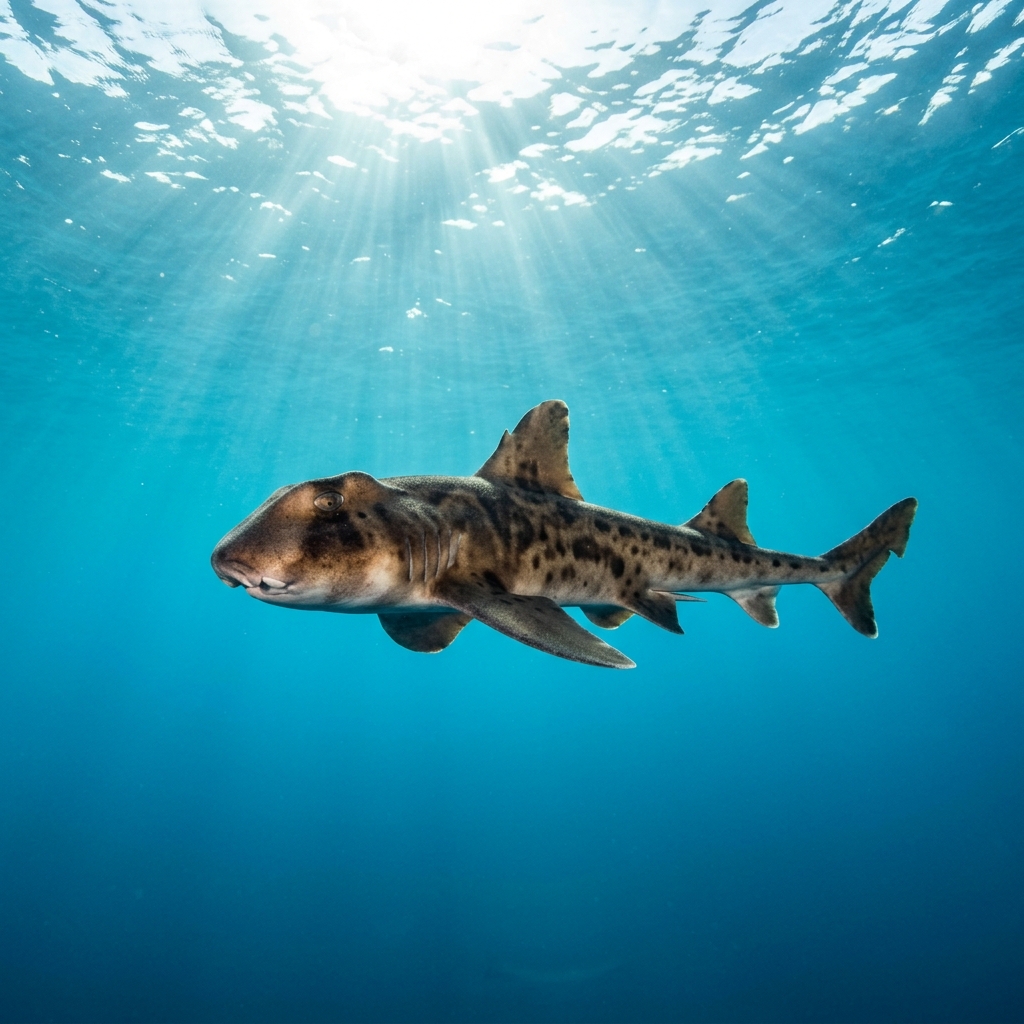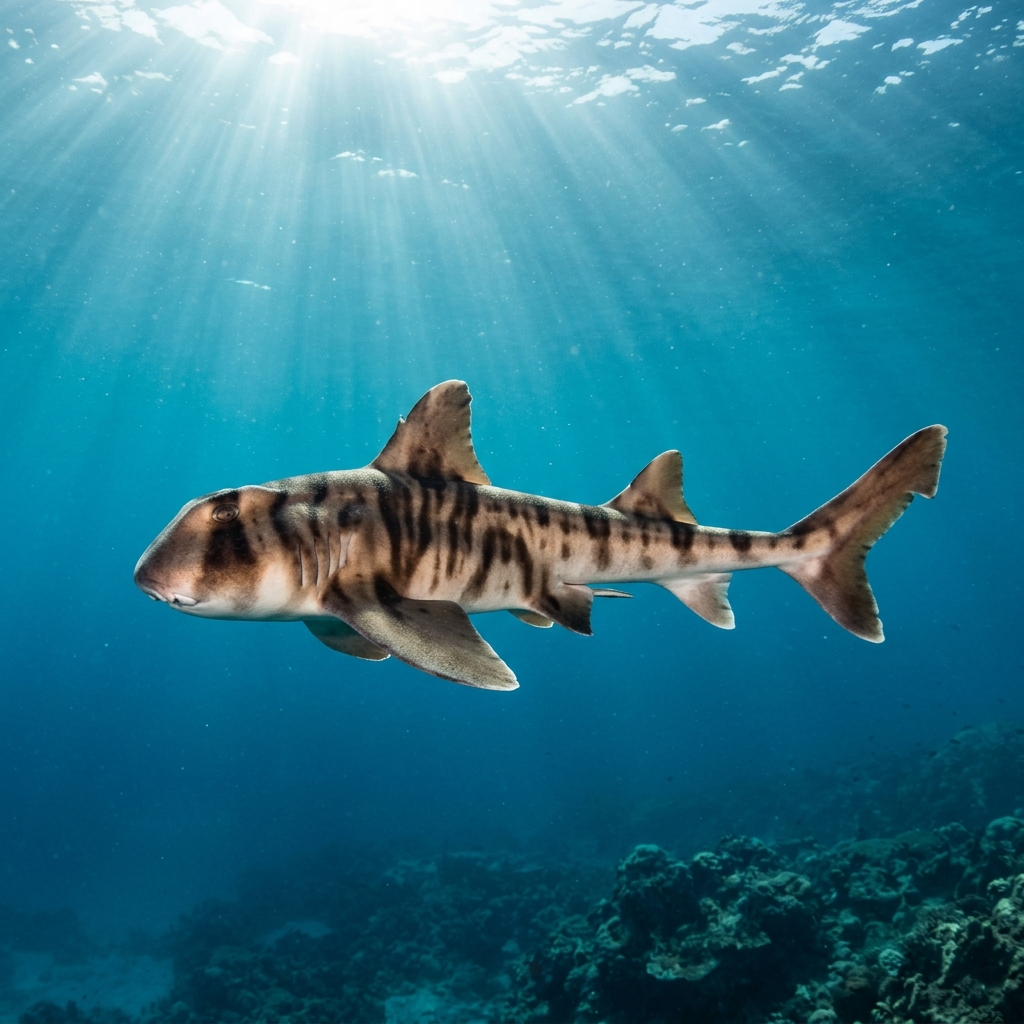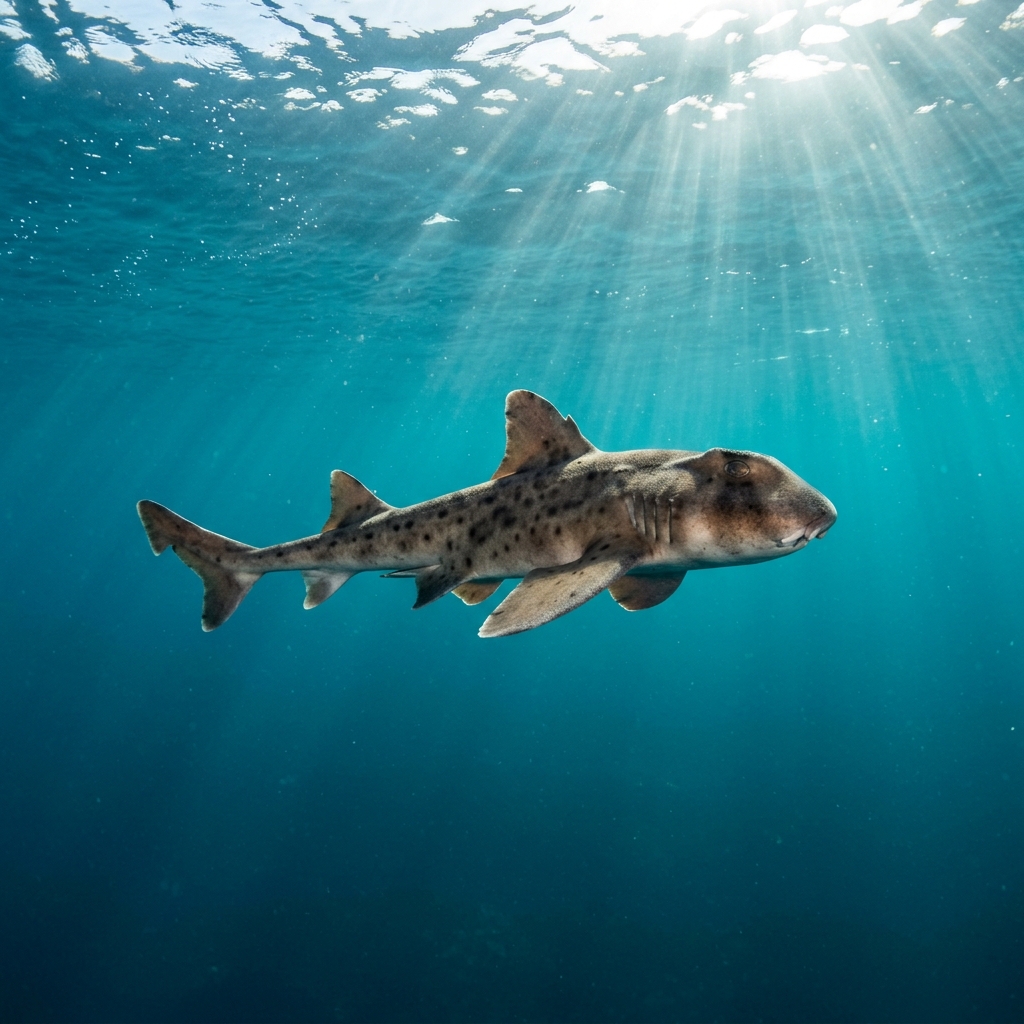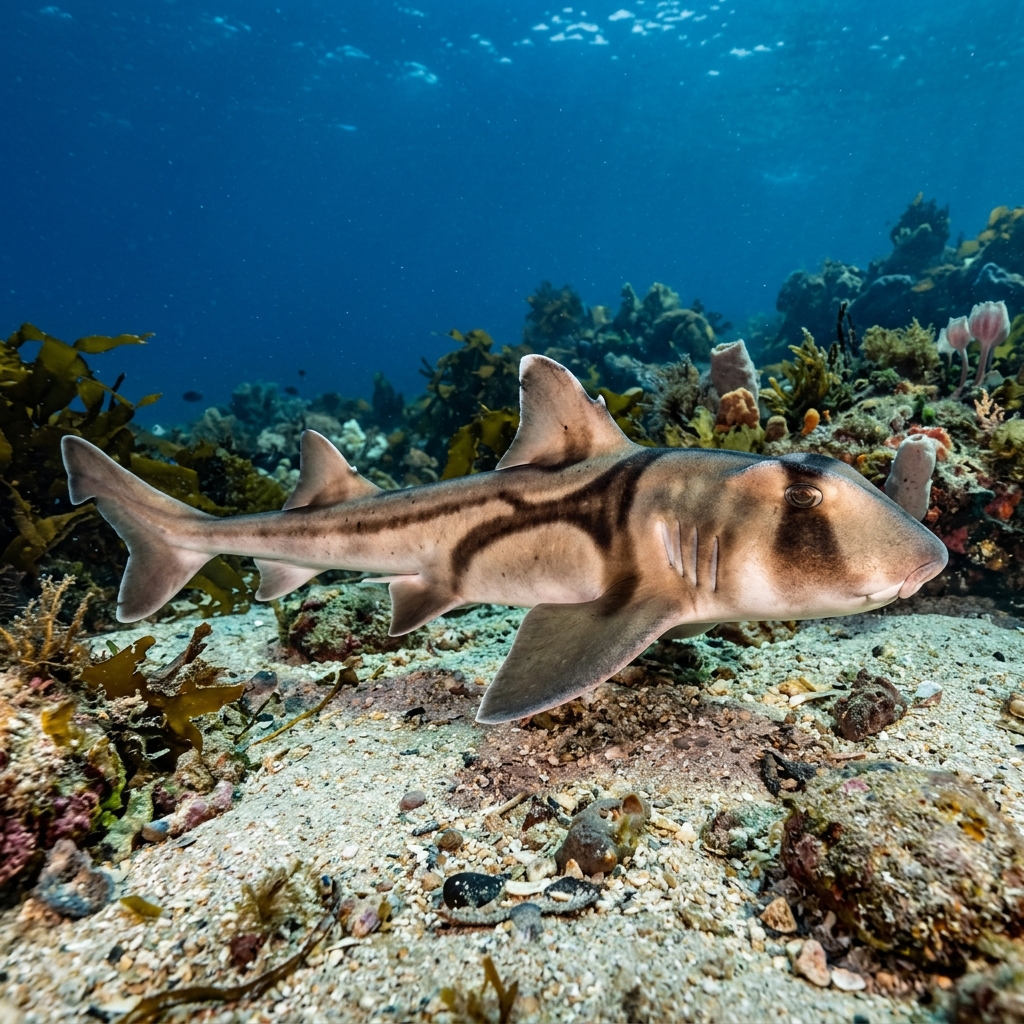
Heterodontus portusjacksoni
Rest on the seabed by day, hunt by night: find Port Jackson Sharks across New South Wales and Western Australia, peaking Jun, Nov.
Safety warning
Port Jackson Sharks are listed as potentially dangerous but bites are rare and typically provoked by divers handling or harassing the animal. Leave resting individuals undisturbed, keep your hands away from any shark wedged under a ledge, and do not attempt to grab or ride them. An unprovoked attack is extremely unlikely; a bite from a startled, cornered animal is not.
If you're bitten
BiteGeneral first-aid guidance, not a substitute for professional medical care. In an emergency, call your local emergency number.
A blunt, broad head and a distinctive dark brown harness pattern that sweeps over the back and down behind each pectoral fin make this shark unlike anything else on a temperate Australian reef. Adults reach around 115 cm and look stocky compared with other sharks, with two prominent dorsal fins each preceded by a sharp spine. The colouring is pale brown to grey with those strong dark saddle-like bands; juveniles carry the same pattern but with more contrast.
During the day you will most likely find them motionless on the seabed or wedged under a ledge, apparently unbothered by divers until you get too close, at which point they cruise quietly away rather than bolt. Come back at night and you will see a different animal entirely, actively patrolling the bottom in search of urchins, molluscs, and other hard-shelled prey. In late winter and early spring, individuals gather in numbers to breed, and females deposit their characteristic auger-shaped egg cases into rock crevices.
Those flat, pavement-like back teeth are built to crush hard-shelled prey such as sea urchins and molluscs, earning the shark its alternative name Oyster Crusher. A freshly laid egg case looks like a dark spiral drill bit, and the female actively screws it into a crack so it cannot be dislodged.
Sightings concentrate from June through November across Southern Hemisphere sites, which aligns with the species' cooler-water preference of roughly 14 to 23 °C and their late-winter to early-spring breeding aggregations.
Reef neighbours a diver could mistake it for. Use the identification notes above to tell them apart.
Port Jackson Sharks are overwhelmingly an Australian encounter, with the strongest sighting records coming from New South Wales, Western Australia, and South Australia, followed by Victoria and Tasmania. New Zealand also holds a real population, with sightings concentrated in the Central New Zealand region and the Fiordland and Stewart Island area. Outside those two countries, the species simply does not occur.
Mapping where Port Jackson Shark is logged…
Australia is by far the best place, with strong records across New South Wales, Western Australia, South Australia, Victoria, and Tasmania. New Zealand is a secondary option, particularly around Central New Zealand and Fiordland. The species does not occur outside these two countries.
Sightings peak between June and November across Australian and New Zealand sites. Late winter and early spring (around August to October) is especially rewarding because sharks gather to breed and females can be seen laying their spiral egg cases.
They are listed as potentially dangerous, but documented bites are almost always linked to divers grabbing or harassing them. Their normal response to an approaching diver is to move away quietly. Give them space and avoid touching them and the risk is negligible.
Look for the dark harness-like saddle markings that cross the back and sweep down behind each pectoral fin on a pale brown or grey body. The head is broad and blunt, and each dorsal fin has a visible spine at its leading edge. No other Australian shark shares this combination of features.
Most adults you will encounter are around 115 cm long. They are stocky and heavy-bodied for their length, which makes them look larger underwater than a slender reef shark of the same size.
The egg cases are shaped like a dark corkscrew or auger. The female actively pushes the case into a rock crevice, screwing it in so that surge cannot pull it free. Each case holds a single embryo and takes around ten to eleven months to hatch.
Site and sighting data is aggregated from diver logs, iNaturalist and GBIF. For taxonomy and conservation status: