Makaira nigricans
Blue marlin roam Florida, Queensland, the Azores and beyond in water from 11-27°C. Find the best dive sites and ID tips on Fin.
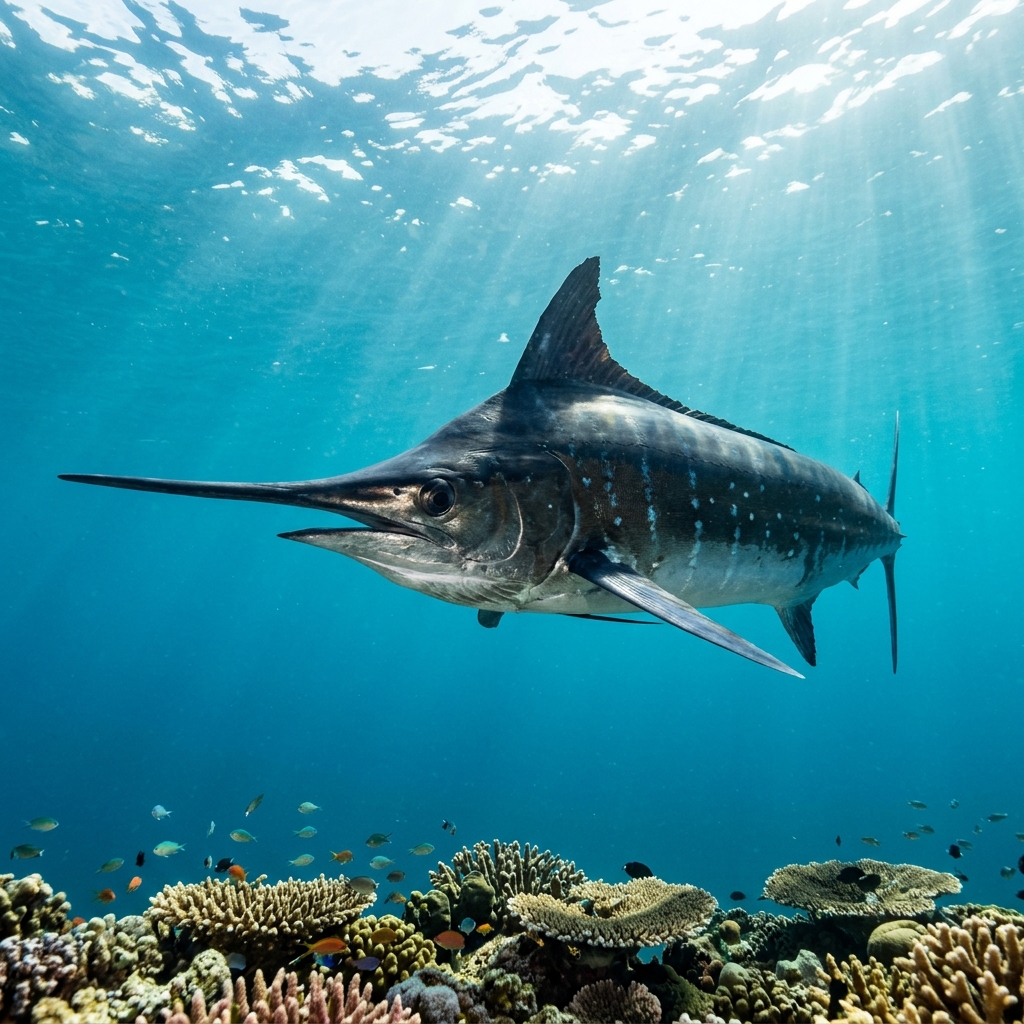
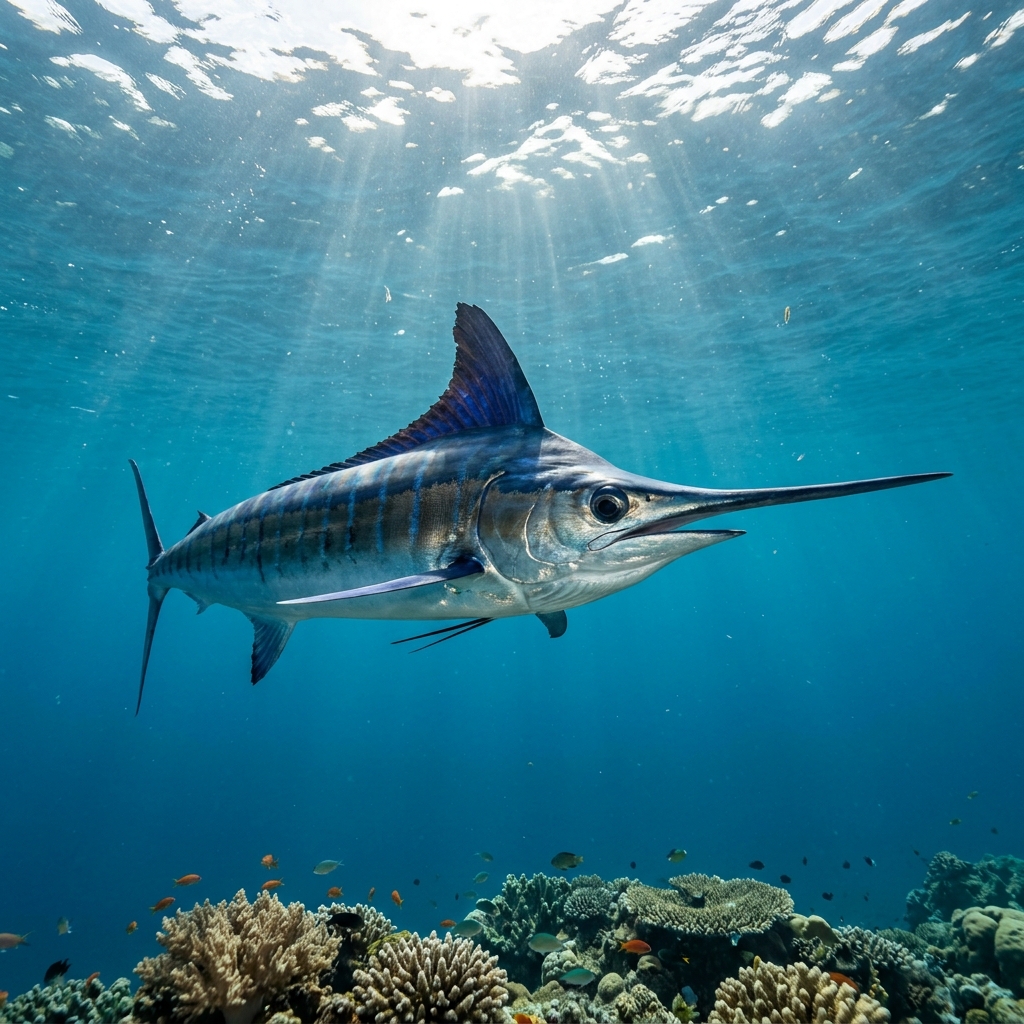
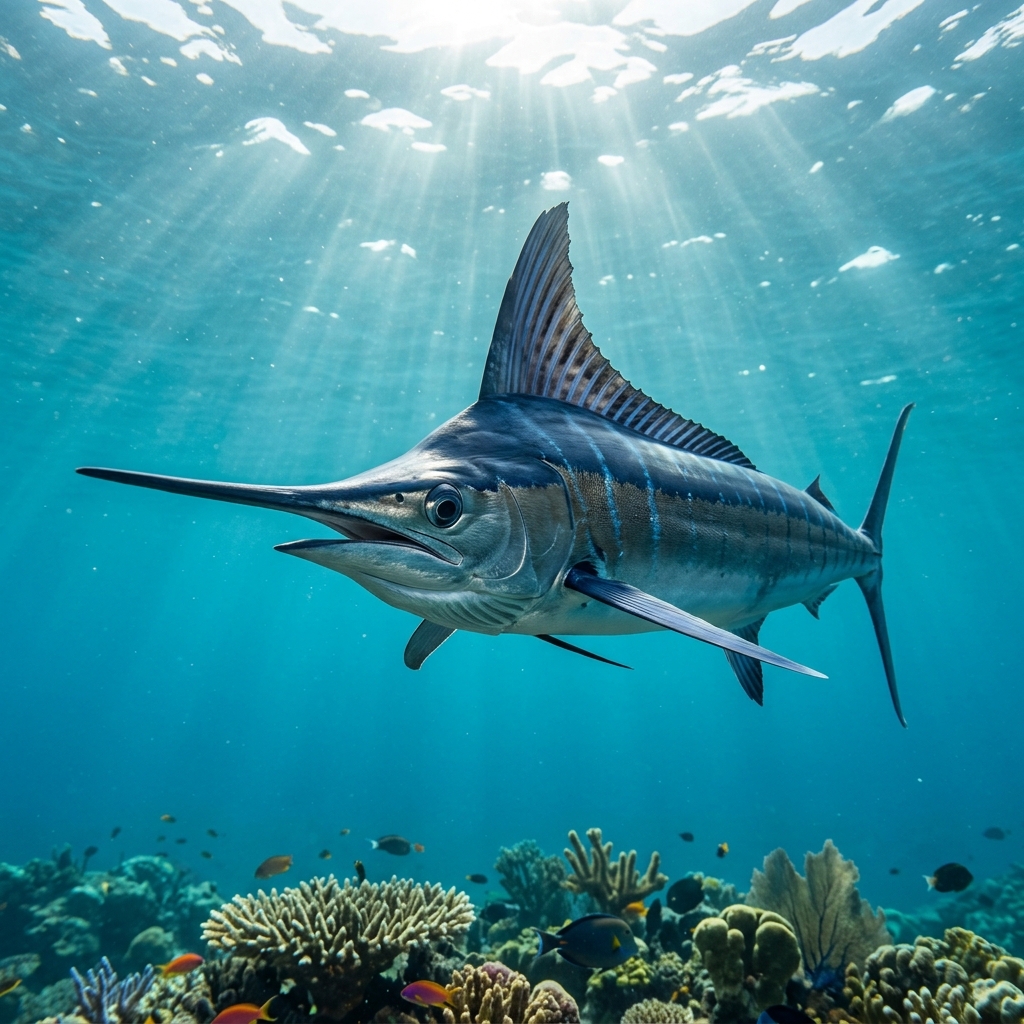
A powerfully built open-ocean fish, the blue marlin is immediately recognisable by its deep cobalt-to-royal-blue back fading to silver-white flanks, marked with roughly 15 faint pale vertical bars. The long, rigid bill (rostrum) projects well ahead of the head and is round in cross-section, not flat. The first dorsal fin is tall near the front and drops sharply towards the tail, which is deeply forked and rigid-looking. In the water, sheer size alone is a strong cue, females routinely dwarf males.
Blue marlin are pelagic (open-water) hunters, so encounters typically happen in blue water well away from the reef rather than over coral. When one does pass a diver or a dive vessel, it is usually moving with purpose, cruising or following bait, and rarely lingers. They are not aggressive towards divers and will almost always veer away when approached.
Blue marlin can rapidly flush bright cobalt and silver colours across their flanks, a form of communication and excitement display during feeding that divers who witness it describe as one of the most vivid colour shows in the ocean.
No clear seasonal peak emerges from current sighting data, so blue marlin should be treated as a year-round possibility across their range. They are comfortable in water from roughly 11 to 27°C, meaning they can appear in both subtropical and cooler temperate regions depending on season.
Reef neighbours a diver could mistake it for. Use the identification notes above to tell them apart.
Blue marlin range widely across tropical and warm-temperate seas, and are most commonly logged in Florida and the broader US southeast, as well as Queensland, Australia. The Azores, particularly around São Miguel and Santa Maria, hold a strong reputation for open-water encounters, as do Brazil's northeast coast and the Bahamas. Venezuela and Western Australia round out the main hotspots.
Mapping where Blue Marlin is logged…
The strongest concentrations of logged sites are in Florida and the US southeast, Queensland in Australia, the northeast coast of Brazil, the Azores archipelago, and the Bahamas. The Azores in particular are a well-known hotspot for encountering these animals in open water.
Current data does not point to a single peak season globally. Blue marlin are present year-round across their broad range, tolerating water temperatures from around 11 to 27°C. Your best approach is to check local charter operators in your target destination, as regional peaks can vary.
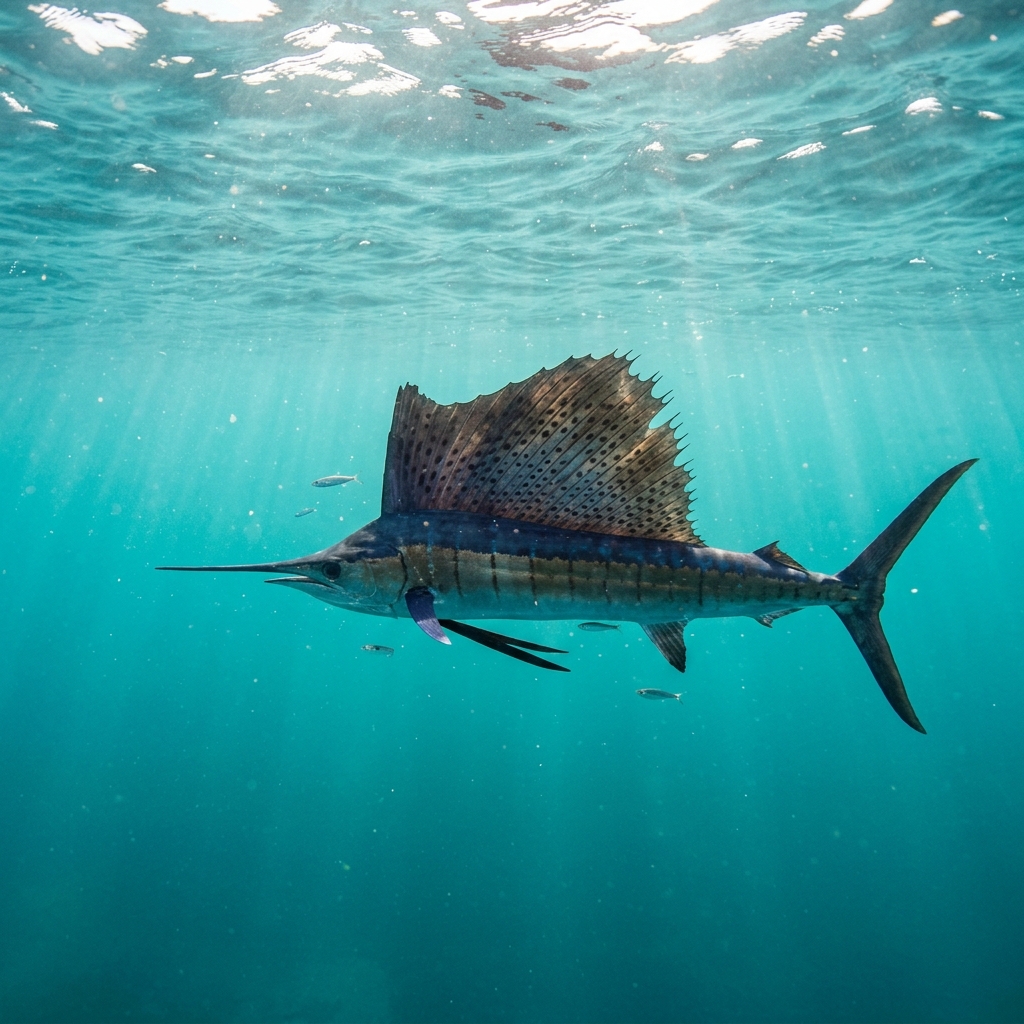
Look for the deep cobalt-blue back, silver flanks with faint pale vertical bars, and the long round bill. The first dorsal fin is tall at the front and tapers quickly, unlike a sailfish, whose sail-like dorsal fin runs almost the full length of the body. The body is also heavier and more muscular than a sailfish.
Females are among the largest bony fish in the ocean, capable of exceeding 600 kg, though most encountered are smaller. Males are significantly smaller, rarely exceeding around 160 kg. In the water, even a modest specimen looks impressively large.
Blue marlin are listed as Vulnerable by the IUCN. Populations have declined significantly due to longline bycatch and targeted fishing pressure. Supporting conservation-minded dive and fishing operators, and reporting sightings to citizen-science platforms, helps researchers track population trends.
The Blue Marlin is listed as vulnerable by the IUCN. Observe from a distance, avoid touching or feeding it, and report sightings to local marine research organisations.
Blue marlin are listed as Vulnerable on the IUCN Red List, driven by decades of pressure from recreational and commercial longline fisheries. When diving near blue marlin, keep a respectful distance and avoid any behaviour that stresses the animal; if you encounter one on a tag-and-release charter, support operators who use circle hooks and handle the fish in the water.
Site and sighting data is aggregated from diver logs, iNaturalist and GBIF. For taxonomy and conservation status: