Nymphaeaceae spp.
Spot water lilies from above or below in freshwater lakes across Germany, Switzerland, the Netherlands and Florida. Here's where and how to find them.
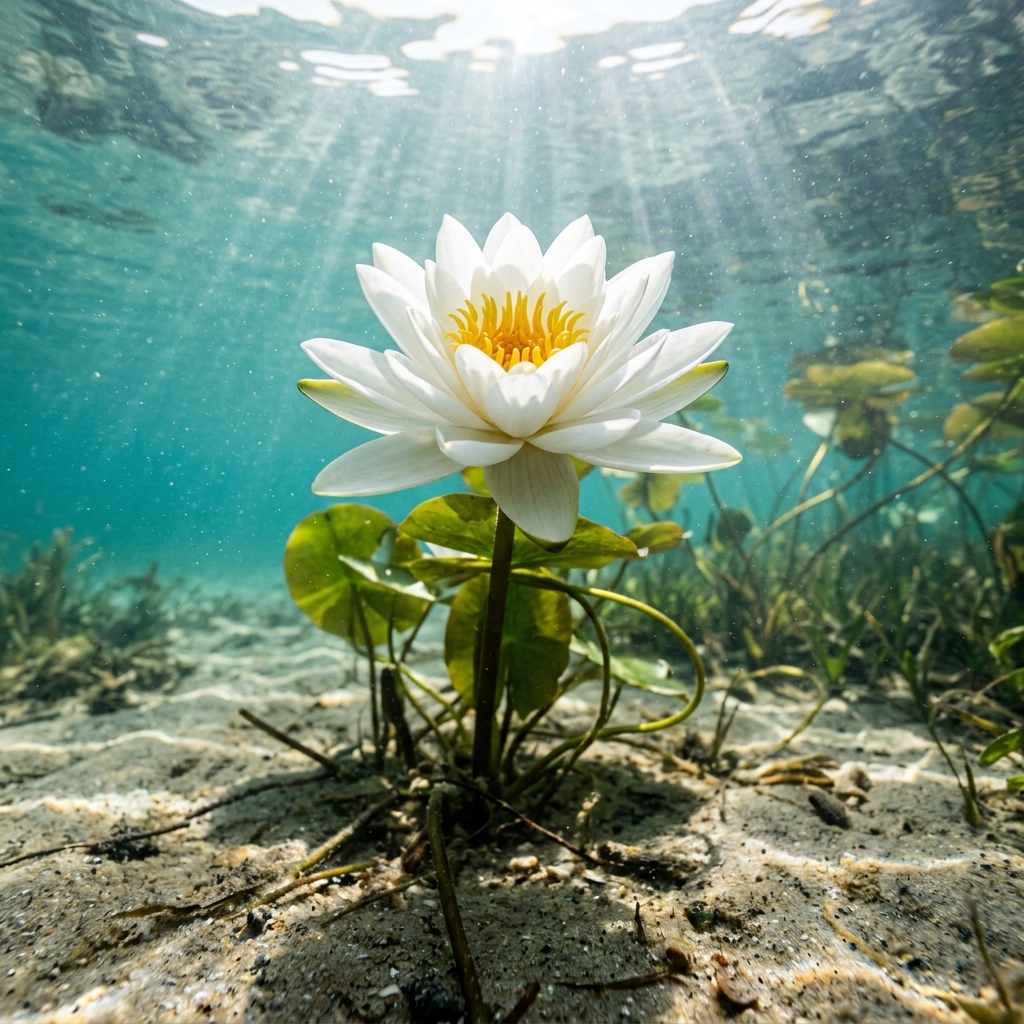
Broad, round floating leaves (lily pads) with a distinctive V-shaped notch cut to the centre are the key feature to look for from below or at the surface. Flowers sit at or just above the water on a long stem and range from white or cream to pale yellow depending on species. Seen from underwater, the pads cast circular shadows and the long, flexible stems trail down into the shallows, usually rooted in soft sediment at depths of a metre or two.
Water lilies are rooted plants, so they do not move, but they do respond to light: flowers open in the morning and close by afternoon on many species, so an early dive or snorkel gives the most photogenic view. From underwater you will typically find the stems arching up from a muddy or sandy bottom into a canopy of overlapping pads at the surface, creating a natural shelter that small fish and invertebrates use heavily. Divers often approach slowly from below to look for wildlife sheltering in the shade of the pads.
The air trapped between the waxy upper surface of a lily pad and the water below acts as a buoyancy aid, and the pads of some larger species can support the weight of a small bird. That waterproof coating also causes water to bead and roll off instantly, a property studied by engineers for self-cleaning surface design.
Sighting data does not point to a concentrated season, so treat water lilies as potentially present year-round wherever conditions suit. Their observed temperature range runs from near freezing up to about 26 °C, matching the temperate freshwater lakes where they are most commonly logged.
Water lilies are most widely logged across Central Europe, particularly in Germany, Switzerland, and the Netherlands, where inland lakes and flooded quarries provide ideal shallow freshwater habitat. The Limburg Lakes and Vinkeveense Plassen in the Netherlands are notable hotspots, as are sites across Central Germany and Central Switzerland. Florida and the broader southeastern United States round out the strongest coverage outside Europe.
Mapping where Water Lily is logged…
Freshwater lakes and flooded quarries across Central Europe offer the strongest coverage, particularly in Germany, Switzerland, and the Netherlands. The Limburg Lakes and Vinkeveense Plassen in the Netherlands are reliable spots, and Florida's freshwater springs and lakes are the best bet in North America.
No strong seasonal pattern emerges from the sighting data, so they can be encountered year-round in suitable freshwater habitats. If you want open flowers, aim for a morning dive or snorkel, as many species close their blooms by midday.
Look for broad, round floating leaves with a V-shaped notch reaching the centre, and long flexible stems rooting into soft sediment below. The underside of the pads is often reddish-purple. No other common freshwater plant combines that circular pad shape with the deep central notch.
No. Water lilies pose no risk to divers or snorkellers. The only practical consideration is that dense stem growth in very shallow areas can tangle around equipment, so move slowly and avoid forcing through thick stands.
The shaded underside of lily pads and the tangle of stems below attract small fish, frogs, dragonfly larvae, and freshwater snails. It is worth hovering quietly beneath the canopy of pads and scanning the stems rather than swimming straight through.
Site and sighting data is aggregated from diver logs, iNaturalist and GBIF. For taxonomy and conservation status: