Posidonia oceanica
Dive the Mediterranean's iconic seagrass meadows from Attica to Sardinia. Find out where and when to spot Posidonia oceanica underwater.
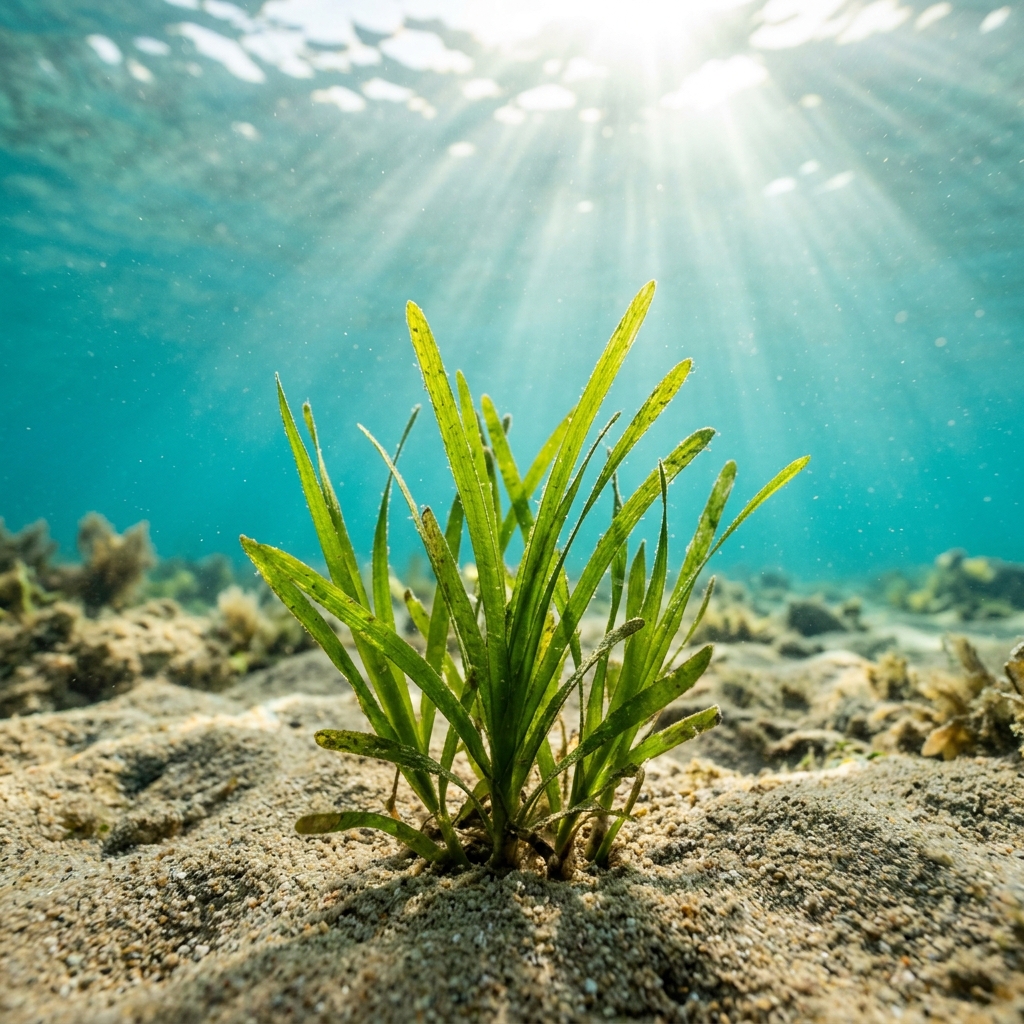
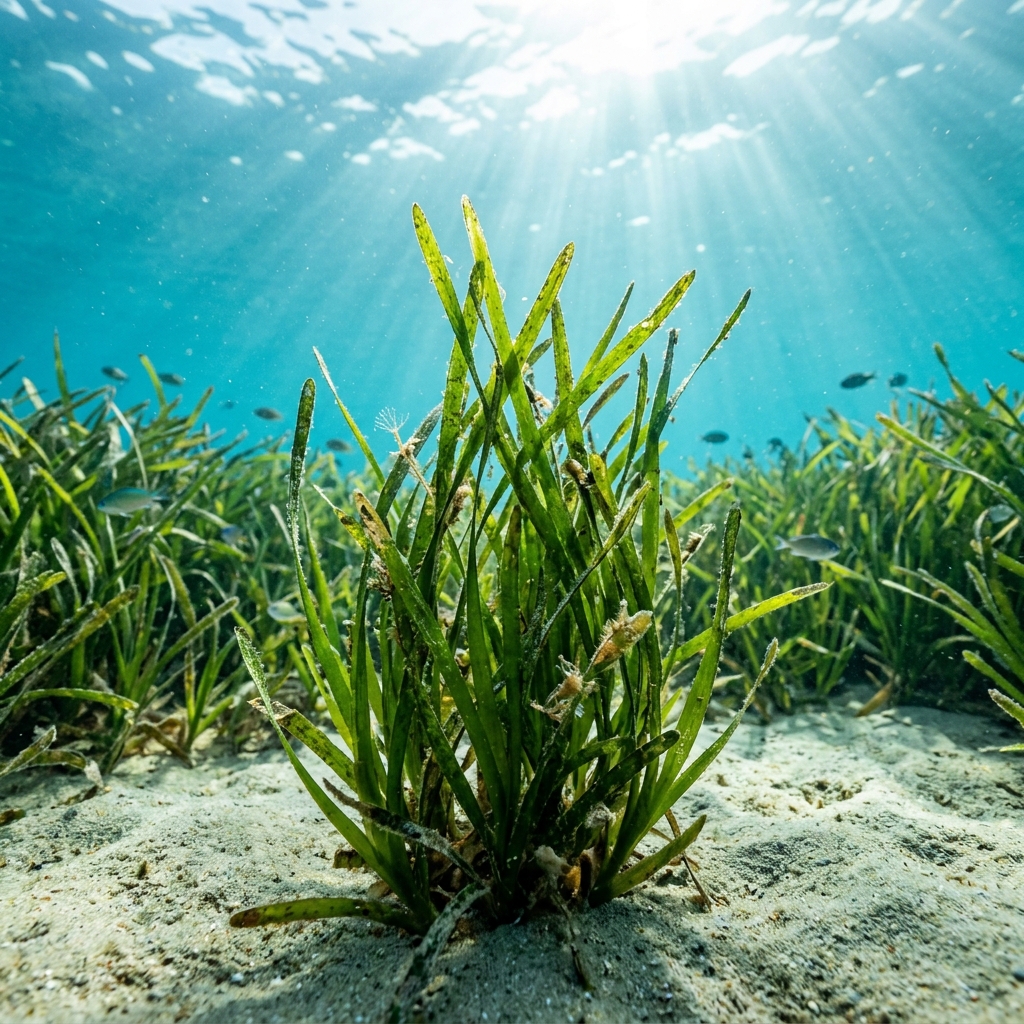
Long, flat, strap-like leaves growing in dense bundles from a fibrous rhizome (underground stem mat) give this seagrass a distinctly lush, ribbon-like appearance underwater. The leaves are dark to bright green, typically 1 cm wide, and can reach 50 cm or more in length, forming meadows that carpet sandy or rocky-sandy bottoms. The thick, dark mats of dead leaf material and compacted rhizomes, called matte, are a reliable identifying feature unique to this species. Unlike seaweeds, the leaves arise from visible stem clusters anchored to the sediment, not from rocky surfaces.
Posidonia seagrass is sessile (fixed in place), so there is no movement to track, what you are watching is a living habitat rather than an individual organism. Leaves sway gently with surge and current, which can make the meadow shimmer and pulse in a way that catches the eye from a distance. Divers typically encounter it as the substrate itself, often hosting nudibranchs, seahorses, pipefish, and small wrasse moving through the canopy.
A single Posidonia meadow can be thousands of years old, some clonal mats in the Mediterranean are estimated to be tens of thousands of years old, making them among the oldest living organisms on Earth.
Sighting data does not point to a specific season, so treat this as a year-round encounter across its Mediterranean range. The observed water temperature window of roughly 13 to 23 °C aligns with the Med's spring-to-autumn diving season, though meadows are present and visible year-round.
Reef neighbours a diver could mistake it for. Use the identification notes above to tell them apart.
Most commonly logged across the Mediterranean, with particularly strong representation in Italy, Greece, Turkey, Croatia, and Spain. The richest concentration of sites sits in regions such as Attica in Greece, the coasts of Sicily and Lampedusa, Sardinia, the Aegean Coast of Turkey, and Central Dalmatia in Croatia. Spain's Costa Blanca and the waters around Cyprus and France round out the core range.
Mapping where Posidonia Seagrass is logged…
Posidonia seagrass is almost exclusively a Mediterranean species. The best-represented dive destinations include Italy (especially Sicily and Sardinia), Greece (Attica and the Cyclades), Turkey's Aegean Coast, Croatia's Dalmatian coast, and Spain's Costa Blanca. Cyprus and southern France also have strong coverage.
There is no defined peak season in the sighting data, so meadows can be encountered year-round. In practice, the most comfortable diving across the Mediterranean falls between late spring and early autumn, when water temperatures sit in the 18 to 23 °C range where this seagrass thrives.
Look for dense meadows of long, dark green ribbon-like leaves growing in bundles from a dark, fibrous mat on sandy bottoms. The thick matte of compacted dead rhizomes and leaf debris at the base is a clear distinguishing feature. Unlike seaweeds, it roots into sediment rather than attaching to rock.
Some Posidonia meadows are estimated to be tens of thousands of years old, growing as slow-expanding clonal mats. The rhizome mat accumulates at just a few centimetres per century, so a thick matte visible on a dive represents an extraordinary span of continuous growth.
Site and sighting data is aggregated from diver logs, iNaturalist and GBIF. For taxonomy and conservation status: