Pristis pectinata
Spot the Smalltooth Sawfish in Florida, Cuba, or the Bahamas. A critically endangered ray recognised by its long, toothed rostrum. Here's where and when to look.
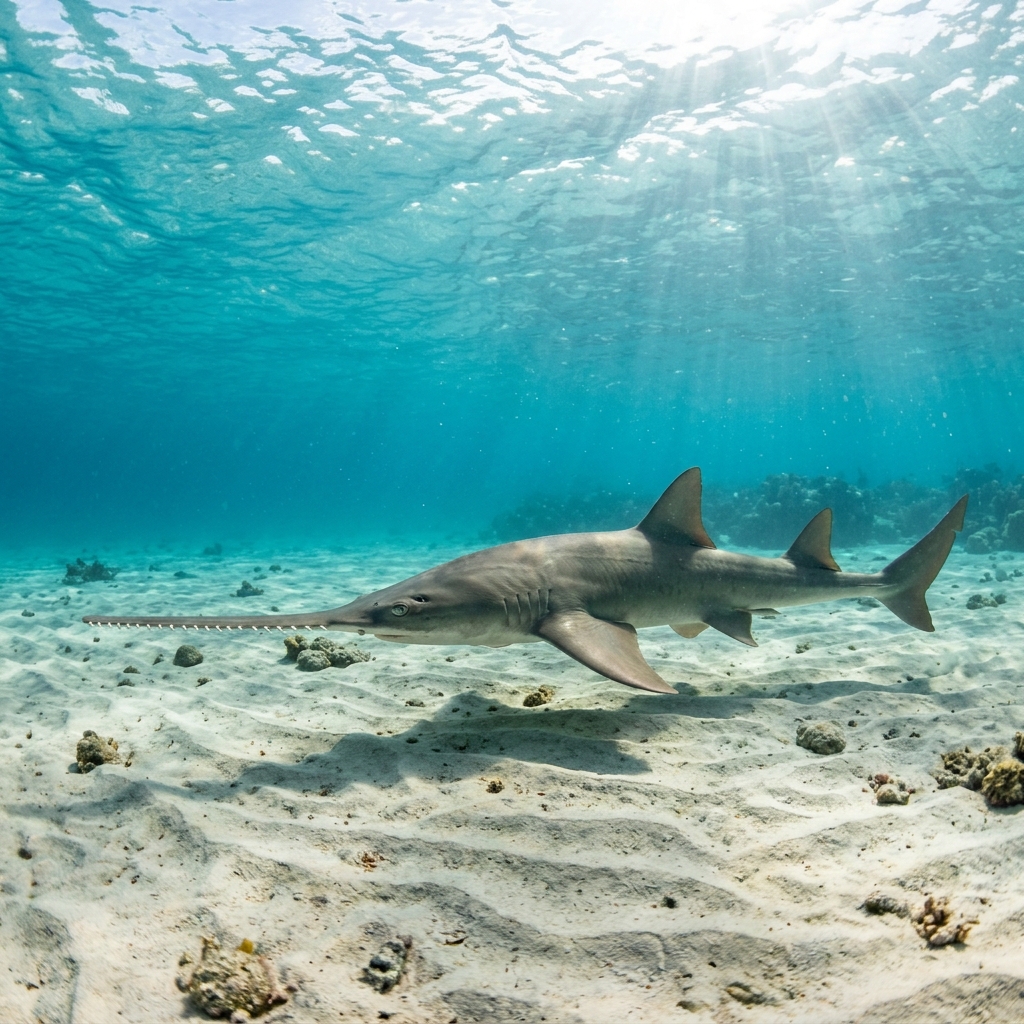
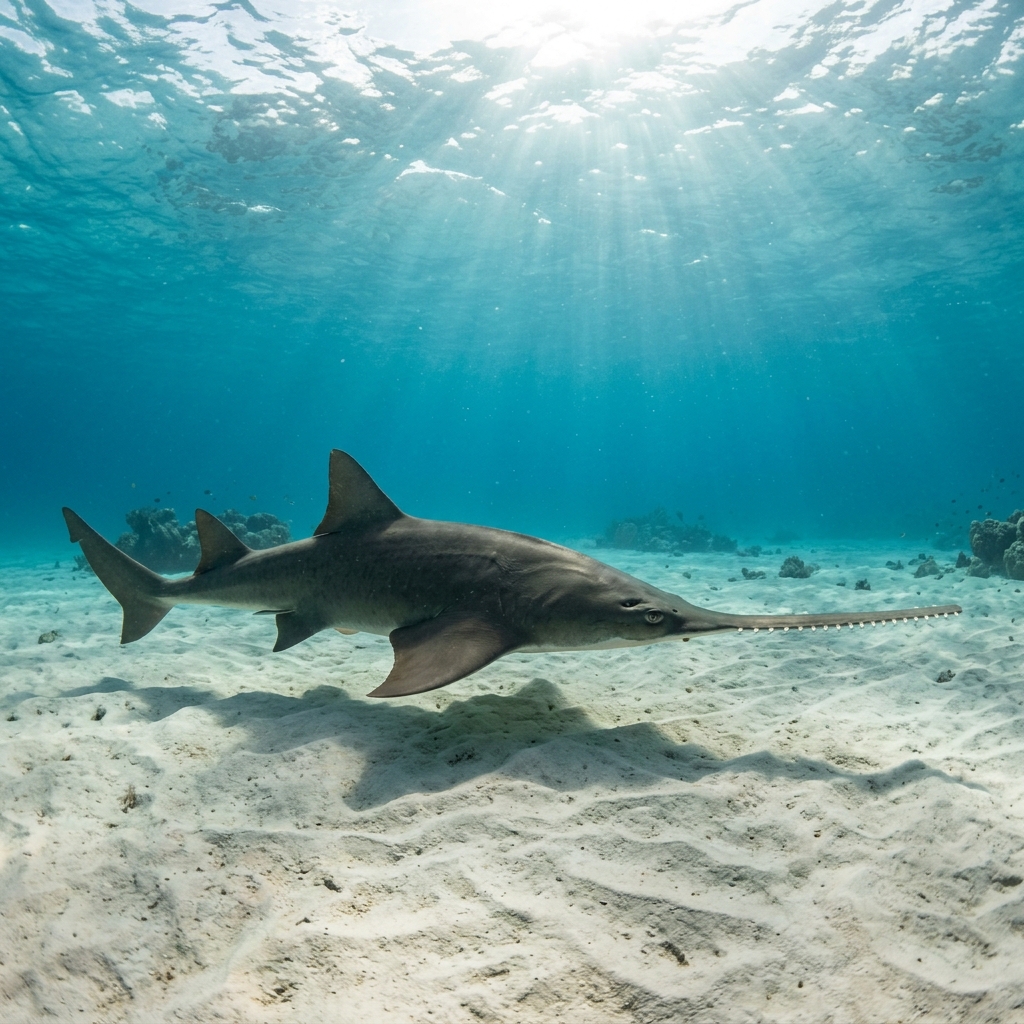
That long, flattened rostrum (the saw-like snout) lined with pairs of evenly spaced rostral teeth is the unmistakable feature underwater. The body is broadly flattened and shark-like rather than disc-shaped, brownish-grey on top and pale beneath. The smalltooth sawfish has more rostral teeth than most other sawfish species, typically 20 or more pairs, giving the saw a notably fine-toothed appearance from close range.
Smalltooth sawfish are bottom-associated, spending most of their time over sandy or muddy substrates in shallow coastal waters, estuaries, and river mouths. The rostrum is used to detect and stun prey, and a sawfish surprised on the bottom may swing it defensively, so give it space. They are generally unhurried and not aggressive towards divers, but encounters in the wild are now extremely rare.
Young smalltooth sawfish are born with a soft, flexible rostrum covered in a protective sheath so they do not injure the mother during birth; the teeth harden and become exposed within hours.
No clear seasonal peak emerges from the available data, so sightings should be treated as possible year-round wherever the species persists. Its observed water temperature range of roughly 23 to 28 °C aligns with warm tropical and subtropical shallows throughout the year.
Reef neighbours a diver could mistake it for. Use the identification notes above to tell them apart.
The range model places the smalltooth sawfish across a broad tropical and subtropical belt, with the largest concentration of mapped sites in Florida and the Southeast United States. Cuba, particularly the Jardines del Rey region, and the Bahamas (especially Grand Bahama) are also strongly represented, as are coastal Venezuela and the Red Sea around Jeddah and the Port Sudan area.
Mapping where Smalltooth Sawfish is logged…
The strongest mapped presence is in Florida and the southeastern United States, Cuba's Jardines del Rey, and the Bahamas. The Red Sea coastlines of Saudi Arabia, Sudan, and Egypt also fall within the species' modelled range. Real diver sightings are very rare given the animal's critically endangered status, but these regions offer the best geographic prospects.
There is no confirmed seasonal pattern in the available data. The species occupies warm tropical and subtropical waters around 23 to 28 °C, which are present year-round across most of its range. Any encounter should be considered exceptional regardless of the time of year.
Look for a large, flattened, shark-bodied ray with a long toothed rostrum. The smalltooth has noticeably more rostral teeth (typically 20 or more pairs) than related species, making the saw appear finer-toothed. The overall colour is greyish-brown above and pale below. No other fish in its range shares this distinctive saw-snout profile.
Smalltooth sawfish are among the largest living rays. Adults commonly reach 5 to 6 metres in total length, with the rostrum accounting for roughly a quarter of that. Historical records suggest some individuals may have reached closer to 7 metres, though animals of that size are essentially no longer encountered.
Yes, they are listed as Critically Endangered on the IUCN Red List. They have been eliminated from large parts of their historical range, including much of the eastern Atlantic and the Gulf of Mexico outside Florida. The main threats are entanglement in fishing nets and coastal habitat destruction. Florida's shallow estuaries now hold one of the last known strongholds for the species.
The Smalltooth Sawfish is listed as critically endangered by the IUCN. Observe from a distance, avoid touching or feeding it, and report sightings to local marine research organisations.
Listed as Critically Endangered, the smalltooth sawfish has disappeared from most of its former range due to habitat loss and entanglement in fishing gear. If you are fortunate enough to encounter one, keep a respectful distance, do not approach the rostrum, and report the sighting to local conservation authorities or citizen science platforms.
Site and sighting data is aggregated from diver logs, iNaturalist and GBIF. For taxonomy and conservation status: