Anoxypristis cuspidata
Spot the Knifetooth Sawfish in Queensland and Northern Territory waters. Here's what to look for and where this critically endangered ray is mapped.
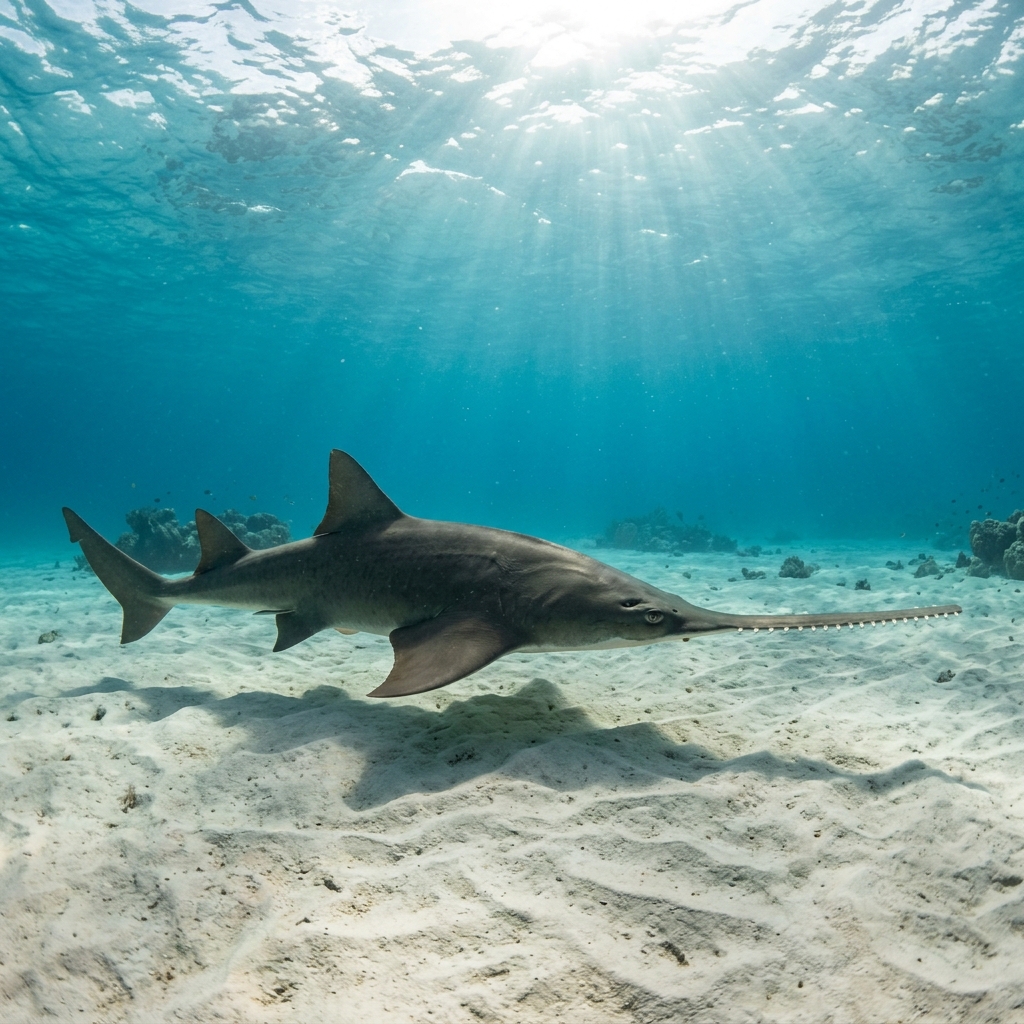
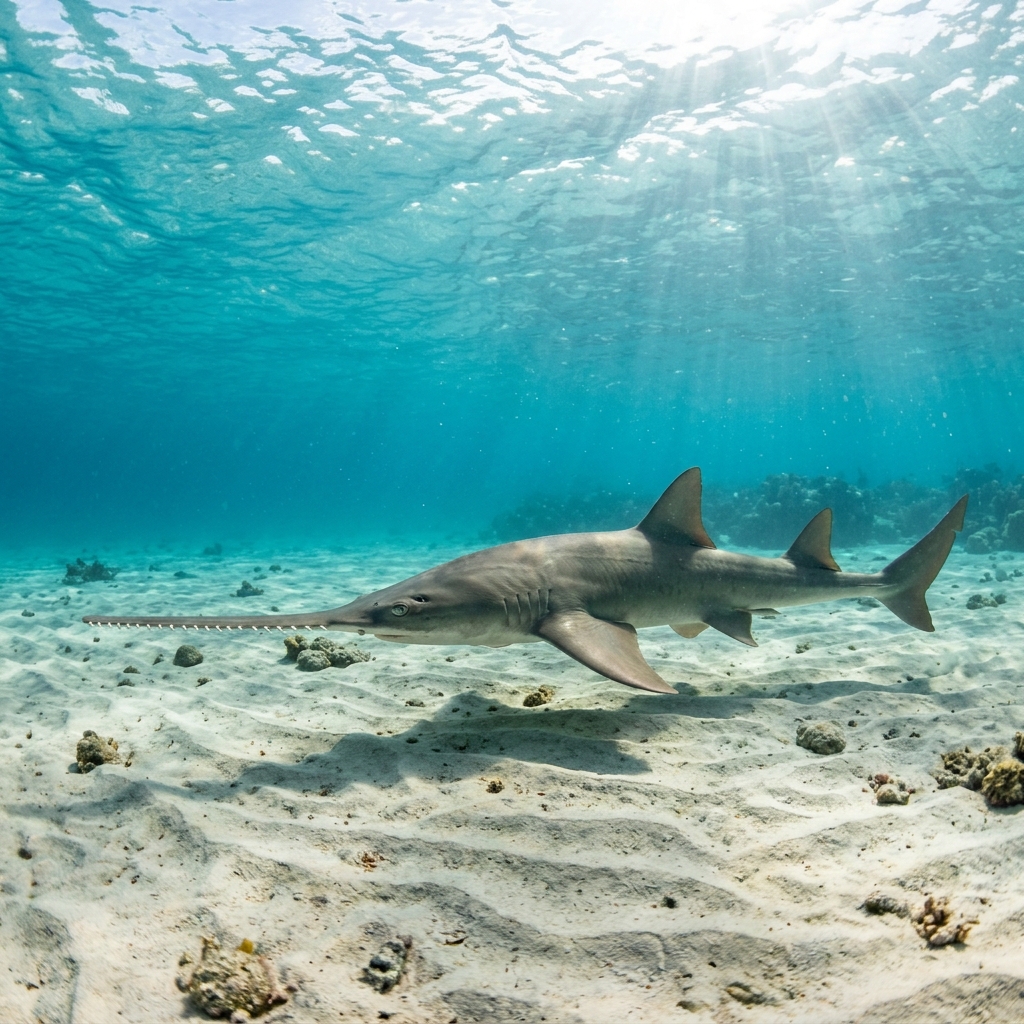
That long, flat rostrum (the saw-like snout) is the giveaway, but look closely at where the teeth sit: on the knifetooth sawfish, the rostral teeth are confined to the upper portion of the saw, leaving the base noticeably bare. The body is grey-brown and flattened like other rays, blending into sandy and muddy bottoms. Compared to other sawfish it has a relatively slender, pointed saw with fewer, well-spaced teeth.
Knifetooth sawfish are benthic (bottom-dwelling), typically encountered resting or slowly cruising over sandy or muddy substrate in shallow coastal waters, estuaries, and river mouths. When approached, they tend to move off calmly rather than flee rapidly. Encounters are rare, and sightings are brief; if you do find one, slow lateral movements and keeping your distance give the best chance of an extended look.
The rostral teeth are not true teeth but modified scales called denticles, and the saw is used to slash through schools of fish or pin prey to the bottom rather than to dig or dig into substrate.
No clear seasonal peak has been detected from available data, so this species is treated as potentially present year-round. It sits within a warm tropical temperature niche of roughly 25 to 29 °C, consistent with tropical Australian and Indo-Pacific waters throughout the year.
Reef neighbours a diver could mistake it for. Use the identification notes above to tell them apart.
The vast majority of mapped sites sit in Australia, with Queensland, the Northern Territory, and Western Australia holding the strongest coverage. India and Sri Lanka also feature prominently, particularly around Pondicherry and the south and west coasts of Sri Lanka.
Mapping where Knifetooth Sawfish is logged…
Mapped sites are concentrated in tropical Australia, especially Queensland, the Northern Territory, and Western Australia. India (notably around Pondicherry) and Sri Lanka's south and west coasts are also key areas. Sightings remain rare anywhere in its range.
There is no confirmed peak season based on current data. The species inhabits warm tropical waters between roughly 25 and 29 °C, which are available year-round across its core Australian and Indo-Pacific range.
The clearest field mark is the rostrum: on the knifetooth sawfish the rostral teeth begin noticeably above the base of the saw, leaving a plain, tooth-free section near the head. The smalltooth sawfish has teeth running much closer to the rostrum's base. The knifetooth also tends to have a more slender, pointed saw overall.
No. Knifetooth sawfish are not considered dangerous to divers and typically move away when approached. Their saw is a hunting tool, not a defensive weapon used against large animals. Standard respectful dive practice applies: keep distance and avoid cornering the animal.
Yes, they are listed as Critically Endangered on the IUCN Red List. Population numbers have dropped sharply due to bycatch and coastal habitat degradation across their Indo-Pacific range. Reporting verified diver sightings to local wildlife authorities or citizen-science platforms directly supports conservation efforts.
Unlike most sawfish, the rostral teeth on the knifetooth do not extend all the way to the base of the saw. The lower portion of the rostrum is smooth and tooth-free, which is the single most reliable identification feature and sets it apart from all other sawfish species.
The Knifetooth Sawfish is listed as critically endangered by the IUCN. Observe from a distance, avoid touching or feeding it, and report sightings to local marine research organisations.
Knifetooth sawfish are listed as Critically Endangered. Bycatch in coastal fisheries and habitat loss in estuarine nursery areas have caused severe global population declines. If you see one, log the sighting with location and depth; verified records from divers contribute to population monitoring.
Site and sighting data is aggregated from diver logs, iNaturalist and GBIF. For taxonomy and conservation status: