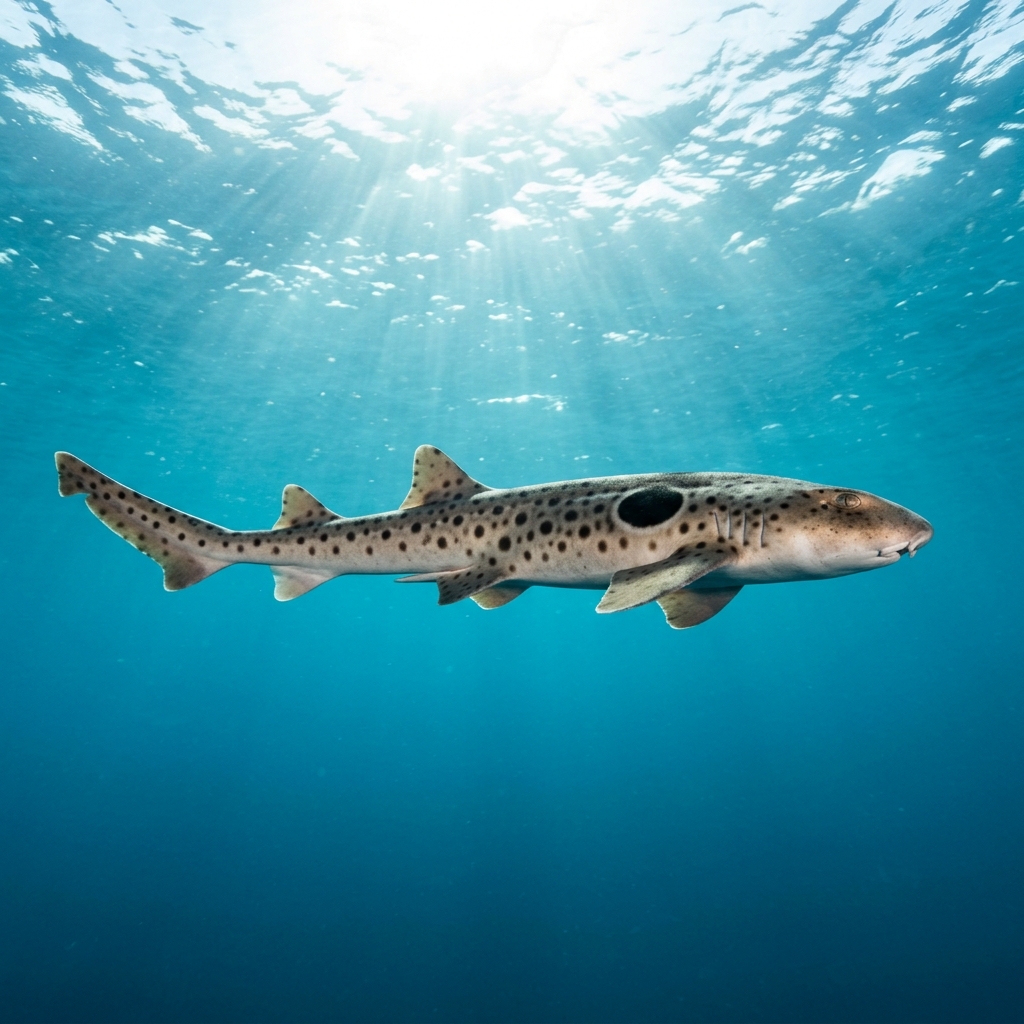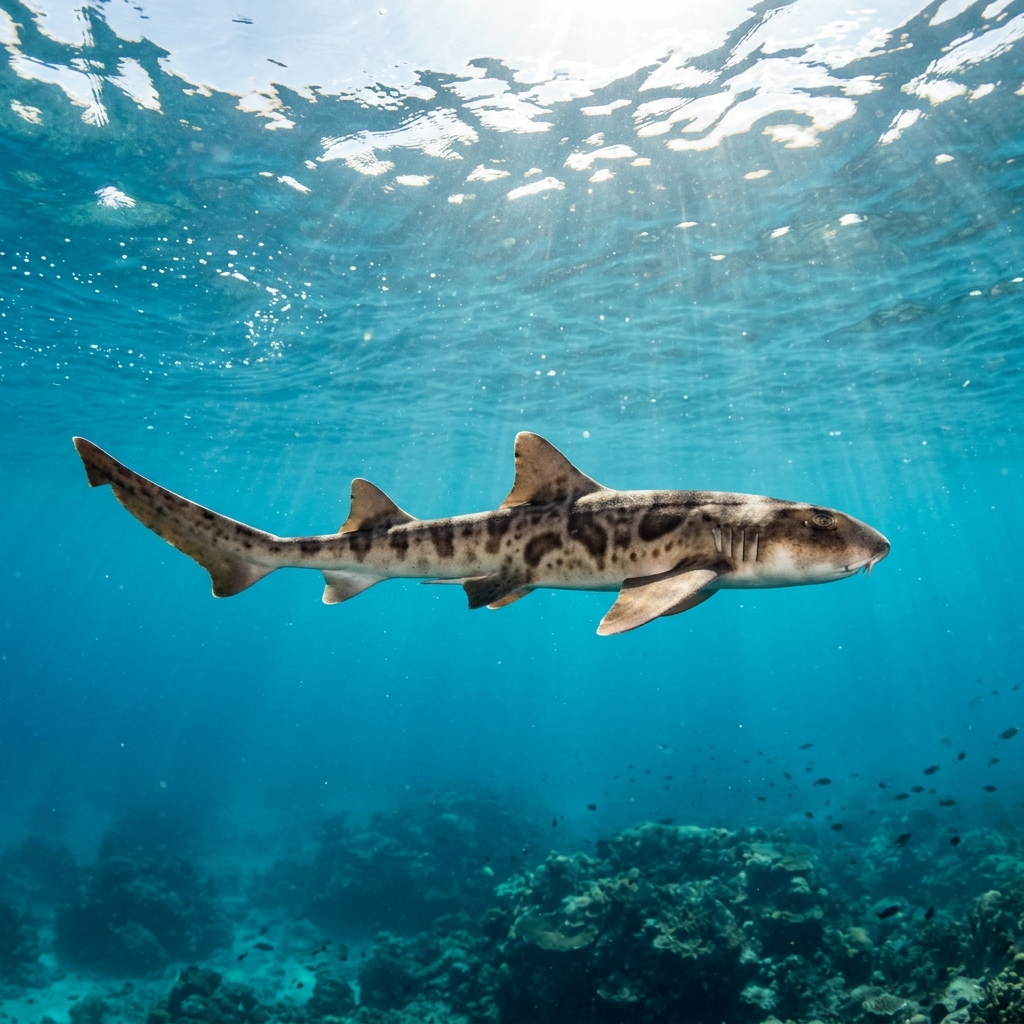
Chiloscyllium punctatum
Spot brownbanded bamboo sharks across the Philippines, Indonesia and Queensland in warm 24-29 °C reef shallows. Here's where divers find them and how to ID them.
A slender, bottom-hugging shark with a long tail that makes up roughly half its total length, brownbanded bamboo sharks are typically pale beige to grey with darker brown bands crossing the body and scattered dark spots. Juveniles show the banding most boldly; adults can fade considerably, leaving a more uniformly grey-brown animal with faint markings. The broad, rounded snout and the habit of resting motionless on the substrate are the two quickest ID cues underwater.
Expect to find them wedged under coral heads, tucked into reef crevices, or simply lying flat on sandy rubble, they are strongly nocturnal and spend much of the day resting. Night dives dramatically increase your chances; torchlight often catches them actively prowling the reef edge for small fish and invertebrates. When approached they tend to stay put or wriggle slowly away rather than bolting, making calm observation easy if you avoid looming over them.
Brownbanded bamboo sharks can survive several hours out of water by sharply reducing their oxygen consumption, an adaptation that lets them persist in tidal rock pools and very shallow reef flats where other sharks cannot.
No clear seasonal peak has emerged from the data, so this is effectively a year-round target wherever it occurs. It sits comfortably in water temperatures of 24 to 29 °C, which describes most tropical reef sites in its range throughout the year.
Reef neighbours a diver could mistake it for. Use the identification notes above to tell them apart.
Most commonly logged in the Philippines and Indonesia, with the Visayas, Palawan and Apo Reef, and the Maluku and Papua regions standing out as strong areas. Australia's Queensland coast also holds a solid population, and Thailand's Gulf of Thailand sites regularly feature them. Malaysia, Vietnam, Cambodia, and Brunei round out the confirmed range across the Indo-Pacific.
Mapping where Brownbanded Bamboo Shark is logged…
The Philippines and Indonesia are the top spots, with particularly strong representation around the Visayas, Palawan and Apo Reef, and the Maluku and Papua regions. Queensland in Australia is another reliable area, and Thailand's Gulf of Thailand sites also feature regular sightings.
They can be found year-round on tropical reefs throughout their range. Because they favour warm water between roughly 24 and 29 °C, any time you are diving in the Indo-Pacific tropics is a valid window. Night dives give you the best chance regardless of season.
Look for a slender, bottom-resting shark with a very long tail, a broad rounded snout, and pale body with darker brown cross-bands. Juveniles show the banding most clearly; adults can appear fairly plain grey-brown. The combination of long tail, resting posture, and banded or spotted pattern is usually enough to confirm the ID.
Adults typically reach around 1 metre in total length, with the tail accounting for a large proportion of that. They are small enough to fit entirely within a coral bommie (coral head), which is often exactly where you find them.
They are currently assessed as Near Threatened by the IUCN. Coastal habitat degradation and incidental capture in shallow-water fisheries are the main pressures. The species is not in immediate danger of extinction but warrants monitoring, particularly in heavily fished parts of Southeast Asia.
Site and sighting data is aggregated from diver logs, iNaturalist and GBIF. For taxonomy and conservation status: