Astrospartus mediterraneus
Spot the Gorgon's Head along the French Riviera and Costa Brava. Year-round in 13-22 °C Mediterranean waters, here's how to find and identify one.
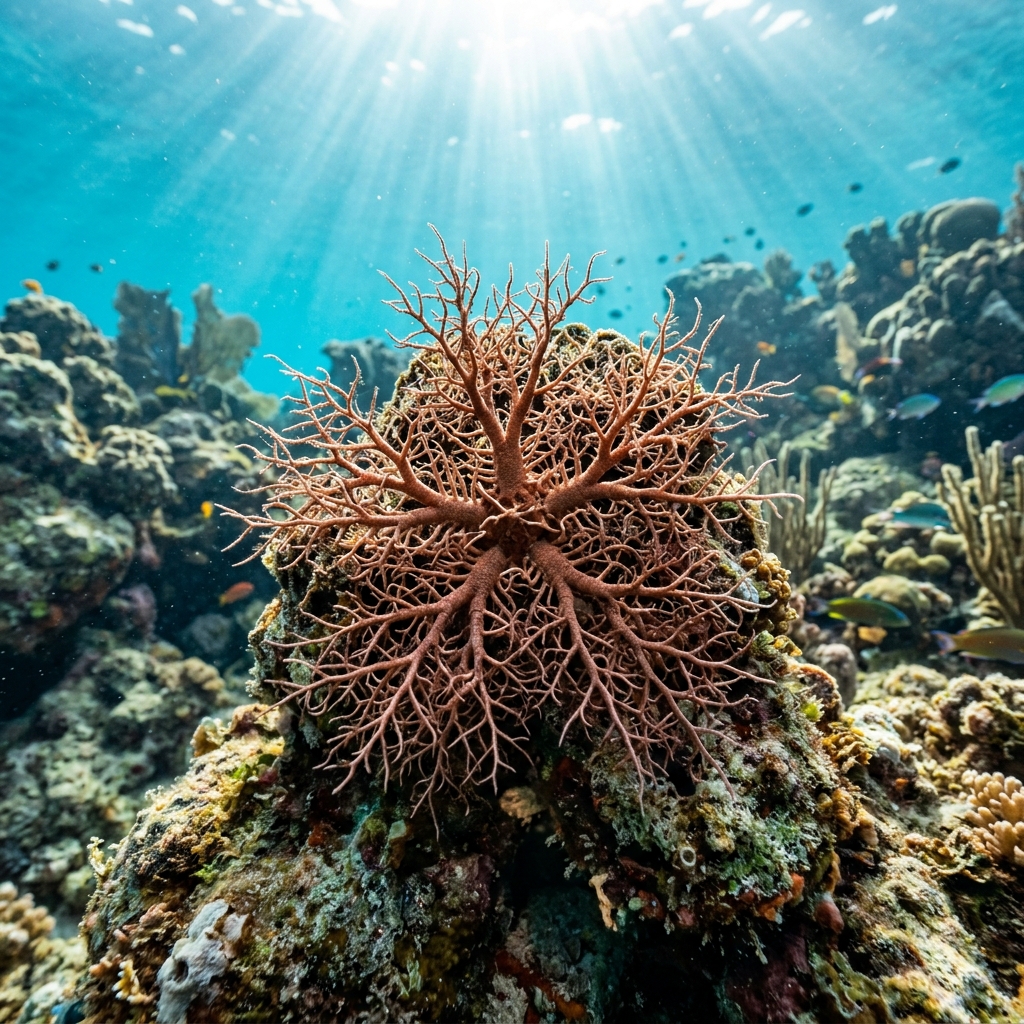
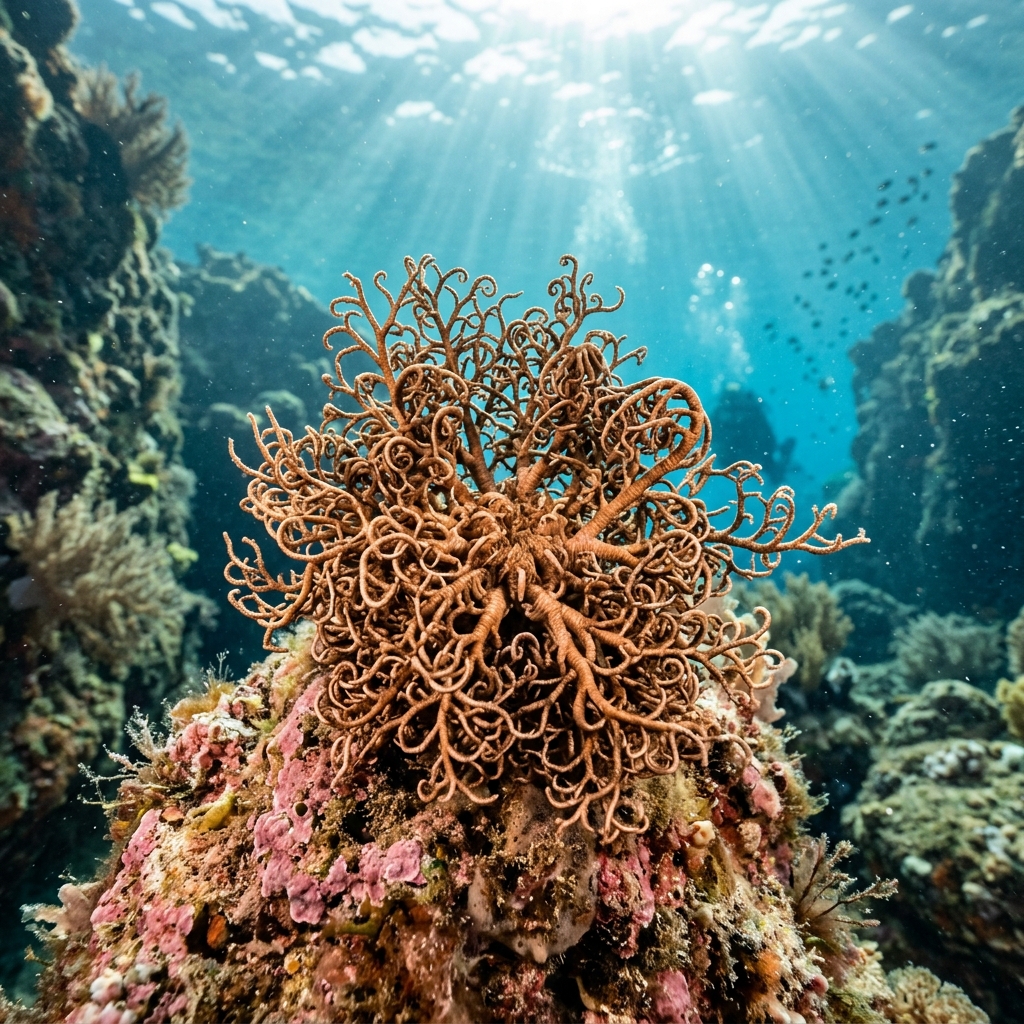
A mass of repeatedly branching, coiling arms radiating from a central disc gives this animal its name: underwater it looks like a tangled medusa of tentacles rather than a conventional starfish. The arms are typically pale cream to tan or yellowish-brown, often with darker banding, and the overall spread can be surprisingly large for a single animal. Look for the densely forked arm tips, which distinguish it from any ordinary brittle star at a glance.
You will most often find a Gorgon's Head perched on rocky outcrops or gorgonian coral (a type of fan coral), arms fully spread and curled into the current to filter-feed on passing plankton. At rest or when disturbed it pulls the arms into a tight, compact ball, making it look more like a rounded lump than a living animal. It tends to occupy the same spot for extended periods, so a sighting at a familiar site is often repeatable.
Those branching arms are not decorative: each tip bears tiny hooks used to snag zooplankton and organic particles drifting in the current, making the Gorgon's Head one of the Mediterranean's most efficient suspension feeders.
Sightings are recorded year-round with no concentrated season, which fits its cool-to-temperate water niche of roughly 13 to 22 °C, typical of the Mediterranean at depth throughout the year.
Reef neighbours a diver could mistake it for. Use the identification notes above to tell them apart.
The Gorgon's Head is most reliably logged along the French Riviera and Provence coast and in the Costa Brava region of Spain, which together account for the great majority of sightings. Northwest Italy and Sardegna also hold strong records, as does much of the rest of the western Mediterranean. Algeria contributes a small but notable spread of sites, rounding out its range across the basin.
Mapping where Gorgon's Head is logged…
The French Riviera and Provence coast is the top region for sightings, followed closely by Spain's Costa Brava and the coasts of Northwest Italy and Sardegna. The Gorgon's Head is a western Mediterranean specialist, and all well-documented records fall within France, Italy, Spain, and Algeria.
They are present year-round. The species thrives in the cool Mediterranean water column, roughly 13 to 22 °C, which persists at depth in all seasons, so there is no single window that stands out for sightings.
Look for a central disc surrounded by arms that split and re-split into dozens of curling, tentacle-like branches, pale cream to tan with darker banding. No other Mediterranean invertebrate you are likely to encounter has quite that densely forked, medusa-like silhouette. When contracted, it forms a tight ball, so an unusual rounded lump on a rocky wall is worth a closer look.
No. They pose no threat whatsoever to divers. Avoid handling them, as with any reef invertebrate, since contact can damage their delicate arms and disturb their feeding posture.
It spreads its branching arms into the current and uses tiny hooks on the arm tips to snag zooplankton and suspended organic particles. This filter-feeding strategy means you will typically find one in areas with reliable current or surge, fully extended and facing the flow.
Site and sighting data is aggregated from diver logs, iNaturalist and GBIF. For taxonomy and conservation status: