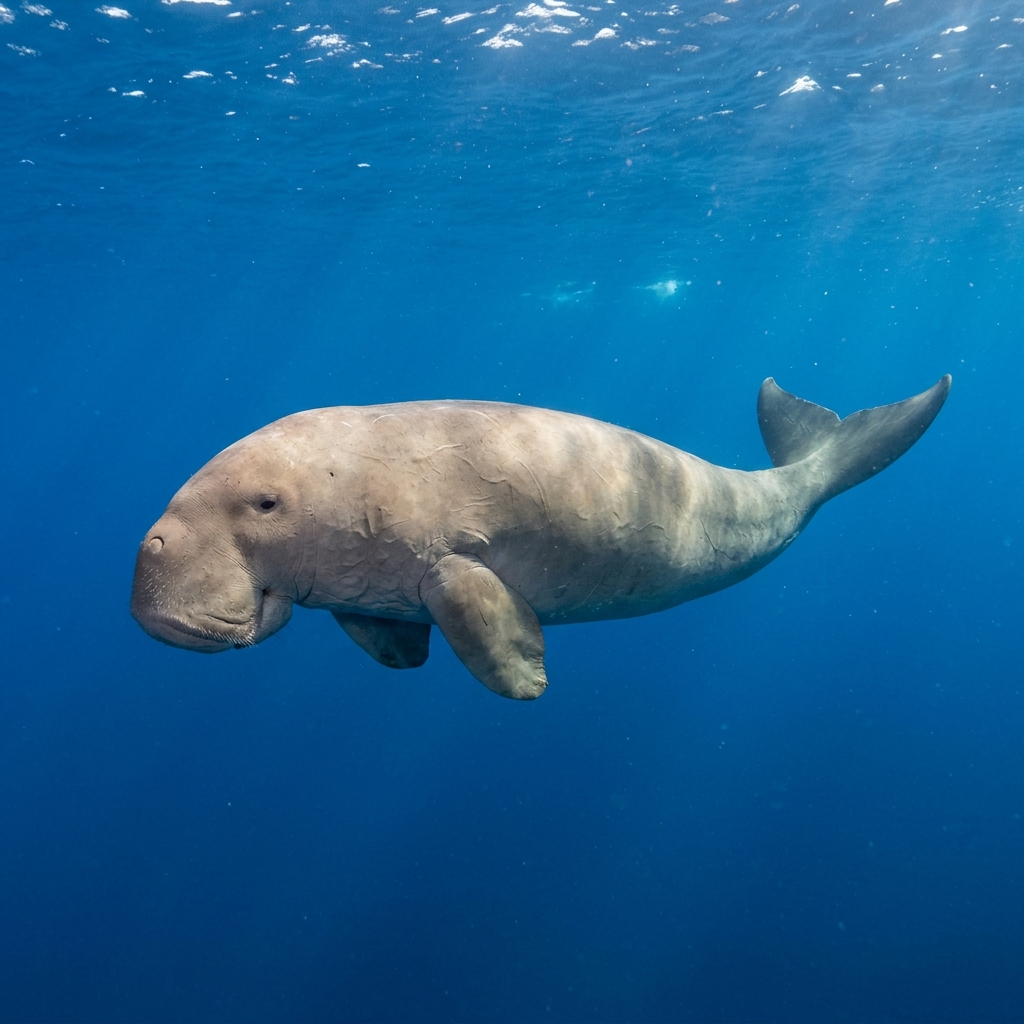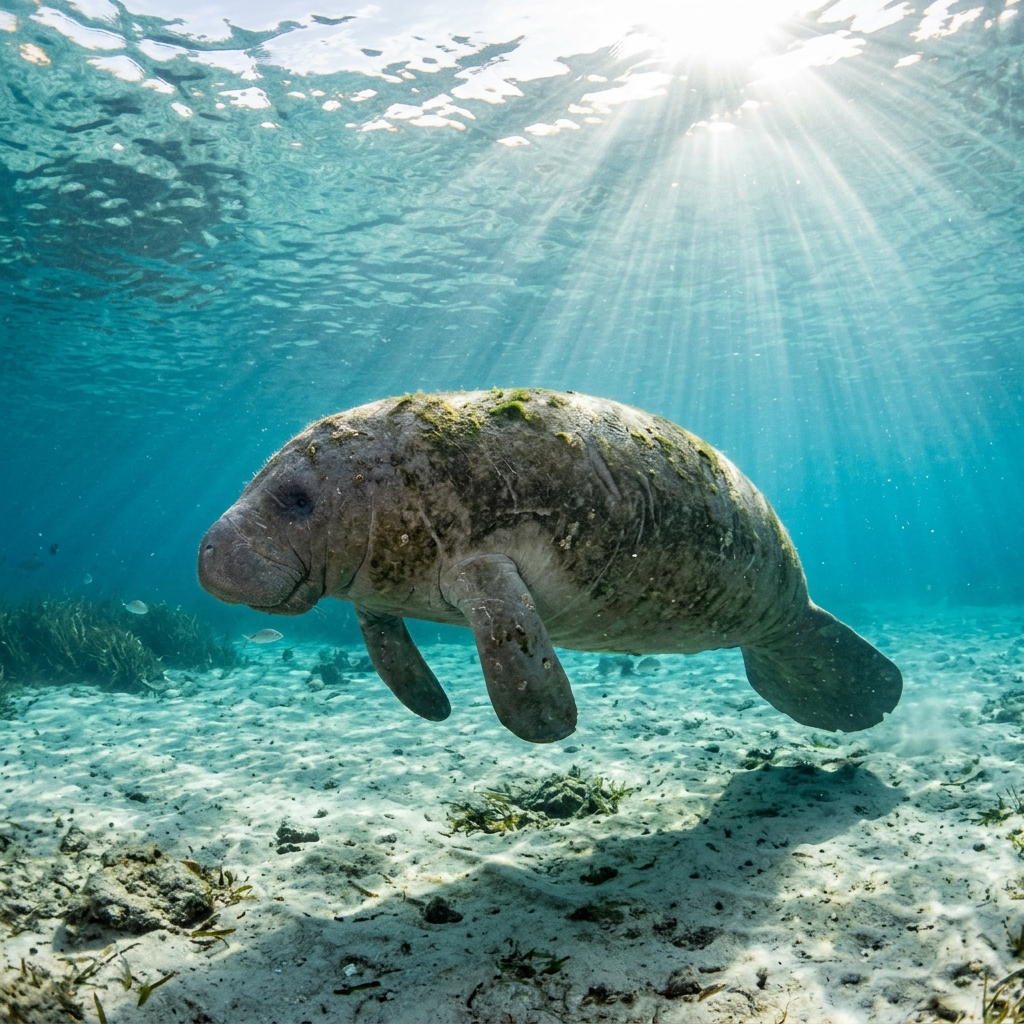
Trichechus manatus
West Indian manatees concentrate in Florida waters Dec, Mar. Here's where divers log them, what to expect, and how to tell them from a dugong.
A very large, grey, torpedo-shaped body stretching to around 2.7 metres instantly distinguishes a manatee from anything else in shallow coastal waters. Look for the broad, rounded paddle tail (unlike a dugong's notched, whale-like fluke) and the wrinkled, bristly face with small eyes and a flexible, prehensile upper lip. Skin colour ranges from mid-grey to brownish-grey, often mottled with pale scars from boat propellers, which are useful secondary ID marks on known individuals.
Manatees spend most of their time at the surface or in the top few metres, grazing slowly on aquatic vegetation in seagrass beds, estuaries, and sheltered coastal shallows. They are unhurried around divers and will sometimes turn to investigate you directly, hovering close and regarding you with small, calm eyes before drifting away. Social groups occasionally roll and nudge against one another, and if you hold still you may watch the whole interaction play out at arm's length.
Manatees breathe at the surface every few minutes but can rest submerged for up to 20 minutes, so a slow scan of the bottom in a known area can reveal one simply lying still on the sand.
In the northern hemisphere, sightings concentrate between December and March, when manatees gather in warm-water refuges such as Florida's springs and power-plant outflows to escape cooler coastal temperatures. The species' observed temperature niche of roughly 21 to 29 °C drives this seasonal pattern.
Reef neighbours a diver could mistake it for. Use the identification notes above to tell them apart.
By far the strongest concentration of logged sightings is in Florida and the south-eastern United States, which accounts for the majority of observed records. Cuba's Jardines del Rey and Brazil's north-east coast are the next most significant areas, with meaningful populations also recorded along Colombia's Caribbean coast and in Venezuela's central coastal waters.
Mapping where West Indian Manatee is logged…
Florida is the most reliably productive area, with sites spread across springs and coastal refuges throughout the state. Further afield, divers log them in Cuba's Jardines del Rey, along Brazil's north-east coast, Colombia's Caribbean coast, and in the Bahamas, though sightings in those regions are less frequent.
In Florida and the wider northern Caribbean, December through March is the peak window, when manatees concentrate in warm springs and sheltered bays as coastal water temperatures drop. Outside this period sightings are possible but less predictable.
The round paddle-shaped tail is the quickest field mark: it is flat and oval, not forked like a dugong's. Combine that with the enormous grey body, whiskered prehensile lip, and sluggish movement in very shallow water and there is little else it could be. Propeller-scar patterns on the back are common and make individuals recognisable once you know a site.
Adults typically reach around 2.7 metres in length and can weigh over 500 kg, making them one of the largest animals a diver is likely to encounter in shallow coastal waters. Their sheer bulk and slow movement make depth perception easy underwater.
They are currently listed as Vulnerable on the IUCN Red List. Florida populations have faced particularly difficult recent years due to seagrass loss and harmful algal blooms reducing food availability. Boat-strike injuries remain a chronic threat across their range, and many adults carry permanent propeller scars.
The West Indian Manatee is listed as vulnerable by the IUCN. Observe from a distance, avoid touching or feeding it, and report sightings to local marine research organisations.
West Indian manatees are listed as Vulnerable, with boat strikes, habitat loss, and harmful algal blooms among the main pressures on populations. Divers should keep a respectful distance, never touch or chase individuals, and follow local regulations, which in Florida include designated manatee protection zones where active swimming towards them is prohibited.
Site and sighting data is aggregated from diver logs, iNaturalist and GBIF. For taxonomy and conservation status: