Ascidiacea spp.
Sea squirts thrive from Florida to Brittany and the British Isles. Learn how to spot these filter-feeding invertebrates on your next dive.
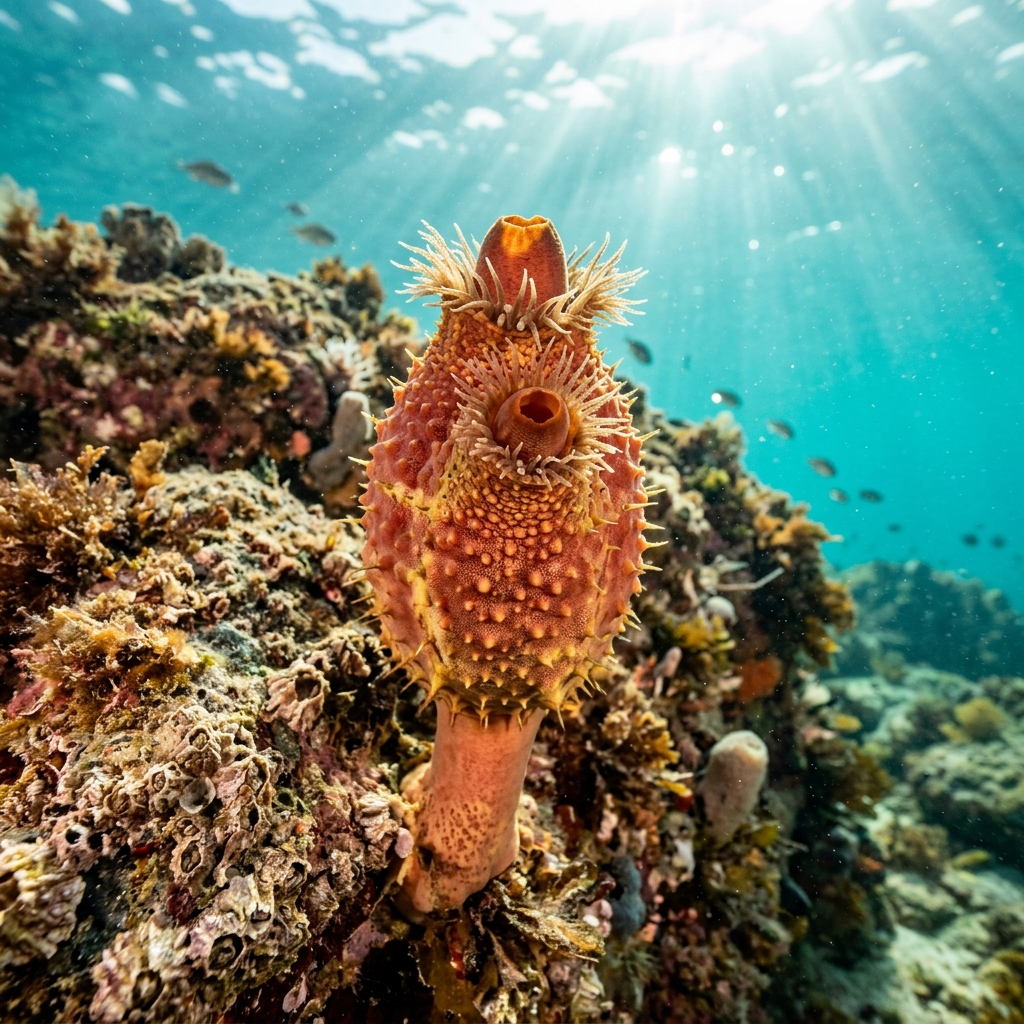
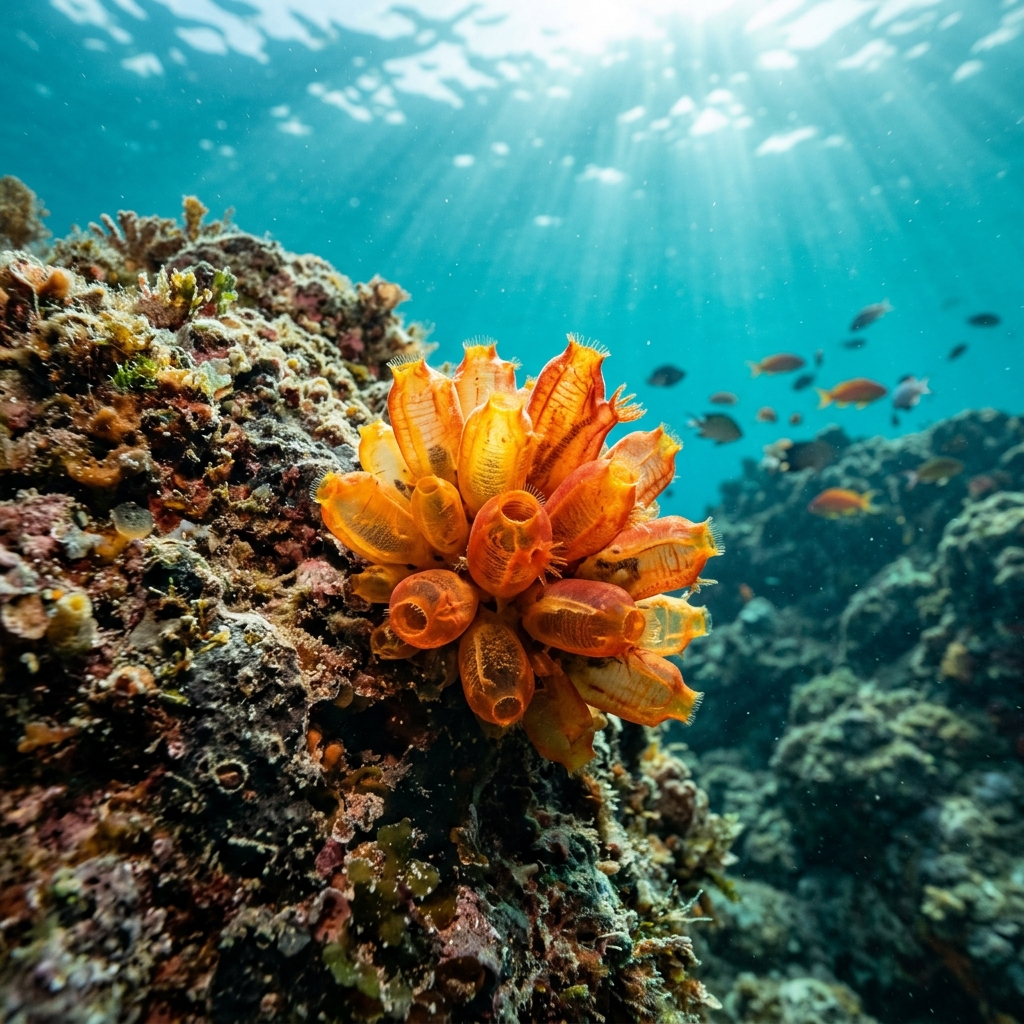
Sea squirts attach firmly to hard surfaces and are easy to overlook as blobs of gel or rubbery tubing until you look closely. Each individual has two openings called siphons: one drawing water in and one expelling it. They come in an enormous range of forms, from solitary barrel-shaped animals several centimetres tall to paper-thin colonial sheets encrusting entire boulders. Colours span translucent white, vivid orange, purple, and deep red, and some colonial species form intricate star or flower patterns on the rock surface.
As fully sessile (permanently fixed) animals, sea squirts do not move, but watch the siphons and you will see rhythmic pulsing as they pull water through and filter out plankton. Disturb them and many species contract rapidly, shooting a jet of water before closing up tight. They tend to cluster densely in areas of current or upwelling where food-rich water is delivered to them, so surge channels, wall overhangs, and the undersides of boulders are productive places to look.
Sea squirts are chordates, the same broad group that includes all vertebrates. Their free-swimming larvae have a notochord (a stiff rod that foreshadows the backbone) which disappears when the animal settles and transforms into its adult form, making them one of the closest invertebrate relatives to fish and, ultimately, to us.
Sea squirts are present year-round and have no detectable season in the dive data. Their observed temperature range of roughly 8 to 23 °C means they are at home in cool temperate seas throughout the year, so any time is a reasonable time to find them.
Sea squirts appear across an exceptionally wide spread of countries, with particularly strong representation in the United States (especially Florida and the Southeast), the United Kingdom, Italy, Greece, and France. Key regions for sightings include Brittany and Normandy in France, the Izu Peninsula in Japan, Nova Scotia and the Bay of Fundy in Canada, and the southwest coast of Ireland. They colonise rocky reefs, pier pilings, kelp holdfasts, and almost any stable hard substrate in both tropical and cold temperate waters.
Mapping where Sea Squirt is logged…
Sea squirts are found across a huge range of countries. Top spots include Florida and the Southeast United States, Brittany and Normandy in France, the British Isles, Italy, Greece, and Nova Scotia in Canada. They colonise rocky and artificial reefs wherever there is reasonable water movement, in both warm and cold temperate seas.
There is no single best season. Sea squirts are present year-round across their range and have been recorded in water temperatures from around 8 to 23 °C, covering cool temperate seas in all seasons. Pick your destination and dive whenever conditions suit you.
Look for barrel-shaped or tube-shaped animals fixed to hard surfaces with two distinct openings (siphons). Solitary species can be several centimetres tall; colonial species form encrusting sheets with intricate star patterns. They range from translucent white to orange, red, and purple. A rapid contraction when touched is a reliable giveaway.
No. Sea squirts pose no threat to divers. They are completely sessile, have no stinging or defensive structures that affect humans, and the worst they do when disturbed is squirt a small jet of water from their siphons.
Size varies enormously across the group. Solitary species can reach several centimetres in height, while colonial forms spread as thin sheets over much larger areas of reef. Some aggregations cover entire boulders or pier pilings in a continuous living crust.
Sea squirts belong to the phylum Chordata, the same group as fish, amphibians, and mammals. Their larvae have a notochord, a stiff rod that is the precursor to a backbone. After settling, the larva transforms and the notochord disappears, leaving behind the fixed filter-feeding adult we see on the reef.
Site and sighting data is aggregated from diver logs, iNaturalist and GBIF. For taxonomy and conservation status: