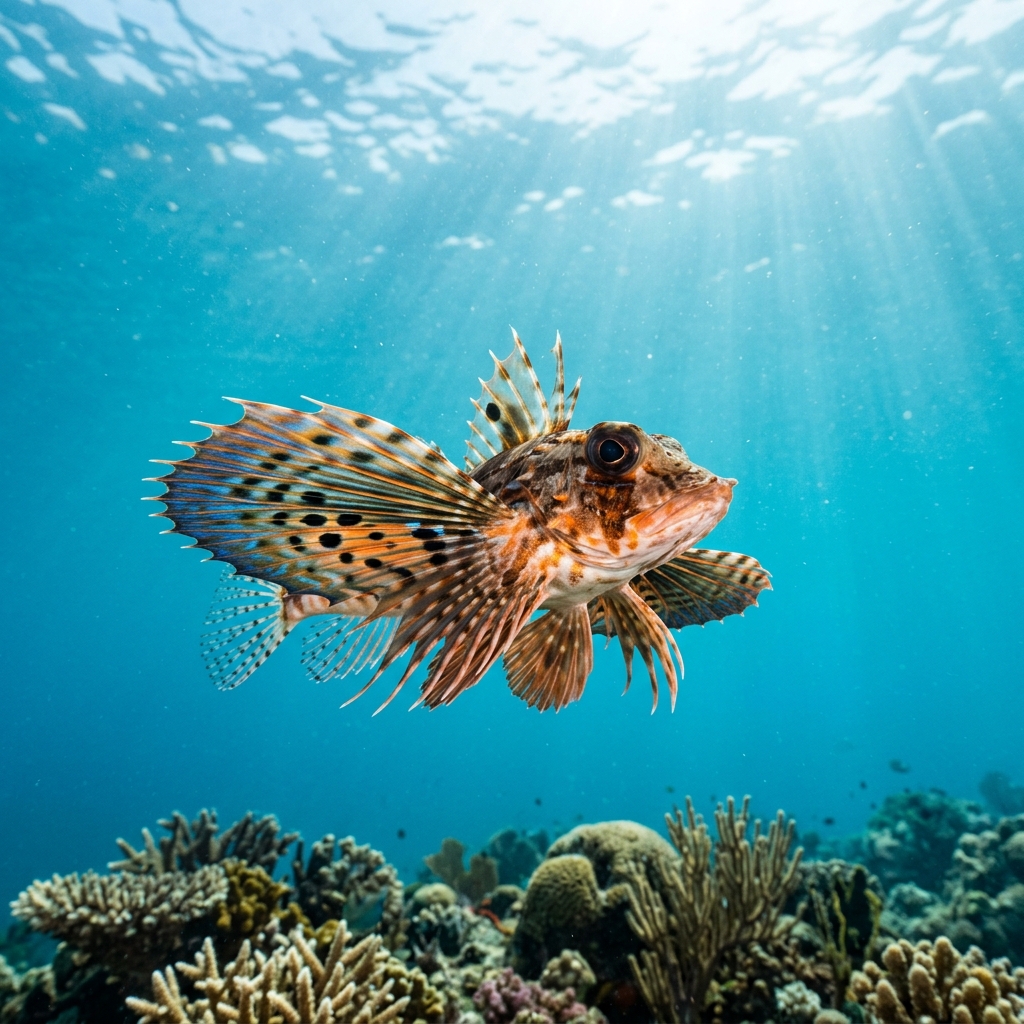
Dactylopterus volitans
Spot the flying gurnard's fan-like pectoral wings in Florida, Spain, and Brazil. Best chances May, Jul and Nov, Dec. Here's where and how to find one.
Those enormous, fan-like pectoral fins are the giveaway: spread wide, they reveal a mosaic of vivid blue spots and bands on a brownish background that looks completely out of proportion to the chunky, armoured body. At rest on sandy or rubble seabed the fins are folded tight, and the fish looks like a plain, flat-headed bottom-dweller with a bony, ridge-covered back. The two separate finger-like lower rays on each pectoral fin, used to probe the sediment, help distinguish it from any other species. A large adult can reach around 40 cm, though most sightings are of smaller individuals.
You will almost always find it on the bottom: sandy flats, rubble patches, and seagrass margins are its preferred hunting grounds, where it walks slowly on its finger-like lower fin rays, flushing out small crustaceans and worms. When threatened it fans those spectacular pectoral fins wide, likely as a startle display to deter predators. It tends to ignore divers who approach slowly and stay low, but a sudden movement will send it trundling away with a short, low burst of swimming.
Despite the name and the wing-like fins, flying gurnards do not actually fly or glide above the surface; the fins are a defence and communication display used entirely underwater.
In the Northern Hemisphere, sightings concentrate in May through July and again in November to December. The species tolerates a broad temperature range (about 13 to 28 °C), so outside those peak windows it can still appear where conditions suit.
Reef neighbours a diver could mistake it for. Use the identification notes above to tell them apart.
Most commonly logged in the Atlantic and Mediterranean, with the strongest records from Florida and the US Southeast, the Costa Blanca and Costa Brava in Spain, and the coasts of Rio de Janeiro and São Paulo in Brazil. Italy, Greece, and Turkey also deliver consistent sightings, particularly in Sardinia, Sicily, and around Attica. It appears across a wide band of tropical and warm-temperate waters, with Spain, the United States, and Italy leading the site count.
Mapping where Flying Gurnard is logged…
Flying gurnard are most reliably logged in Florida and the US Southeast, along the Spanish Mediterranean coast (Costa Blanca and Costa Brava), and around the Rio de Janeiro and São Paulo coastline in Brazil. Italy, Greece, Turkey, and Croatia also have strong records, so the Atlantic and Mediterranean are your best hunting grounds.
In the Northern Hemisphere, sighting rates peak in May to July and again in November to December. The fish tolerates a wide water temperature range, so brief encounters are possible outside those windows, but your odds are best during those two seasonal concentrations.
Look for a bony, flat-headed fish walking slowly on the seabed using two finger-like fin rays. When it fans its pectoral fins you will see their full width, covered in vivid blue spots and bands on a dark background. Folded tight, the fish looks unremarkable, so scan sandy and rubble patches carefully.
Adults commonly reach around 30 to 40 cm in length. Underwater they often appear smaller because the armoured body is compact; it is the spread of the pectoral fins that creates the impression of a much larger animal.
The fan display is a defence mechanism: spreading those large, boldly patterned pectoral fins makes the fish look far bigger and more intimidating to would-be predators. It is also thought to play a role in communication between individuals. Despite the wing-like appearance, the species does not fly or glide; the fins are used exclusively underwater.
Site and sighting data is aggregated from diver logs, iNaturalist and GBIF. For taxonomy and conservation status: