
Enhydra lutris
Spot sea otters along the Pacific Coast and British Columbia in cold waters from 4-16 °C. Here's where divers see them and what to look for.
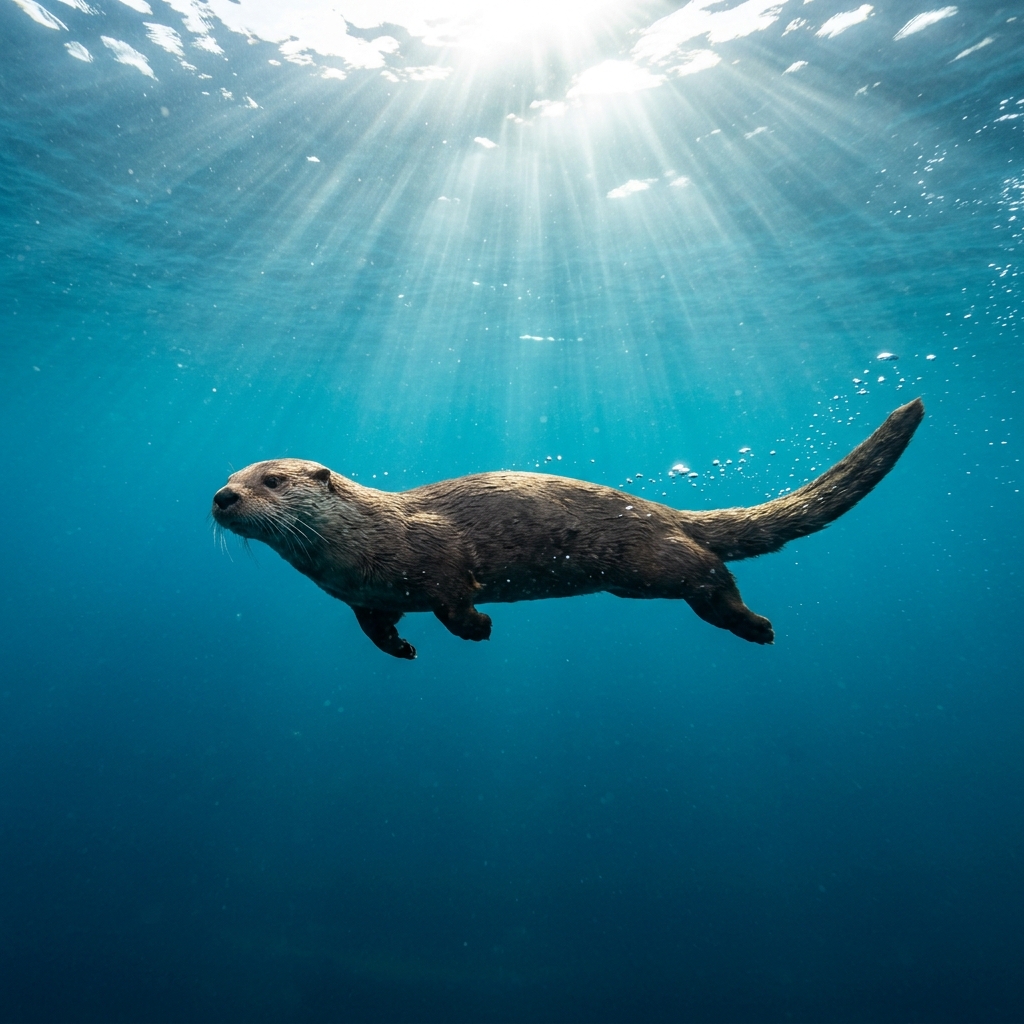
Thick, dark-brown to chestnut fur covers the body, with a noticeably paler, almost cream-coloured face and head that becomes more silvery in older individuals. At around a metre long, they are far larger than any fish you might confuse them with, and their rounded, whiskered face is unmistakable. Underwater, watch for a stocky, torpedo-shaped body with large, flipper-like hind feet and small forepaws held close to the chest. They are often seen near the surface, rolling, grooming, or holding objects on their bellies.
Sea otters spend much of their time at or just below the surface, often resting on their backs and wrapping themselves in kelp (the fronds of large brown algae) to avoid drifting. Divers who approach slowly in shallow kelp forests may observe them cracking open shellfish by hammering them against a rock balanced on their chest. They are generally curious but can become wary if approached too quickly, so a slow, passive presence gives the best chance of a relaxed encounter.
Sea otters have the densest fur of any mammal, with up to 150,000 hairs per square centimetre. They rely entirely on this fur for insulation rather than a blubber layer, which is why they spend so much time grooming, keeping the coat clean enough to trap air and retain warmth in freezing water.
No clear seasonal peak has emerged from the data, so encounters are possible year-round wherever the animals are present. Their preferred water temperatures run from about 4 to 16 °C, which matches the cold, nearshore Pacific and North Atlantic environments where they live permanently.
Most sites fall along the Pacific Coast of the United States, including California and Alaska, and along the British Columbia coast of Canada, with Newfoundland also hosting a significant number of modelled sites. Japan's Izu Peninsula and the Russian Far East round out the range, making the North Pacific the undisputed place to look. In the US, the central California coastline and Southeast Alaska are the strongest areas to target.
Mapping where Sea Otter is logged…
The best areas are along the Pacific Coast of the United States, particularly central California and Alaska, and the British Columbia coast of Canada. Japan's Izu Peninsula and Russia's Far East also fall within their range. These are all cold, nearshore environments, typically with kelp forest habitat.
Sea otters are present in their cold-water habitat year-round, and no strong seasonal pattern has been recorded for diver encounters. You can plan a trip to the Pacific Coast at any time of year, though local kelp forest conditions and sea state are often more relevant than season.
Look for a large, stocky mammal about a metre long with dense dark-brown fur and a pale, whiskered face. They are almost always near the surface and move with a sinuous, rolling motion rather than the fin-driven propulsion of fish. The large, paddle-like hind feet and habit of floating on their back are the clearest giveaways.
Adults typically reach around 103 cm in length. Males are considerably heavier than females, but both are large enough to be unmistakable in the water compared to any local fish or invertebrate.
Sea otters are not considered dangerous to divers. They may be startled by a diver's approach, especially mothers with pups, so a slow and calm approach is recommended. Keep a respectful distance to avoid stressing the animal.
Yes, sea otters are listed as Endangered on the IUCN Red List. Their population was nearly wiped out by the fur trade in the 18th and 19th centuries, and while some populations have recovered, they remain vulnerable to oil spills, entanglement, and habitat degradation. Divers can help by reporting injured or entangled animals to local wildlife agencies.
The Sea Otter is listed as endangered by the IUCN. Observe from a distance, avoid touching or feeding it, and report sightings to local marine research organisations.
Sea otters are listed as Endangered on the IUCN Red List, still recovering from near-extinction caused by the historical fur trade. Divers should keep a respectful distance, avoid touching or disturbing resting animals, and report any entanglement in fishing gear to local wildlife authorities.
Site and sighting data is aggregated from diver logs, iNaturalist and GBIF. For taxonomy and conservation status: