
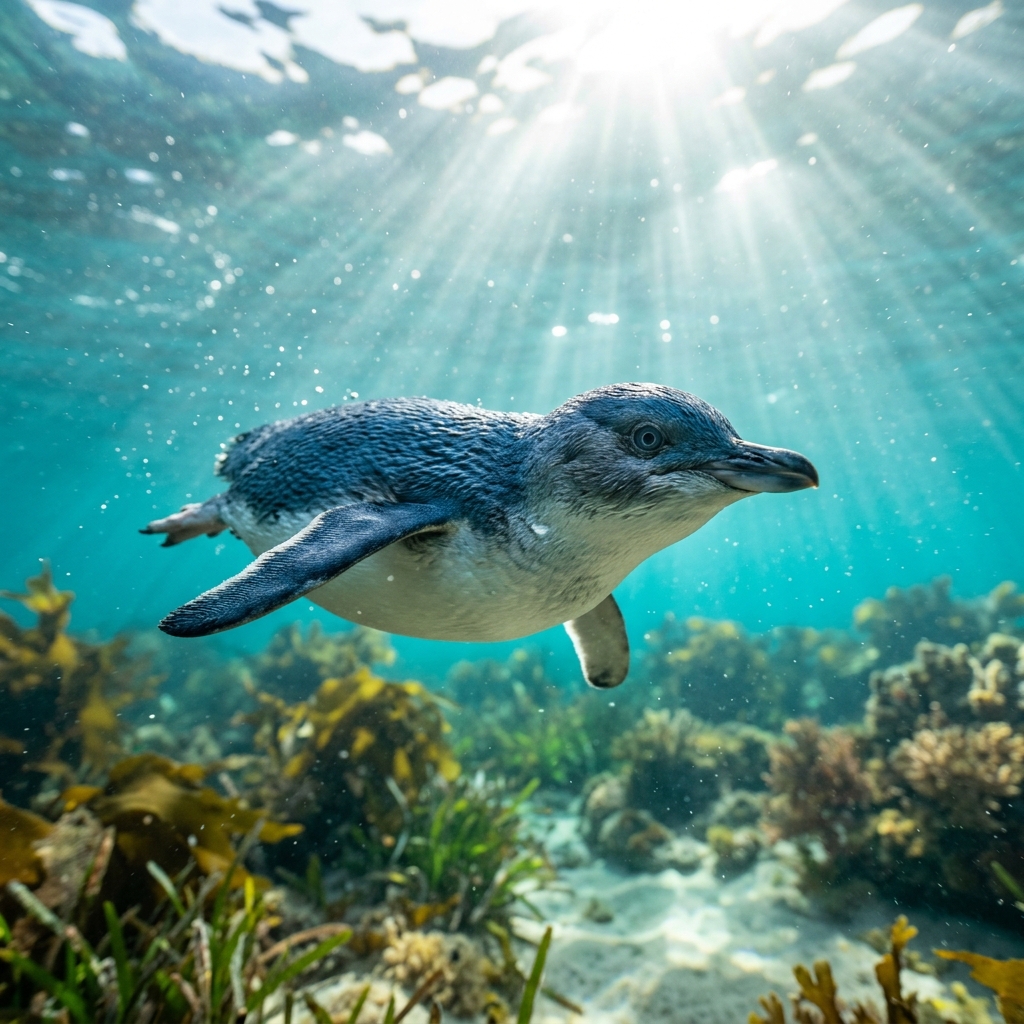
Eudyptula minor
Spot little penguins in New Zealand and Australia, from Coromandel to Tasmania, in cool 13-18 °C waters. Here's where divers encounter them.
At around 28 cm, this is the world's smallest penguin, compact enough to be mistaken for a large fish at first glance. Look for the sharp two-tone colouring: dark blue-grey on the back and wings, clean white on the belly. Underwater, they move with rapid, almost torpedo-like wing strokes, completely unlike any fish. There is no dramatic size or colour difference between sexes, though females tend to be slightly smaller.
Little penguins are active, fast-moving birds underwater, using their wings to fly through the water column with remarkable agility as they hunt small fish and squid near the surface and along rocky coastal reefs. They are naturally curious but quick, and tend not to linger around divers for long. Encounters are often brief and exciting, with the penguin darting past before you have time to process what you saw.
Little penguins are the only penguin species to come ashore exclusively after dark, emerging from the sea and marching up beaches in groups after sunset to reach their burrows, a behaviour known as the 'penguin parade'.
There is not enough logged monthly data to point to a single peak season, so treat encounters as a year-round possibility. Their observed temperature range of roughly 13 to 18 °C matches the cool temperate conditions found in these regions throughout the year.
Sightings are modelled across sites in New Zealand and Australia, with New Zealand holding the stronger spread, particularly around Coromandel and the Bay of Plenty, and Northland and Auckland. In Australia, Tasmania and South Australia are the key areas, with Victoria and Queensland also featuring. These cool, temperate coastal waters are where little penguins are most at home.
Mapping where Little Penguin is logged…
Little penguins are found across temperate coastal waters in New Zealand and Australia. New Zealand sites in the Coromandel, Bay of Plenty, and Northland and Auckland regions offer the widest spread, while in Australia, Tasmania and South Australia are the strongest areas. Victoria and Queensland also have recorded sites.
There is no clearly defined peak season in the dive data, so encounters are possible year-round. Their preferred water temperature of around 13 to 18 °C is typical of these temperate regions throughout the year, meaning conditions are fairly consistent regardless of season.
Size is the biggest clue: at around 28 cm, they are tiny. The dark blue-grey back contrasts sharply with a white belly, and their wing-propelled swimming style is completely unlike any fish. Once you see that torpedo silhouette and rapid wingbeat, there is nothing else it could be.
Little penguins reach around 28 cm in length, making them the smallest penguin species in the world. In the water, their compact size can make them easy to overlook or briefly misidentify as a fast-moving fish.
No, little penguins pose no meaningful risk to divers. They may nip if handled, but wild encounters are typically brief and the birds are more focused on swimming than on investigating humans. Give them space and enjoy the moment.
Unlike any other penguin, little penguins only come ashore after dark, returning from the sea in small groups each night to reach their burrows. This nocturnal landing behaviour is a distinctive part of their biology and means daytime beach sightings are rare; the ocean is where you are most likely to encounter them.
Site and sighting data is aggregated from diver logs, iNaturalist and GBIF. For taxonomy and conservation status: