
Crinoidea
Feather stars appear on reefs from Florida to the Philippines and tolerate water as cold as 3.5 °C. Find where and when to dive with them.
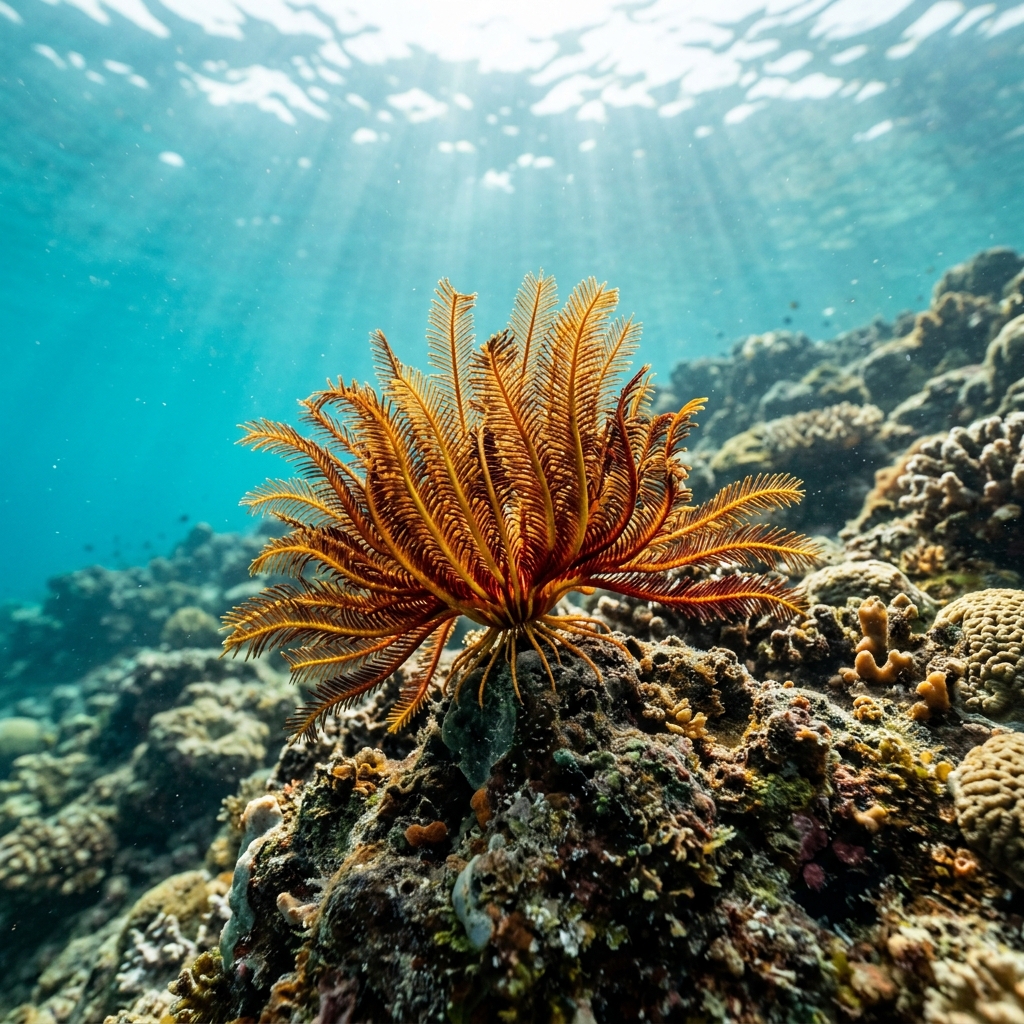
Arms are the giveaway: feather stars have multiple long, feathery arms (called pinnules) radiating from a central disc, giving the animal a fern-like silhouette. Colour varies enormously across the group, from jet black and vivid yellow to banded red-and-white or mottled brown. Most perch on high-relief structures with arms spread wide to catch passing plankton; when dislodged they can swim by rhythmically beating alternate arms. The absence of a hard shell or spine immediately separates them from urchins and starfish.
On the reef, feather stars typically anchor themselves on a prominent coral head, sea fan, or rock with small claw-like appendages called cirri, holding their arms open into the current to filter-feed on plankton. They are passive and generally ignore divers, but will curl their arms inward if physically disturbed. Some species descend into crevices during the day and climb back up to exposed positions as night falls, so evening dives can reveal far more individuals than midday dives.
Feather stars are among the oldest animal groups on the reef, with a fossil record stretching back roughly 480 million years, and they sit at the base of the echinoderm (spiny-skinned animals) family tree alongside sea urchins and starfish.
Feather stars appear to be available year-round across their range, which makes sense given the group tolerates water temperatures anywhere from around 3.5 °C in cold temperate seas to nearly 29 °C on tropical reefs. No single season stands out in the dive data, so plan your dive around the destination rather than the animal.
Feather stars are logged across an extraordinary range of dive destinations, with particularly strong representation in the United States (especially Florida and the Southeast), Canada, Australia (Queensland and Western Australia), the Philippines, Italy, Greece, and France. The Maldives' North and Central Atolls and Japan's Izu Peninsula and Hachijojima are also well-represented regions in the data. This spread reflects the group's ability to colonise both tropical coral reefs and cold-water rocky reefs worldwide.
Mapping where Feather Star is logged…
Feather stars are logged at dive sites across a huge number of countries. Particularly strong showings appear in the United States (especially Florida), Australia, the Philippines, Canada, Italy, Greece, and France, as well as the Maldives and Japan. Cold-water and tropical reefs alike host different species within this group.
Feather stars can be encountered year-round. The group tolerates water temperatures from below 4 °C to nearly 29 °C, so different species are present across all seasons depending on the destination. No concentrated season emerges from dive records, making them reliably findable whenever you visit a site.
Look for the feathery arms radiating from a central body, creating a fern or flower shape. They lack the hard test (shell) of an urchin and the rigid rays of a starfish. Colour varies widely across species, but the soft, branching arm structure is distinctive and consistent across the group.
No. Feather stars pose no threat to divers. They do not sting, bite, or have venomous spines. The only consideration is handling: their arms are delicate and can detach if grabbed, so the best practice is to observe without touching.
Yes, briefly. When knocked off their perch, many species can swim by alternately beating groups of arms in a rowing motion. It is not a long-distance action but it is distinctive and surprising to watch underwater. They use it mainly to escape predators or relocate to a better feeding position.
Site and sighting data is aggregated from diver logs, iNaturalist and GBIF. For taxonomy and conservation status: