
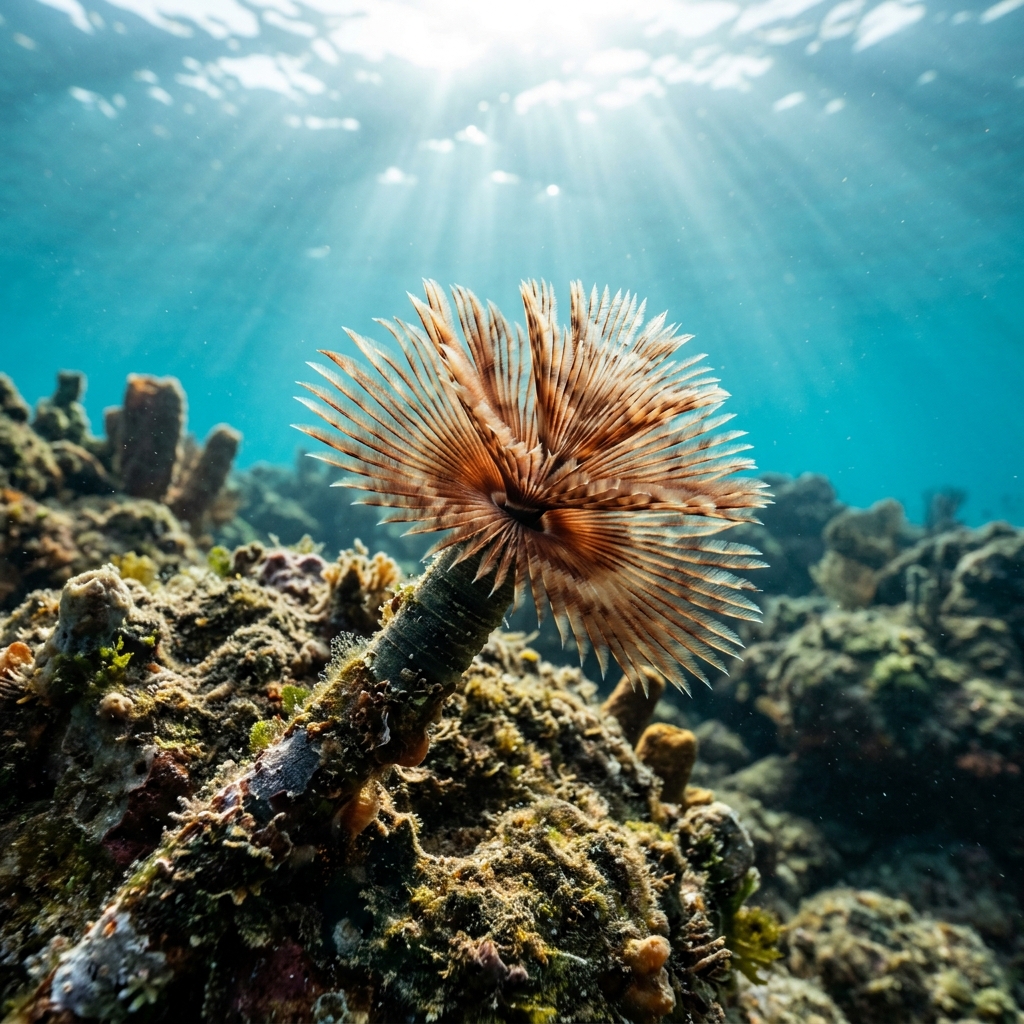
Sabellida spp.
Fanworms are logged at dive sites from the French Riviera to the Yucatán Peninsula. Find out where to spot them and how to recognise their feathery crowns.
Fanworms are most easily spotted by their crown of feathery radioles (the fan-shaped ring of feeding filaments) fanning out from a protective tube anchored to hard substrate. Crowns range widely in colour, from bright orange, purple, and white to banded combinations, and can span anything from a centimetre to well over ten centimetres across depending on the species. The tube itself is often leathery or mucus-encrusted and blends into the reef, so your eye is really drawn to the open crown above it. Touch the water nearby and the crown vanishes into the tube in an instant.
Fanworms are sedentary filter feeders, so what you see when you find one is the crown held open in the water column, slowly sweeping particles toward the mouth at its centre. They are highly sensitive to shadows and pressure waves: swim too close or let your torch sweep across them and the crown snaps shut before you can get a good look. Your best approach is to stop a body-length away, hold still, and wait for the crown to reopen, which usually takes less than a minute.
Each fanworm builds and lives inside its own self-secreted tube, which it never leaves. If a predator grabs the crown, most species can regenerate it, regrowing the radioles over the following weeks.
In the Northern Hemisphere, fanworms are recorded year-round with no concentrated season, which fits their tolerance for water temperatures from about 13 to 28 degrees Celsius across both temperate and tropical reefs. In the Southern Hemisphere the data points to April and May as the period when sightings cluster most reliably.
Fanworms are among the most widely logged invertebrates on the platform, with strong presences across the Caribbean, the Mediterranean, and both coasts of North America. The Yucatán Peninsula and Grand Cayman lead in the Caribbean, while the French Riviera and Provence coast are the standout region in Europe. Zeeland in the Netherlands, Roatán in Honduras, and Bonaire also return consistent sightings, reflecting how broadly this group spans tropical and cool-temperate seas.
Mapping where Fanworm is logged…
Fanworms are logged across a wide range of countries and regions. Top spots include the Yucatán Peninsula in Mexico, Grand Cayman, Roatán in Honduras, Bonaire, and the French Riviera in France. They also appear regularly along the Netherlands coast in Zeeland and on both the Atlantic and Pacific coasts of the United States.
In the Northern Hemisphere they are present year-round, with no particular season when sightings peak. If you are diving in the Southern Hemisphere, sightings concentrate in April and May based on available data.
Look for a feathery, flower-like crown of filaments (called radioles) protruding from a fixed tube on the reef or rocky substrate. Crowns come in a wide range of colours and banded patterns. The surest confirmation is watching the crown retract rapidly into its tube when disturbed, a reflex no other reef invertebrate quite matches.
Size varies considerably across the Sabellida group. Crown diameters range from under a centimetre in smaller species to more than 20 centimetres in the largest, such as the Caribbean feather duster worm. The tube hidden beneath can be several times longer than the visible crown.
Fanworms have no eyes, but their radioles are packed with light-sensitive cells and mechanoreceptors that detect shadows and vibrations. This triggers one of the fastest withdrawal reflexes in the invertebrate world, pulling the soft crown into the protective tube in a fraction of a second. It is their primary defence against predators and curious divers alike.
Site and sighting data is aggregated from diver logs, iNaturalist and GBIF. For taxonomy and conservation status: